
Are Google Reviews Important for Local Search
Are Google reviews important for your local business? Learn how review count and recency impact map results, build trust, and drive more near me searches.
Table of Contents
- 1Introduction
- 2The Reality of Near Me Searches
- 3What the customer actually sees
- 4Why this isn't just a website problem
- 5How Reviews Influence Map Results
- 6The three inputs that matter most
- 7Volume usually beats perfection
- 8What to prioritize first
- 9Why Recency Matters More Than Total Count
- 10Recent reviews answer the real question
- 11Total count still matters, but it stops being the whole story
- 12What works in practice
- 13Generating Reviews Without Breaking the Rules
- 14Use a side-by-side choice
- 15A simple review request workflow
- 16What doesn't work well
- 17Responding to Feedback to Build Trust
- 18Why responses matter to shoppers
- 19How to respond without making it worse
- 20Multi-location teams need consistency
- 21Your Next Step for Local Visibility
- 22A practical weekly check
- 23Think like a buyer, not like a marketer
- 24The one move to make this week
Introduction
A customer stands outside your restaurant at 7:10 p.m. and searches on their phone. A homeowner with a leaking pipe searches for a plumber. A patient looks for a dentist who can see them this week. In each case, Google shows a map and a short list of local businesses first.
That's where the decision usually happens.
If you run a salon, clinic, hotel, contractor business, or franchise location, reviews are part of that decision before anyone sees your website. They shape whether someone trusts your business enough to call, book, or drive over. So when you ask, are Google reviews important, the practical answer is yes. But not in the lazy way people often mean it.
It's not just “get as many five-star reviews as possible.” It's whether your profile looks active, believable, and current enough for both Google and the customer.
The Reality of Near Me Searches
Someone searches “breakfast near me,” “AC repair near me,” or “urgent care near me.” They don't open ten tabs and start researching like they're buying software. They scan the map results, look at the stars, read a few recent comments, and pick a business that feels safe.
That split-second choice is why local reviews matter so much. They sit right between the search and the visit.
Google has long ranked local results using relevance, distance, and prominence, and review signals feed into prominence in local results, as explained in this overview of documented local ranking factors. For a business owner, the useful takeaway is simple: your Google Business Profile isn't a set-it-and-forget-it listing. It's part of daily operations.
What the customer actually sees
A diner comparing two Mexican restaurants won't know which kitchen runs tighter service. A hotel guest won't know which front desk solves problems faster. A family looking for a pediatric clinic won't know which office communicates clearly.
They use reviews to fill that gap.
According to Review42's 2026 online review statistics roundup, 81% of consumers check Google reviews before visiting a business, 88% trust online reviews as much as personal recommendations, and people read an average of 10 reviews before trusting a business. The same roundup says 67% of consumers trust Google-based reviews the most, ahead of Amazon and Yelp.
Practical rule: If your profile looks stale, thin, or inconsistent, many customers won't give you the benefit of the doubt.
Why this isn't just a website problem
A contractor can have a solid website and still lose map traffic. A salon can post great work on Instagram and still miss calls from nearby searchers. A multi-location clinic can have strong branding and still underperform in one neighborhood.
The map results are their own battleground.
If you want a plain-language overview of why this matters beyond reviews alone, this guide on the benefits of local SEO is useful. The short version is that “near me” visibility depends on the signals around your local presence, not just your homepage.
How Reviews Influence Map Results
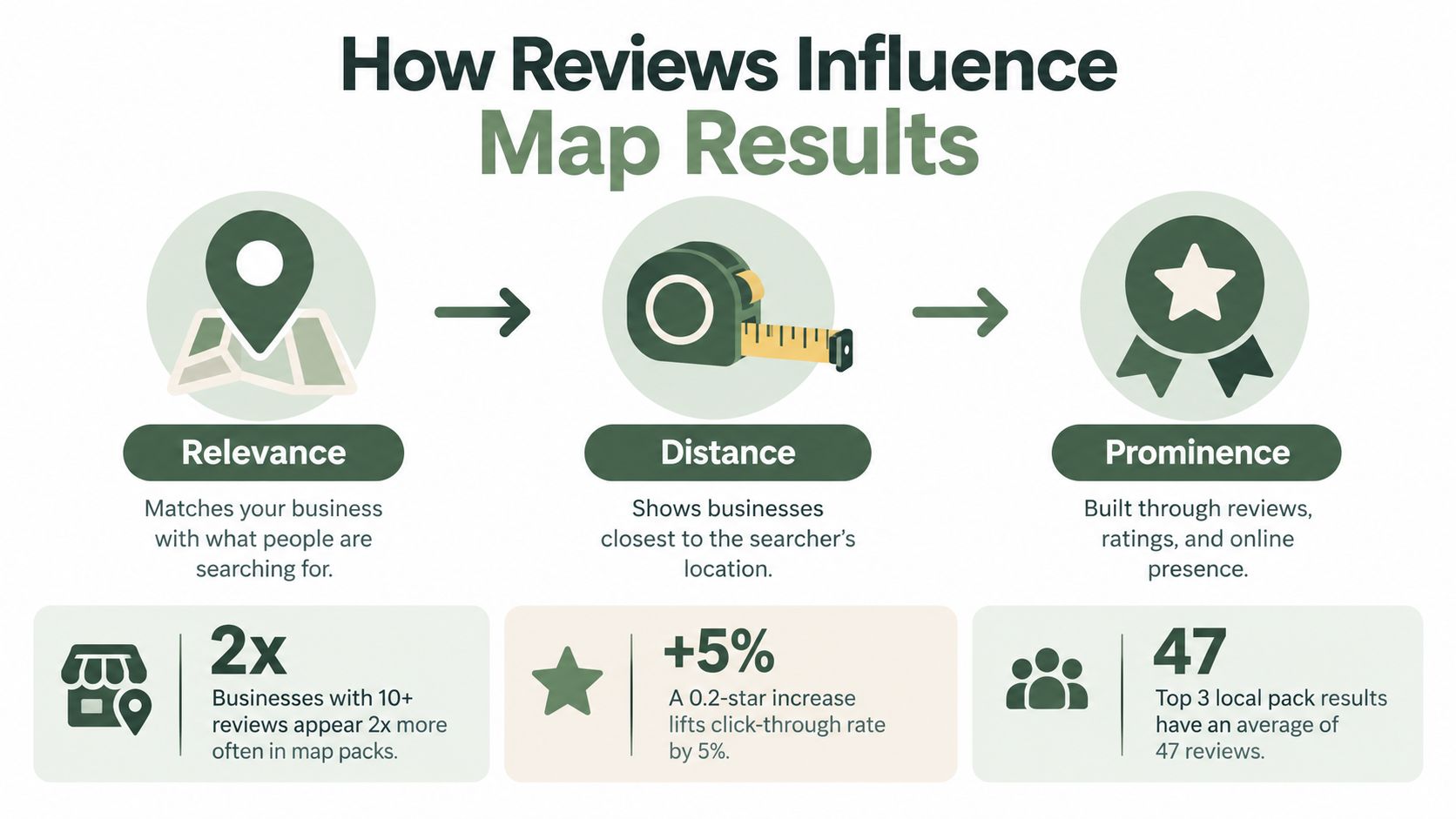
You can't control how close a searcher is to your business. You can control whether your business looks established enough to surface when Google chooses who belongs in the local pack.
That's where reviews come in.
The three inputs that matter most
Google's local system has been built around relevance, distance, and prominence. Reviews affect prominence directly. A **Google Maps review guide says star rating, review count, review recency, and review-text keywords all influence visibility, and it estimates that businesses with reviews earn 270% more clicks than those without, while star ratings can increase click-through rates by 20% to 35% compared with plain blue-link listings**.
That doesn't mean reviews are the only factor. It means they're one of the few factors you can improve without changing location.
A second layer matters too. Review signals account for roughly 16% of Local Pack weight in **BrightLocal's 2024 local ranking factors coverage by Search Engine Journal. That same analysis says that for positions 1 to 21, proximity explains 55% of placement decisions while review count explains 19%, but in the top ten, proximity drops to 36%, review count rises to 26%, and review keyword relevance reaches 22%**.
Volume usually beats perfection
A lot of owners get stuck chasing a perfect score. That's usually the wrong obsession.
A large Google Business Profile analysis reported in UENI's review impact study found that profiles with 1 to 5 reviews reached the top three local results 39.3% of the time, while profiles with 201 to 500 reviews reached the top three 73.0% of the time. The same analysis said average star rating was flatter than review count, and even a perfect 5.0 didn't outperform a 4.9 in that dataset.
So if you have a 4.8 with strong volume and regular activity, that can be a healthier profile than a perfect 5.0 built on a handful of reviews.
Customers trust patterns more than perfection. Google often does too.
This matters in real buying decisions. If someone is choosing a maternity provider, for example, they often read detailed patient experiences rather than staring only at the average rating. A practical example of that behavior shows up in Bornbir's Tucson labor guide, where review depth helps people compare options that look similar at first glance.
Here's a short video if you want to see the map-results dynamic in action.
What to prioritize first
If your team is short on time, focus on these in order:
- Fix profile basics first: Correct category, hours, phone, services, and photos.
- Build review volume steadily: Don't wait for staff to remember. Put review requests into your normal customer flow.
- Watch the average rating, but don't worship it: A believable, active profile usually beats a spotless but empty one.
Why Recency Matters More Than Total Count
A lot of businesses celebrate a milestone review count, then stop asking.
That's a mistake.
A salon with 220 reviews sounds strong until a customer notices most of them are old. A roofer with years of praise can still lose the lead if the latest comments suggest slow callbacks or sloppy cleanup. People don't just ask whether you were good once. They want to know if you're good now.
Recent reviews answer the real question
The trust question isn't “Have lots of people ever liked this business?” It's “What are customers saying lately?”
That shift matters because shoppers have become more skeptical. Concerns about fake and AI-generated reviews have made authenticity and freshness more important, as discussed in this customer trust statistics summary. Old five-star history can look less convincing when there's no recent proof behind it.
WeaveRev's review analysis notes that roughly 67% of consumers check feedback from the last 3 months, which tells you exactly how many buyers care about what happened recently, not years ago.
If your last meaningful review activity was six months ago, customers notice.
Total count still matters, but it stops being the whole story
A lot of advice goes wrong here. It treats reviews like a scoreboard. Get to a big number and you're done.
That's not how customers read profiles. They scan for signs of life.
A strong local profile usually has these traits:
| Signal | What the customer likely thinks |
|---|---|
| Recent reviews | “This business is still active.” |
| Specific comments | “These sound like real experiences.” |
| Mixed but credible feedback | “This looks believable.” |
| Owner replies | “They pay attention.” |
Recent reviews
Specific comments
Mixed but credible feedback
Owner replies
What works in practice
You don't need a one-time push. You need a rhythm.
If you only run a review campaign twice a year, your profile will keep aging between bursts.
- Ask every week: Build review requests into checkout, discharge, job completion, or follow-up.
- Ask close to the service moment: The experience is fresh, and the customer remembers details.
- Keep the request simple: One clear ask works better than a long message.
Generating Reviews Without Breaking the Rules
Plenty of businesses know they need more reviews. The problem is how they go about it.
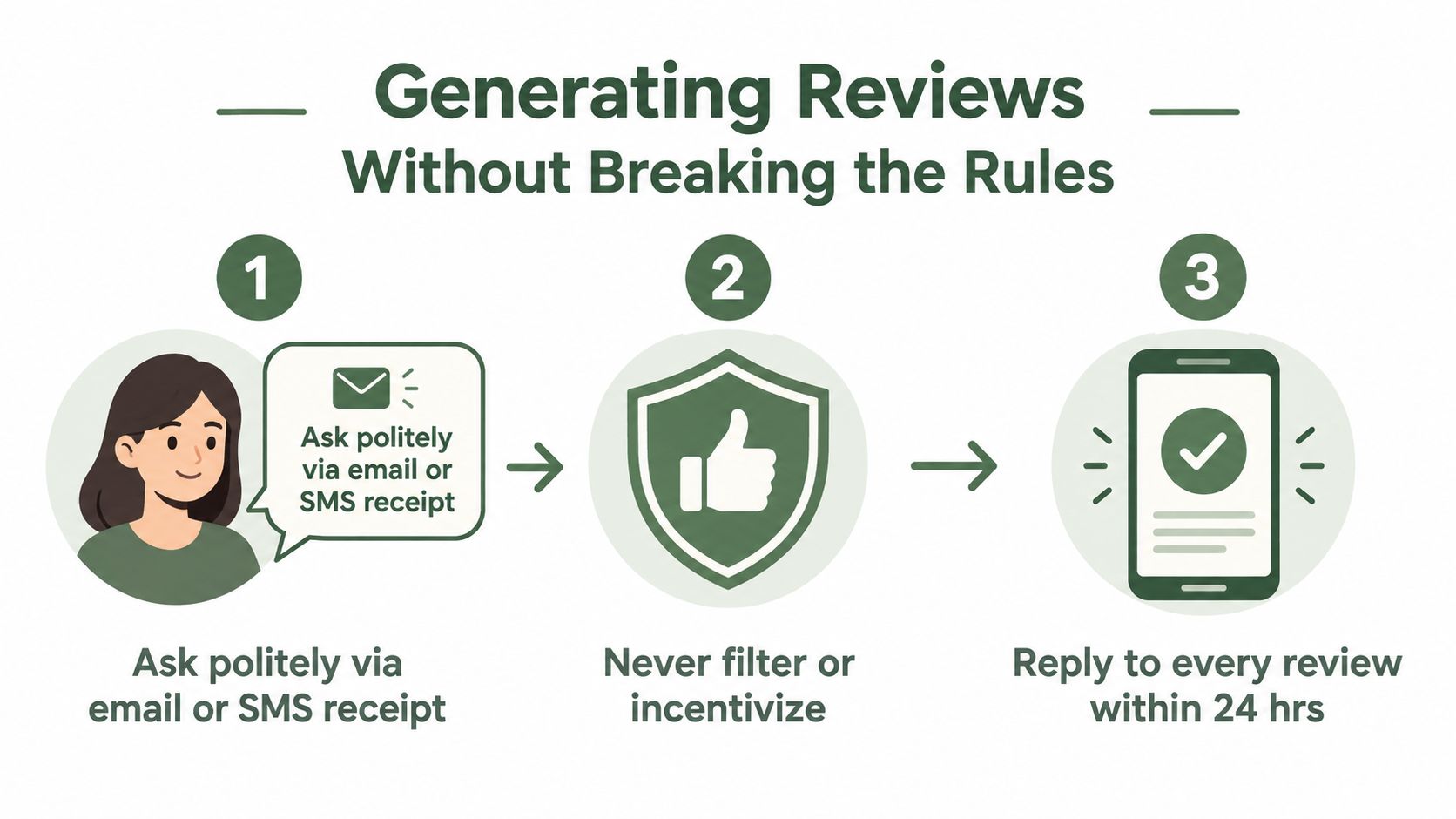
Some teams try to screen customers first. If the customer seems happy, they get sent to Google. If they seem unhappy, they get diverted somewhere private. That's the wrong move. It puts your profile at risk and trains your staff to hide operational problems instead of fixing them.
The safe way is simpler.
Use a side-by-side choice
Every customer should be able to choose between leaving a public Google review and sending private feedback. Side by side. No filtering based on mood. No holding back unhappy customers from the public option.
That keeps your process cleaner and more defensible.
If you want a plain summary of the policy issues, review this guide to Google reviews guidelines. The important part is operational: don't build a system that decides who gets to review publicly.
A simple review request workflow
Most local businesses don't need anything fancy. They need consistency.
For a restaurant, it may be after payment. For a contractor, after job completion. For a clinic, after the visit follow-up. For a hotel, after checkout.
Email works. SMS works. QR codes at the front desk work. Printed cards can work if staff hand them out.
Thank them. Ask for feedback. Give the two options side by side.
Don't leave this to memory. Put it into the receipt flow, CRM, booking system, or post-visit process.
Operational note: The best review process is the one your staff doesn't have to remember.
- Pick your trigger point
- Choose the delivery method
- Keep the ask short
- Make it part of operations
What doesn't work well
Avoid these habits:
One tool that fits this side-by-side approach is RecensioAI. It automates review requests through email, SMS, QR codes, and shareable links while showing every customer a public Google review option and a private feedback option together, so the customer decides.
- Only asking your favorite customers: You'll get an uneven profile and miss useful feedback.
- Asking in big bursts: Activity spikes, then the profile goes quiet again.
- Writing overcomplicated messages: More words usually means fewer responses.
Responding to Feedback to Build Trust
Replying to reviews won't solve weak service. It also isn't a confirmed ranking lever you should rely on for map placement.
It still matters because customers read those replies.
A public response is part of your storefront now. It shows how you handle friction, whether you're paying attention, and whether a complaint gets respect or defensiveness.
Why responses matter to shoppers
According to Digital Applied's Google Business Profile guide, responses become part of what customers see on the profile, helping a shopper judge whether to call, book, or visit by showing that complaints are handled and the business is active.
That's the practical value. Not algorithm magic. Human trust.
How to respond without making it worse
For positive reviews, keep it warm and brief. Thank the person. Mention the service if relevant. Don't paste the same canned line fifty times.
For negative reviews, slow down before you type.
A calm reply to a bad review can help the next customer trust you more than a perfect profile with no signs of life.
- Acknowledge the issue: Even if you disagree with parts of it, show that you heard the concern.
- Don't argue in public: Future customers are reading, not just the reviewer.
- Offer a next step: Give a clear path to continue the conversation privately.
- Look for patterns: If several reviews mention wait times, no response template will fix that. Staffing or process will.
Multi-location teams need consistency
This gets harder when you manage several locations. One manager replies quickly. Another ignores reviews for weeks. One sounds helpful. Another sounds irritated.
That inconsistency shows.
If you need a framework for your team, this article on why businesses should always respond to their reviews is a good place to start. The key is to set a tone, assign ownership, and make sure no location goes silent.
Your Next Step for Local Visibility
By now the answer to are Google reviews important should be clear. Yes, they matter. But the useful lesson is narrower than that.
Review management isn't a side project. It's an operating habit.
You need enough review volume to look established. You need recent activity so people trust what they're seeing today. You need real customer language on the profile. And you need replies that show you're paying attention. That combination helps in map results and helps convert the people who find you there.
A practical weekly check
Don't start with a complicated strategy. Start with a fifteen-minute audit this week.
Use this checklist:
- Search your main service plus your city: Look at the local pack on Google Maps.
- Compare your profile to the top three: Check review volume, freshness, photos, and business details.
- Look at your last ten reviews: Are they recent enough to reassure a new customer.
- Fix one broken step: If staff forget to ask, add a QR code at checkout or automate the follow-up.
Think like a buyer, not like a marketer
If you owned a bakery, you'd probably inspect how nearby cake shops present themselves before making changes. The same habit applies online. Looking at examples outside your category can help too. If you want to see how specialized local businesses position themselves visually and commercially, for custom cake decorators is a useful reference point for how niche service providers present trust and selection.
The broader point is this: customers compare you to the options around you, not to an abstract standard.
The one move to make this week
Set up a review request process that runs after every completed visit, sale, stay, or job.
That's the move. Not a redesign. Not a long SEO project. Just one reliable process that keeps fresh, genuine feedback coming in and gives every customer the same fair choice between a public Google review and private feedback.
If you do that consistently, your profile will stop looking neglected. And that's where local visibility usually starts.
---
RecensioAI B.V. helps local businesses automate review requests, collect public Google reviews alongside private feedback, and keep Google Business Profile activity organized across one or many locations. If you want a cleaner process for getting recent reviews and responding without gaps, visit RecensioAI B.V..
Frequently asked questions
You might also like
Handpicked articles for you
White-Label Local SEO Tools for Agencies
What RecensioAI offers agencies: an embeddable white-label Google Business Profile audit that works as a lead magnet on your own site, plus an agency account where you run every client workspace, report, SMS credit and invoice. With pricing, margin and a 30-day rollout.
How to Beat Your Competitors on Google in 2026
The complete playbook to outrank local competitors on Google Maps in 2026: how many reviews you need to overtake the business above you, how to break into the top 3, and how RecensioAI runs the work for you, with real screenshots from the app.
Connect Your POS or CRM and Get Google Reviews Automatically (2026)
Integrate your POS, online store, booking system or CRM with RecensioAI and every customer gets a review request automatically. How it works, every integration we support, and how to go live in 3 steps.