Competitor Tracking Software: Top Picks for 2026
Compare top competitor tracking software for local businesses, featuring local visibility tools, pricing, strengths, and multi-location fit.
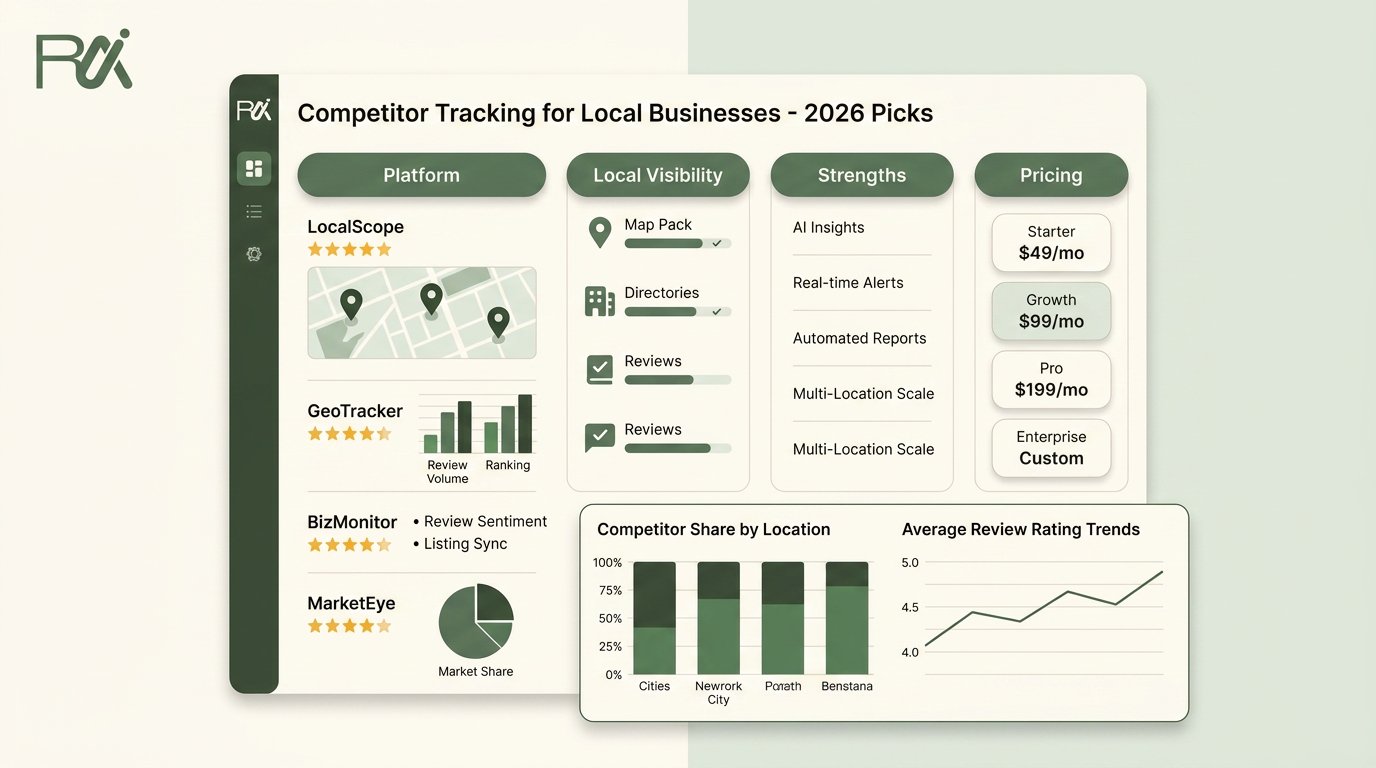
Table of Contents
- 1Introduction
- 21. RecensioAI B.V.
- 3What it solves for local operators
- 42. Semrush
- 5Best for broader search questions
- 63. Ahrefs
- 7Where Ahrefs earns its place
- 84. Similarweb
- 9When local rank data isn't enough
- 105. SpyFu
- 11Good for quick competitive gaps
- 126. BrightLocal
- 13Strong fit for franchises and local reporting
- 147. Local Falcon
- 15Useful when the map is the product
- 168. Crayon
- 17Built for shared competitive intelligence
- 189. Kompyte
- 19Best when sales needs the signal
- 2010. Owler
- 21Fast awareness, limited search depth
- 22Top 10 Competitor Tracking Tools Comparison
- 23Choose the Tool You Will Check Every Week
Introduction
A restaurant owner searches “Italian restaurant near me” after a slow Tuesday and sees another restaurant taking the top map position. A salon manager notices that a newer competitor has more recent reviews. A contractor checks Google Maps and finds that nearby businesses are getting the calls, directions, and quote requests.
That's where competitor tracking software can help, but the phrase covers several different jobs. One tool may show your visibility across a map grid. Another may reveal search terms, paid ads, traffic sources, or content gaps. Enterprise platforms can monitor pricing, product changes, news, and sales messaging. Review and profile platforms focus on the public signals local customers see before they call.
The right choice depends on how many locations you operate, the question you need answered, the time you can spend each week, and whether public pricing matters. Google says local results mainly depend on relevance, distance, and prominence. Google also identifies review count and links from other websites as prominence signals, and says that more reviews and positive ratings can help local ranking. Review responses, review text, and posting activity are better treated as trust and profile-completeness work, not confirmed ranking causes. (Google Business Profile local ranking guidance)
If your team is also thinking about how competitors appear in AI answers, see this guide to AI visibility tools for SEO teams. The list below starts with local review and profile workflows, then moves into map visibility, search research, market intelligence, and enterprise monitoring.
1. RecensioAI B.V.
For a restaurant, hotel, salon, clinic, or contractor, competitor tracking often starts with a simple question: why does the nearby business look more active and trusted on Google Maps? RecensioAI combines review workflows, Google Business Profile checks, competitor benchmarking, and customer follow-up in one platform. That makes it a better fit when the problem is not just rank data, but the daily work behind a stronger local presence.
The platform sends review requests after visits by email, SMS, QR code, or shareable link. Its review page detects the customer's device language, which is useful for a hotel serving international guests or a salon with a multilingual customer base. Customers see a public Google review option and a private feedback option side by side, and they choose which one to use. This is different from review gating, which can create compliance risk.
What it solves for local operators
RecensioAI can generate replies in your tone, group review comments into recurring themes, audit categories, hours, services, attributes, and photos, and generate Google Business Profile posts. The review and profile work supports trust, engagement, and completeness. It shouldn't be presented as a guarantee of better Google rankings.
The competitor feature can show the review gap between your business and rivals appearing for the same local searches. Multi-location dashboards let a franchise owner see individual stores and roll-up performance without checking every profile separately. POS and booking integrations can also reduce the chance that staff forget to send review requests after a completed visit.
Practical rule: Use the competitor view to decide what needs attention, then verify the business details and customer experience behind the numbers.
The platform also turns selected reviews into marketing content for Google, Facebook, and Instagram Stories. Email marketing and Wi-Fi lead capture can use the same customer data. Free tools include a QR code generator, review score calculator, website SEO scan, and Google Business Profile audit.
RecensioAI advertises a 14-day free trial with no credit card, with plans starting at €47 per month, followed by €77 per month and €177 per month tiers. (RecensioAI pricing and product information) The trade-off is that the monthly cost may be difficult for a very small business, and AI replies still need human review for sensitive complaints, unusual situations, or a very specific local voice.

2. Semrush
Semrush is the strongest choice here when your question is broader than Google Maps. It helps you compare organic search visibility, paid search activity, competitor discovery, traffic channels, audiences, and top pages. A contractor could use it to see whether competitors are attracting searches for roof repair, storm damage, or insurance-related services. A clinic could compare which treatment pages bring rivals search visibility.
Best for broader search questions
Its Position Tracking tool supports side-by-side competitor benchmarking with local and ZIP targeting. That matters when a restaurant performs well in one part of a city but disappears from searches several miles away. Semrush also includes tracking for SERP features and AI Overviews, so it can help you investigate how search visibility is changing beyond the traditional blue links.
You can use competitor discovery to find businesses you weren't already watching, then compare share of voice and search trends. Traffic and Market analytics add a wider view of channels and audiences. That's useful for a hotel trying to understand whether a rival depends on search, referrals, or other digital sources.
Use Semrush when you need to answer “which searches and channels are competitors winning?”
The downside is breadth. An owner who only needs a local map grid may spend time navigating reports that don't affect this week's decisions. Some market modules and toolkits are separate purchases, so check the exact package before budgeting. The product is a strong fit for a multi-location business with someone available to interpret search data, but it may be too much for a single salon owner who mainly needs review and profile workflows.
For a practical local strategy, pair the platform's search data with this guide on how to beat your competitors on Google in 2026. Visit the Semrush website to compare current capabilities and plan options.
3. Ahrefs
Ahrefs is built around organic search, backlinks, and content gaps. It's a good choice when a competitor keeps appearing above you because its website has useful service pages, stronger referring links, or content that answers customer questions more clearly.
A contractor might enter a rival's domain into Site Explorer and inspect its top pages, ranking keywords, backlink quality, and paid strategy. A hotel could compare pages for neighborhood guides, event stays, or room types. A clinic could identify treatment questions that competing websites answer but its own site ignores.
Where Ahrefs earns its place
Rank Tracker compares your site with competitors and can monitor SERP features, including local pack results and AI Overviews. Content and keyword gap tools help you see missed opportunities. The large index and historical views are useful when you're trying to distinguish a temporary ranking change from a longer shift in a competitor's search strategy.
Ahrefs is less useful if your main problem is operational. It won't replace a system for sending review requests after appointments, checking every location's Google Business Profile, or making sure holiday hours are current. Google's profile guidance specifically recommends maintaining regular, special, and holiday hours, as well as relevant service details. (Google Business Profile best-practices playbook)
The cost and reporting depth can also be more than a very small team needs. Daily rank updates may require add-ons, so confirm update frequency before signing up. Ahrefs makes the most sense when a business has a real website content problem, not when the owner only wants to know which competitor is ahead on the map.
You can review the current product at the Ahrefs website.

4. Similarweb
Similarweb answers a market-level question: where do competitors get their digital attention, and how does that compare with the category? It covers websites and apps, with tools for traffic sources, audience overlap, segmentation, market comparisons, and competitor alerts.
That perspective can help a hotel group compare destination competitors rather than only the properties appearing beside one location. A franchise can investigate whether a larger rival draws visitors through search, referrals, display advertising, or direct visits. A growing clinic network can use audience and market segments to understand which competitors have broader digital reach.
When local rank data isn't enough
Similarweb's competitor trackers and alerts can flag launches, content changes, advertising activity, and traffic shifts. Company and website analysis helps put those changes into a wider market picture. Its deeper segments and API or export options are more relevant when several people need the information for planning, reporting, or integration.
The trade-off is focus. Similarweb is less suited to the granular map visibility questions that matter to a single restaurant or salon. It won't show the same neighborhood-by-neighborhood view as a local search grid tool. Pricing is also modular and often depends on modules and users, with many plans requiring a sales conversation.
A small business should only choose Similarweb when it has a clear market comparison question. If you want to know why your clinic is missing from a local pack, start with a local rank tracker. If you want to understand how a hotel competitor's digital audience compares across a whole market, Similarweb is more appropriate.
Review the available options at the Similarweb website, and consider this Similarweb data extraction service only if your team has a specific data workflow that the standard interface doesn't cover.
5. SpyFu
SpyFu is the practical pick for a business that wants to study competitor keywords and paid search activity without buying a broad enterprise intelligence platform. Its SEO and PPC views show overlapping keywords, estimated clicks, estimated value, and budget signals. That can give a service business a starting point for deciding which search terms deserve attention.
A contractor could compare three local rivals and identify shared terms for emergency plumbing, kitchen remodeling, or commercial work. A salon might find that competitors are targeting searches around bridal services, extensions, or specific treatments. A restaurant could inspect whether rivals are investing in paid searches for delivery, catering, or private dining.
Good for quick competitive gaps
The Kombat tool compares multiple competitors and separates shared terms from white space. That visual approach is useful when you don't have time to study a large set of reports. Project dashboards and exports also make it easier to save a list of terms for a website update or paid campaign review.
SpyFu's limitation is that it's not a full local operations platform. It won't manage Google Business Profile completeness, review requests, public replies, or map-grid movement as its central job. Its market-level intelligence is also lighter than Similarweb, Crayon, or Kompyte. Historical data depth can vary by plan, so verify what you'll receive before relying on long-term comparisons.
A keyword gap is only useful if you can turn it into a service page, ad, or offer that your business can actually deliver.
For a busy owner, use SpyFu to produce a short list, not an endless research project. Choose a few terms tied to profitable services, check whether the competitor's page answers the customer's question, and assign the website or advertising work to a named person.
Visit the SpyFu website for current plan details.

6. BrightLocal
BrightLocal is designed for the local problem most owners recognize: your visibility changes from one neighborhood to the next. Its Local Search Grid shows map-based performance across an area, while its rank tracker compares your business with selected competitors and filters SERP features.
A salon can check whether it appears near the downtown shopping district but drops outside its immediate neighborhood. A clinic can compare visibility around several office locations. A franchise operator can roll up local reporting across stores while still opening individual location details when one branch falls behind.
Strong fit for franchises and local reporting
BrightLocal's local focus makes it easier to discuss the data with a manager who doesn't work in search marketing. Instead of saying that a domain has lost visibility, you can point to the parts of the service area where a restaurant or contractor is less visible than nearby competitors. The reporting tools are also suited to external or white-label reporting, which can help franchise groups standardize updates.
The main limitation is the number of competitors available within a report. The plan notes identify a limit of up to four competitors for competitor tracking in a report. (BrightLocal local SEO platform) That's enough for a focused local set, but not for a large market where you want to watch every nearby business.
BrightLocal is not a general market-intelligence suite. It won't give you the same depth on competitor traffic, company news, product changes, or broad PPC research as other tools on this list. Choose it when the decision is about local visibility by location, not a full digital strategy.
The location-based pricing model can also make sense for a multi-location business because the number of active locations is a clear planning unit. A single-location business should still check how many reports and scans it needs before choosing a tier.
7. Local Falcon
Local Falcon gives you a visual answer to a map question: where do we win, where do we lose, and which competitor appears in those spots? Its geo-grid tracking displays rankings across the area around a business and overlays competitors. Share of Local Voice helps summarize local-pack presence across the grid.
That's useful for a restaurant located on the edge of a busy district. The owner may rank well near the entrance but lose visibility on the other side of the neighborhood. A contractor can use the map to separate a real service-area weakness from a ranking result taken from one search point. A multi-location operator can compare the shape of each store's local visibility.
Useful when the map is the product
Competitor and trend reports help you monitor movement over time. Falcon Guard monitors changes to competitor listings, while campaigns, Looker Studio integration, and API access support more formal reporting. Falcon AI is available as an optional analysis add-on, according to the product plan notes.
The credit-based pricing model requires planning. Frequent scans, AI analysis, and some tools consume additional credits, so a team that checks too often can use its allowance quickly. Local Falcon also isn't the right choice for broader web analytics, company news, or deep keyword and backlink research.
Map-grid software is most useful when you act on the location pattern, not when you collect another weekly screenshot.
Use the first scan to find a specific operational question. Maybe one clinic needs better category and service information. Maybe one hotel location has fewer recent reviews than the closest rival. Google's guidance says local prominence includes reviews and other public signals, but the tool can't fix the underlying customer experience or profile details for you. (Google local results guidance)
For a detailed Maps-focused workflow, read how to outrank your competitor on Google Maps, then evaluate the Local Falcon website.
8. Crayon
Crayon is for an enterprise problem: many teams need to know what competitors changed, and someone has to turn those changes into usable guidance. It aggregates competitor moves across pricing, product, content, social, news, and messaging. It also distributes insights and battlecards to sales and product teams.
That can matter to a franchise system with a central sales team, product group, and field operators, but it's usually too much for one restaurant owner. A multi-location healthcare business could use it to track how competing providers describe services, prices, and differentiators across their websites. A hotel group could share changes in competitor offers with revenue and sales teams.
Built for shared competitive intelligence
Crayon's strength is cross-functional adoption. AI-assisted collection and enablement features help classify and summarize changes, while templates support a more organized intelligence program. Battlecards can give frontline teams a current response when a customer asks how your service differs from a competitor's offer.
The trade-off is budget and setup. Pricing isn't public and typically requires an enterprise conversation. Onboarding and program design also make more sense when several departments will use the information. If you only need keyword gaps, ad research, or map-grid visibility, Crayon adds complexity without solving the immediate problem.
Crayon won't replace a local rank tracker for a neighborhood battle. It's better for monitoring a competitor's overall digital footprint and making sure the right people hear about a meaningful change.
See the current enterprise offering at the Crayon website.

9. Kompyte
Kompyte focuses on automated competitor change detection and sales readiness. It watches competitor websites, pages, and pricing, then connects important updates to battlecards, CRM workflows, and sales teams.
A commercial contractor with a dedicated sales group could use it to monitor how rivals change service pages or package their offers. A healthcare network could give sales representatives current information when competitors update pricing or positioning. A franchise headquarters team could maintain shared playbooks instead of sending scattered updates through email.
Best when sales needs the signal
Website and pricing alerts reduce manual checks. Battlecards and CRM integrations help turn a change into a task or conversation, while role controls and SSO support larger organizations. Flexible licensing can be useful when the number of users or tracked competitors changes.
Kompyte isn't a standalone local search solution. It won't give a salon owner the same neighborhood map view as Local Falcon or BrightLocal, and it isn't centered on review requests or Google Business Profile maintenance. Pricing is not public, so you'll need a sales or discovery conversation to right-size the plan.
Use it when the business decision depends on competitor changes reaching frontline employees quickly. Don't choose it just because your website needs occasional monitoring. A simpler page-change tool may be easier to manage if sales enablement isn't part of the requirement.
AI search also deserves a separate question. To understand how to monitor visibility in ChatGPT, Gemini, and Perplexity, see this guide on AI competitor monitoring.
Review the product at the Kompyte website.

10. Owler
Owler is the choice for company-level competitor awareness. It delivers news and alerts on tracked businesses, leadership changes, launches, funding, and other company moves. Its relationship graph helps executives and sellers see how businesses connect within a market.
That's more relevant to a hotel group watching a regional chain, a contractor entering a new commercial market, or a franchise headquarters team monitoring large competitors. It can also help sales teams prepare for account conversations when a rival makes a move that affects a customer or prospect.
Fast awareness, limited search depth
Owler's newsfeed and alerts are designed for fast awareness rather than detailed SEO analysis. Integrations for Salesforce, HubSpot, and Slack can help distribute updates to teams that already work in those systems. Community-sourced information gives the platform broad coverage across company profiles.
The limitation is precision. Owler won't tell a restaurant which map-grid points it's losing, which keywords a competitor ranks for, or which paid search terms overlap. It works best alongside a local SEO tool or search research platform.
Pricing for Pro, Enterprise, and Max tiers isn't transparently listed and generally requires a demo or sales conversation. That makes it harder for a small business to test against a simple alert system. If your need is only to watch a few local businesses, first decide whether company news would change any action you take.
Visit the Owler website to assess whether its company monitoring fits your operation.
Top 10 Competitor Tracking Tools Comparison
The interactive comparison below lines up all ten tools on the same criteria: core features, quality, price and value, who each one is built for, and what genuinely sets it apart. Filter by the job you need done — local map rankings, search and ad data, or broad competitive intelligence — and note that vendor pricing changes, so confirm current plans before you commit.
Ten competitor tracking tools, side by side
Filter by what you actually need: local map rankings, search and ad data, or broad competitive intelligence. Prices are vendor guidance and can change.
| Tool | Focus | Quality | Entry price |
|---|---|---|---|
| RecensioAI | Local & Maps | From €77/mo · 14-day free trial | |
| Semrush | SEO & search data | Tiered plans | |
| Ahrefs | SEO & search data | Subscription + add-ons | |
| Similarweb | SEO & search data | Enterprise, contact sales | |
| SpyFu | SEO & search data | Budget-friendly entry | |
| BrightLocal | Local & Maps | Per location | |
| Local Falcon | Local & Maps | Credits per scan | |
| Crayon | Competitive intelligence | Enterprise, contact sales | |
| Kompyte | Competitive intelligence | On request | |
| Owler | Competitive intelligence | Pro/Enterprise, contact sales |
RecensioAI
- Core features
- Automated review requests (email/SMS/QR/link), Google-compliant public reviews + private feedback, AI replies, GBP audits, social auto-posting
- Value & price
- Pro €77/mo · Multi €177/mo · Pro Managed €249/mo · 14-day free trial (no card)
- Best for
- SMBs and multi-location: restaurants, hotels, salons, clinics, retail, franchises
- What sets it apart
- GBP-safe private feedback alongside public reviews, AI replies in your own voice, competitor gap plans and multi-location rollups
Semrush
- Core features
- Daily position tracking, competitor discovery, traffic and market analytics
- Value & price
- Tiered plans; advanced modules priced separately
- Best for
- SEOs, agencies and enterprises needing full marketing intel
- What sets it apart
- Strong local/ZIP tracking, Share of Voice and scheduled reports
Ahrefs
- Core features
- Site Explorer, Rank Tracker, content and keyword gap tools
- Value & price
- Subscription tiers; some daily features require add-ons
- Best for
- SEO teams, content marketers, agencies
- What sets it apart
- Best-in-class backlink data and trend analysis
Similarweb
- Core features
- Traffic and audience analysis, competitor alerts, market share benchmarking
- Value & price
- Enterprise/module pricing; contact sales
- Best for
- Market researchers, enterprise product and strategy teams
- What sets it apart
- Market-level share and audience overlap insights
SpyFu
- Core features
- SEO and PPC competitor keywords, Kombat overlap tool, exports
- Value & price
- Budget-friendly entry; higher tiers for unlimited exports
- Best for
- SMBs and agencies focused on PPC/SEO
- What sets it apart
- Cost-effective ad/keyword value estimates and overlap analysis
BrightLocal
- Core features
- Local Rank Tracker, Local Search Grid (map view), multi-location reporting
- Value & price
- Pricing scales by number of locations (clear model)
- Best for
- Local businesses, agencies, franchises
- What sets it apart
- GBP-focused tooling, white-label reports, map visualizations
Local Falcon
- Core features
- Geo-grid map rank tracking, competitor overlays, Falcon Guard
- Value & price
- Credit-based pricing (plan your scans accordingly)
- Best for
- Local managers and multi-location ops focused on Maps
- What sets it apart
- Visual grid plus Share of Local Voice to pinpoint where you win or lose
Crayon
- Core features
- Central CI feed across product, pricing, messaging and PR; battlecards
- Value & price
- Enterprise pricing; demo and onboarding required
- Best for
- Enterprise competitive intelligence, product and sales teams
- What sets it apart
- Cross-functional CI with distribution and battlecards at scale
Kompyte
- Core features
- Automated website and pricing change detection, battlecards, CRM integrations
- Value & price
- Custom pricing via sales
- Best for
- Sales and product teams needing live competitive playbooks
- What sets it apart
- Automated change detection plus battlecards for frontline reps
Owler
- Core features
- Real-time newsfeed, alerts, large company relationship graph
- Value & price
- Pro/Enterprise tiers; contact sales
- Best for
- Executives, sellers, competitive watchers
- What sets it apart
- Community-sourced company graph with real-time alerting
Want to see where you stand against your competitors?
Start with a free scan of your Google profile, or try RecensioAI free for 14 days.
Choose the Tool You Will Check Every Week
The best competitor tracking software is the one that answers a question you'll act on. A dashboard full of competitor data won't help if nobody checks it, understands it, or assigns the next step.
For map-grid visibility, start with BrightLocal or Local Falcon. BrightLocal is a practical fit for local rank tracking, competitor comparisons, neighborhood grids, and multi-location reporting. Local Falcon is especially useful when you need a visual map showing exactly where each store wins or loses. A salon with one location may only need a focused grid. A franchise should compare location-level reports and use a shared process for deciding what happens next.
For broader search research, choose Semrush or Ahrefs. Semrush fits a business that wants search, paid ads, audience, and market views in one system. Ahrefs is stronger when the main question involves organic content, backlinks, and keyword gaps. Use SpyFu when PPC research and practical keyword overlap matter more than broad market intelligence.
For market-level comparisons, Similarweb gives you a wider view of traffic sources, audiences, and digital segments. It's more useful for a hotel group or growing clinic network than for a single contractor trying to improve visibility in one service area.
For enterprise monitoring, Crayon and Kompyte help central teams track competitor changes and distribute the information through battlecards or sales workflows. Owler is the better fit when the urgent question is company news, leadership changes, launches, or broader account awareness. None of these replaces a local tool when your decision depends on Google Maps visibility.
Set up your first week with a small, repeatable process:
Google's local guidance emphasizes relevance, distance, and prominence. Profile completeness matters because Google recommends current business information, accurate hours, relevant categories, and other details customers use to decide where to go. (Google Business Profile best-practices playbook) Reviews also deserve attention. A 2026 Localo study reported that review count had the widest spread in top-three visibility among the factors it measured, from a 39.3% top-three rate at 1 to 5 reviews to 73.0% at 201 to 500 reviews. The same study reported that average rating was the flattest line in its data, with a perfect 5.0 ranking worse than 4.9 in that dataset. (Localo local SEO ranking-factor study)
If you also need review requests, Google Business Profile checks, replies, and multi-location workflows, RecensioAI is worth evaluating alongside a map tracker. It can connect the competitor question to the profile and customer follow-up work that your staff must keep doing.
Select the tool that answers your most urgent question, then run a small pilot before adding more locations or features. For businesses testing video and customer-content workflows as well, this Satura AI video analytics guide may help with a separate measurement need.
---
RecensioAI B.V. combines review requests, public and private customer feedback options, AI-assisted replies, Google Business Profile audits, competitor tracking, and multi-location reporting for local businesses. If your restaurant, salon, clinic, hotel, contractor business, or franchise needs a practical way to monitor competitors and keep customer feedback work moving, visit RecensioAI B.V. and start with a focused pilot.
- Record important searches: Write down the “near me,” service, neighborhood, and location searches that customers use.
- Add real competitors: Track the businesses customers compare with you, not only the brands you consider important.
- Choose a schedule: A fixed weekly check is easier to maintain than constant dashboard browsing.
- Assign one owner: One manager should decide what gets reviewed and who handles each follow-up.
- Connect signals to work: Turn a missing service detail, competitor offer, review gap, or content opportunity into a specific task.
You might also like
Handpicked articles for you
Hotel Review Management: Automate Post-Stay Requests with Apaleo, Mews and Your PMS
A practical guide to turning hotel checkouts into timely review requests, with Apaleo live, Mews early access and flexible PMS alternatives.
Why the Business Around the Corner Beats You on Google: What 21,373 Profiles Reveal
We compared 21,373 Google Business Profiles with their three strongest nearby competitors. The gap is smaller than most owners think, but it has two sides: rating and volume.
Treatwell Review Management for Salons: One Reputation View Alongside Google
Bring your public Treatwell rating and recent reviews into RecensioAI, then combine salon signals with Google for faster, better decisions.