Benefits of Local SEO for Small Business Growth
Discover the real benefits of local SEO for small businesses. Learn how map pack visibility, reviews, and profile completeness drive calls, visits, and revenue.
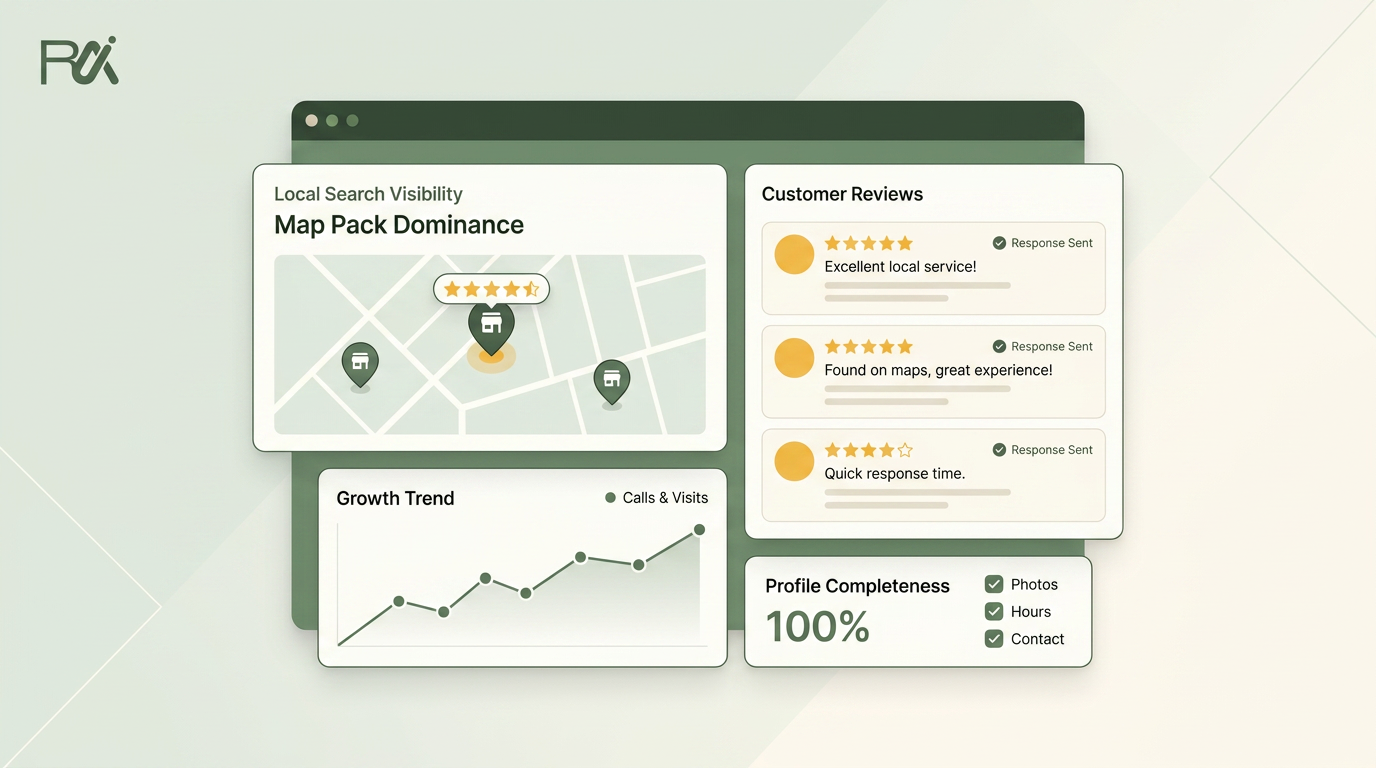
Table of Contents
- 1Introduction
- 2What Happens When Someone Searches for Your Business
- 3The difference between visible and overlooked
- 4How Google Decides Which Three Businesses to Show
- 5Relevance
- 6Distance
- 7Prominence
- 8Why a Complete Google Business Profile Builds Trust
- 9Check the fields customers use
- 10How Local Searches Turn Into Real Customers
- 11Measure the action after the search
- 12Why Reviews Are Your Strongest Local Ranking Lever
- 13Build a review process, not a one-time campaign
- 14A Practical Weekly Local SEO Routine
- 15Five minutes each day
- 16Twenty minutes once a week
- 17Your Next Step to Improve Local Visibility
Introduction
A customer is standing outside a hotel, salon, clinic, or restaurant with a phone in hand. They search for “restaurant near me,” “salon open now,” or “plumber near me.” Google shows a map, three businesses in the local pack, and then the regular organic results. If your business is missing from the map results, that customer may never reach your website, even if your website ranks well.
That's the practical value of local SEO. It puts your business in front of people who already have a location, a need, and often a short time frame. The question isn't only whether local SEO brings visitors. It's whether those searches produce calls, direction requests, bookings, visits, and purchases.
What Happens When Someone Searches for Your Business
A homeowner finds a leak under the kitchen sink and needs help now. They search “plumber near me” or “plumber open now.” Google uses the searcher's location to display a map and three local businesses, followed by traditional results.
Those map listings are designed for decisions, not passive browsing. A customer may see your phone number, hours, website, reviews, directions, services, photos, and other profile details in one place. They can call without opening your website, request directions immediately, or reject the listing because the business is closed.

The difference between visible and overlooked
Two salons in the same neighborhood may deliver equally good haircuts, yet their listings can produce very different results. One shows current hours, clear service categories, recent photos, booking information, and substantial customer feedback. The other has an outdated holiday schedule, few photos, and little service detail. The first gives a searcher more evidence to contact it.
The same decision factors apply across industries:
Practical rule: Treat your Google Business Profile as an action page, not a directory listing.
Website rankings still matter when customers need detailed information. Map listings, however, can influence the decision sooner because the searcher can call, request directions, or book directly from the result. Google's local search data found that 50% of consumers who searched on a smartphone visited a store within a day, and local smartphone searches converted into purchases within a day at 18% versus 7% for non-local searches, according to BrightLocal's summary of local SEO statistics.
A map impression is not revenue by itself. Track calls, direction requests, bookings, visits, and purchases by source so local SEO is judged by conversion quality, not visibility alone.
- Restaurants: A complete profile lets customers compare cuisine, hours, photos, menu information, and directions.
- Salons: Accurate services and booking details support a choice between a haircut, color appointment, or styling service.
- Clinics: Current hours, appointment information, accessibility details, and services reduce uncertainty before a patient calls.
- Contractors: Service coverage, phone access, photos, and reviews help homeowners choose which company to contact first.
How Google Decides Which Three Businesses to Show
Understanding the benefits of local SEO starts with knowing how Google evaluates relevance, distance, and prominence. These factors help explain why a map placement can produce qualified calls and visits, while a high impression count alone says little about revenue.
Relevance
Relevance measures how closely a business matches the searcher's request. A restaurant listed only as “restaurant” may provide weaker context for a specific query than one with accurate cuisine categories, menu information, services, and a clear description.
A clinic should identify its actual specialties and appointment services. A contractor should describe the work it performs and the areas it serves, without forcing unrelated keywords into the profile. Clear information helps Google match the listing with the right searches and helps customers decide whether to contact the business.
Distance
Distance is the physical relationship between the searcher and the business. A company cannot move its premises closer to someone searching from another neighborhood, and a contractor cannot claim a location where it does not operate.
This factor explains why a nearby competitor may appear ahead of a better-known business. Distance limits which searches a business can win, so it is not a profile field that can be optimized away.
Prominence
Prominence reflects how established and recognized a business appears. Google says it may consider factors such as reviews and links from other websites. Its official local ranking guidance also states that more reviews and positive ratings can help local ranking.
Two Italian restaurants on the same street may offer similar menus and sit at comparable distances. The one with accurate information, a stronger review history, and consistent online references gives Google more evidence of relevance and prominence. That advantage can improve the quality of map traffic, but no profile change guarantees a specific position.
Use the detailed explanation of Google Business Profile ranking factors to separate documented signals from common SEO assumptions. Review count and rating are recognized local ranking factors. Review responses, posts, and profile activity may support customer trust and engagement, but they should not be described as direct causes of ranking changes.
Measure the outcome after a placement appears. Compare calls, direction requests, bookings, visits, and purchases by source. A three-pack position matters when it brings customers who take profitable actions, not just when it generates views.
Why a Complete Google Business Profile Builds Trust
A customer comparing local businesses often makes a decision from the profile alone. Missing information adds another search, call, or uncertainty. The business that answers the practical questions first has a better chance of earning the click and the visit.
A complete profile supports credibility because it shows that the business is active, reachable, and prepared for customer questions. That trust matters commercially: a map placement is valuable when the listing helps someone call, request directions, book, or buy.
Check the fields customers use
Review each field from the customer's point of view.
A salon profile with only an address and phone number makes customers search elsewhere for services and booking details. A clinic should make specialties and appointment steps easy to find. A contractor needs clear service coverage and a dependable contact path, especially when the problem is urgent.
Completeness also requires maintenance. Hours change, services change, photos become dated, and businesses add locations or appointment options. Set a recurring review so customers do not become the first people to find an error.

Use this Google Business Profile completeness guide for a focused listing review. A broader step-by-step local SEO strategy can cover the profile alongside website pages and local listings.
Judge the profile by customer actions, not appearance alone. Compare calls, direction requests, bookings, and purchases from Google before and after important updates.
This video provides another practical walkthrough for businesses reviewing their profile setup:
- Categories: Choose the primary category that best describes the business, then add relevant secondary categories.
- Hours: Check regular, holiday, and special hours. A restaurant shown as open when it is closed can lose a ready customer immediately.
- Photos: Add current, well-lit images of the storefront, dining area, treatment rooms, team, products, or completed work.
- Services and products: List what you sell or perform. A salon should separate cuts, color, and treatments. A contractor should identify plumbing, drain work, or installation services it provides.
- Attributes: Add useful details such as accessibility, outdoor seating, appointment requirements, payment options, or service options where applicable.
- Reviews: Monitor new feedback, respond professionally, and use recurring comments to improve the customer experience.
How Local Searches Turn Into Real Customers
A homeowner with a leaking roof may search for a contractor nearby and call the business shown in Maps before visiting its website. A salon customer searching for an appointment may book from the profile if the booking option is clear. These searches carry commercial intent because they combine a service, a location, and often a timing signal.
Google reported that near me and close-by queries grew by more than 500% over five years, while open now near me searches rose 900%, according to BizIQ's local search statistics. The figures show growing demand for local answers, but impressions alone do not show whether a business earns revenue.

Measure the action after the search
A useful local SEO report connects map exposure with customer actions. Track calls, direction requests, website visits, bookings, and completed purchases, then compare those actions with revenue.
For example, a salon can tag booking requests from Google, record completed appointments, and calculate the value of those appointments. If Google generates ten booking requests, seven become appointments, and each appointment averages the salon's standard service value, the owner can compare that revenue with the work required to maintain the profile. A contractor can ask each new caller how they found the business, mark leads that came directly from Maps, and compare won jobs with average project value.
Industry roundups cite 76% of near me searches leading to a visit within 24 hours and 28% of local searches resulting in a same-day purchase, summarized in Ranktracker's 2025 local SEO statistics. Treat those figures as context, not a forecast. Your own call records, booking system, direction requests, and point-of-sale data provide a better view of conversion quality.
For multiple locations, report calls, bookings, visits, and revenue by branch. Website analytics can miss customers who call or act directly from Google Maps, so map visibility should be judged by the business results it produces.
Why Reviews Are Your Strongest Local Ranking Lever
A business can have accurate hours, the right category, and a well-defined service area, yet still lose the map pack to a similar nearby option. Reviews are one of the most practical areas you can influence consistently, provided you ask customers fairly and give every customer a public Google review option.
Google considers review quantity and positive ratings among the signals that can support local ranking. A 2025 analysis of 3,269 Google Business Profiles found that proximity explained 55% of visibility overall, while review count explained 19%. Among the top ten positions, review count rose to 26%, and keyword relevance in review text reached 22%, according to Semrush's local SEO rankings analysis.
These figures do not make reviews a shortcut to the top. They show where review signals can separate businesses that are otherwise similar, particularly near the top of map results. The business impact is practical: stronger review proof can help a searcher choose you, while the resulting calls, bookings, and purchases reveal whether visibility is producing revenue.
Build a review process, not a one-time campaign
Ask after a genuine interaction, such as a completed appointment, meal, stay, repair, or installation. Keep the request clear and use a channel your business already relies on. Do not offer rewards for positive reviews, pressure customers to change feedback, or hide the public review option from anyone.
Review detail also helps prospects understand your services. A contractor whose customers naturally mention water heaters, emergency repairs, or drain work gives future customers more useful context than a profile filled with vague praise.
Responding to reviews supports customer communication and profile trust. It shows that the owner reads feedback and gives customers a place to raise concerns. A response itself is not a confirmed direct ranking factor, so treat replies as reputation work rather than a ranking tactic.
Measure the business result, not just the review total. Compare review activity with calls, booked appointments, closed jobs, and average customer value. If reviews increase map actions but those actions rarely become customers, examine lead quality, response time, pricing, or the booking process. For background on the relationship between reviews and local search, see how Google reviews influence local SEO.
A Practical Weekly Local SEO Routine
A local profile stays useful when someone owns the work, the checks are brief, and changes are recorded. The goal is not activity for its own sake. Keep information accurate, then connect profile actions with calls, bookings, and other customer outcomes.
Five minutes each day
Check for new reviews and respond calmly with specific detail. A restaurant can thank a customer for mentioning a dish. A clinic can acknowledge the experience without discussing private medical information. A contractor can address service feedback without revealing job details.
Verify business hours before opening, especially when staffing, weather, holidays, or appointments change. An incorrect “open now” result can send a customer to a closed location and damage trust before the business knows there is an issue.
Twenty minutes once a week
Use one weekly session for these checks:
A small business owner can assign the daily check to a manager and keep the weekly review. A franchise operator can apply the checklist at each branch, then investigate locations whose customer actions differ from comparable stores.
Consistency matters because customers need accurate information whenever they search, and small profile improvements only matter when they help more qualified searchers become customers.
- Add a current photo. Show a new menu item, a clean treatment room, a completed bathroom repair, a renovated hotel space, or the storefront during business hours.
- Publish a useful Google Business Post. Share a seasonal service, appointment availability, event, menu update, or customer notice. Write for customers, not keyword repetition.
- Review profile details. Check categories, services, attributes, booking links, phone numbers, and special hours.
- Compare nearby listings. Review businesses appearing for the searches that matter to you. Note clearer photos, more specific services, stronger review detail, or information that makes choosing easier.
- Record actions and outcomes. Track calls, direction requests, bookings, and profile changes by location. Where possible, compare these actions with completed jobs, visits, or sales so map visibility is judged by conversion quality rather than impressions alone.
Your Next Step to Improve Local Visibility
Local SEO is ongoing maintenance with a business outcome: accurate information helps qualified searchers call, request directions, book, or visit. The benefits of local SEO compound over time when your profile stays current and your review process has no gaps. Map placement matters because it can bring customers who are ready to choose, not merely increase impressions.
Open your Google Business Profile today and compare it with the checklist above. Fix the first three gaps you find, such as incorrect hours, missing services, weak photos, or an incomplete category setup. Then record calls, direction requests, bookings, and walk-ins as a baseline. Later, compare those actions with completed jobs or sales to judge conversion quality.
For broader guidance, small business SEO in Brisbane provides a local-business perspective. RecensioAI offers free tools, including a Google Business Profile audit and review score calculator, to identify gaps before you decide what to automate.
RecensioAI B.V. helps local businesses automate review requests, monitor profile completeness, manage review responses, and track local visibility across locations. Visit RecensioAI B.V. to audit your profile and identify which parts of your local search process need more consistent attention.
You might also like
Handpicked articles for you
Hotel Review Management: Automate Post-Stay Requests with Apaleo, Mews and Your PMS
A practical guide to turning hotel checkouts into timely review requests, with Apaleo live, Mews early access and flexible PMS alternatives.
Why the Business Around the Corner Beats You on Google: What 21,373 Profiles Reveal
We compared 21,373 Google Business Profiles with their three strongest nearby competitors. The gap is smaller than most owners think, but it has two sides: rating and volume.
Treatwell Review Management for Salons: One Reputation View Alongside Google
Bring your public Treatwell rating and recent reviews into RecensioAI, then combine salon signals with Google for faster, better decisions.