Best QR Code Generator for Business: 10 Tools
Compare the best qr code generator for business tools for reviews, payments, Wi-Fi, menus, integrations, pricing, and multi-location use.
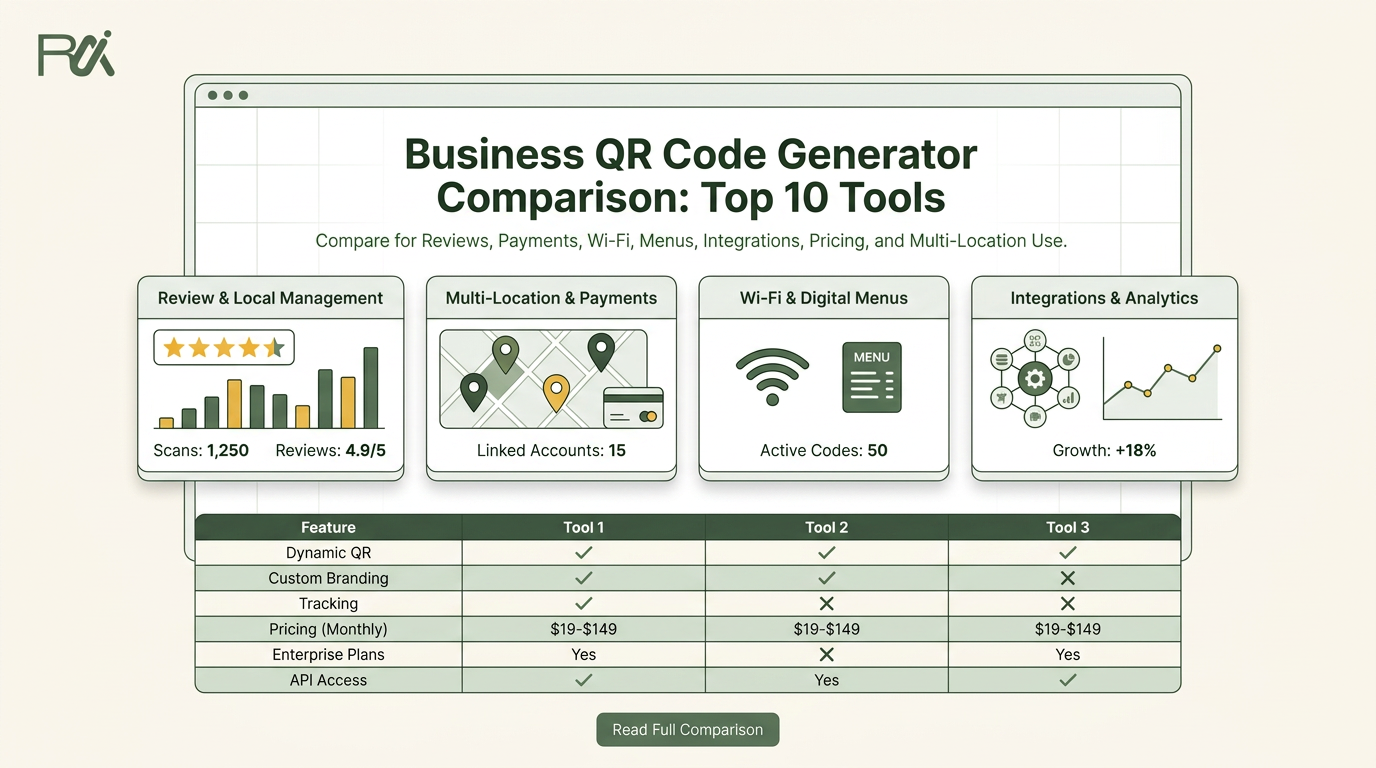
Table of Contents
- 1Introduction
- 21. Free Google Review QR Code Generator by RecensioAI
- 3Where it fits best
- 42. Uniqode
- 5The operational advantage
- 6Best local-business jobs
- 73. Flowcode
- 8Trade-offs for owners
- 94. QR TIGER
- 10Start with the free limits
- 115. QR Code Generator by Bitly
- 12What to confirm before printing
- 136. Bitly QR Codes in the Bitly Connections Platform
- 14Choose it for existing workflows
- 157. Scanova
- 16Why the landing page matters
- 178. QRCodeKIT
- 18Watch the scan experience
- 199. QRFY
- 20Don't treat unlimited as a complete answer
- 2110. ME-QR
- 22Use the free mode carefully
- 23Top 10 Business QR Code Generators: Features & Pricing
- 24Choose the Tool That Matches Your Next QR Job
Introduction
The best QR code generator for business depends on the job. Use a simple review QR code for a fast Google request, a dynamic tool when menus or booking links may change, and a team platform when several locations need shared controls.
A restaurant owner may print a QR code on every receipt, then discover the review link sends customers to the wrong page. A salon may change booking software but still have old codes on mirrors and appointment cards. A clinic may want a Wi-Fi code that stays simple, while a hotel needs to update menus without reprinting table cards.
Start with one question: will the destination ever change? A static QR code stores the destination directly. It works for a permanent Wi-Fi instruction or fixed contact page, but changing the link means creating and printing a new code. A dynamic QR code uses a managed redirect, so you can update the destination after printing and review scan activity.
The market is now large enough that this choice affects daily operations. The global QR code market was valued at $13.04 billion in 2025 and is projected to reach $33.14 billion by 2030, a 20.5% compound annual growth rate. Dynamic codes account for 64.92% of QR code format revenue, according to market data summarized by Wave Connect. That points to a practical shift. Businesses increasingly need editable destinations, campaign tracking, and controls across locations, not just a downloadable image.
This comparison focuses on setup, destination editing, scan limits, analytics, branding, integrations, billing terms, and the risk that a printed code stops working. It covers a fast review code, restaurant menus, Wi-Fi access, payments, lead capture, and multi-location rollout. The ten tools are followed by use-case guidance, pricing checks, and a recommendation matrix.
1. Free Google Review QR Code Generator by RecensioAI
If your main job is to make review requests easier, start with the Free Google Review QR Code Generator by RecensioAI. It's browser-based, requires no account, and sends customers directly to your Google Business Profile review page. You can generate and download a PNG QR image, then create print-ready A5 flyers and business-card layouts for staff, counters, receipts, or tables.
Google provides its own review-request workflow. From a Google Business Profile on desktop, an owner can choose Read Reviews, then Get more reviews to create a review request link or QR code, as shown in Google's official instructions for review QR codes. A direct code removes extra steps for a customer who has just completed a meal, haircut, appointment, or stay.
The tool also supports review destinations beyond Google, including Trustpilot, Facebook, TripAdvisor, and Booking.com. That's useful when a hotel wants one code for a booking platform, or when a service business collects feedback across more than one public profile. It's also practical for multi-location operators that need clear, printed requests without building a full QR campaign system.
Where it fits best
Use it for review requests at the point of service. Put the code on a receipt, checkout card, table tent, appointment handout, or front desk sign. Customers should see a public Google review option and a private feedback option side by side, then choose for themselves. Never filter unhappy customers away from Google or hold back negative reviews. Review gating violates Google policy.
Google says local results are mainly based on relevance, distance, and prominence. It also says prominence is influenced by information such as links and reviews, and that more reviews and positive ratings can help local ranking, according to Google's local ranking guidance. A QR code can make a review request easier, but it can't guarantee reviews or rankings.
The trade-off is clear. This is primarily a QR and review-link generator, not a campaign automation, analytics, or review-response workflow. For a broader explanation of the choice between a direct review link and a QR code, see Google review link or QR code guidance.
Practical rule: Use this tool when the destination is a Google review page and your priority is getting a compliant, printable request in front of customers quickly.
2. Uniqode
Uniqode is the strongest fit for a franchise, hotel group, clinic network, or retailer that needs centralized control. It supports dynamic QR codes, scan analytics, smart routing by device, time, and location, bulk generation, API access, templates, custom domains, and white-label options.
That combination matters when one printed code serves different customers. A hotel might route guests to a mobile menu during service hours and a booking page later. A multi-location restaurant might use separate codes for each branch, then let a central team manage naming, permissions, and reporting without asking every manager to rebuild assets.
The operational advantage
Uniqode includes team roles, permissions, audit trails, and governance features such as SSO. Those controls are more useful than decorative design when a QR code appears on packaging, compliance materials, or long-lived signage. You can assign responsibility for who creates a code, who edits its destination, and who reviews scan data.
The downside is billing and lifecycle risk. Many paid tiers are billed annually, so a small operator should confirm the commitment before printing. Dynamic codes can become inactive if a paid plan or trial ends. Scan limits reset annually, which means you need to plan capacity before a seasonal promotion, large packaging run, or multi-location launch.
Best local-business jobs
Choose Uniqode for:
For a single clinic Wi-Fi sign or one review card, it's more platform than you need. For a business with several locations and a real owner for QR operations, it's the clearest enterprise choice.
- Bulk rollout: Create many location or product codes through CSV or API workflows.
- Routing rules: Send users to different destinations by device, time, or location.
- Governance: Keep roles, approvals, and code ownership under central control.
- Long-lived deployments: Manage packaging, compliance content, and repeatable workflows.
3. Flowcode
Flowcode is the design-first option. Pick it when the code will sit on a premium menu, event display, branded package, video placement, or customer-facing campaign where appearance matters as much as destination control.
You get branded designs, frames, dynamic destinations, analytics dashboards, bulk tools, and enterprise packaging. Templates cover print, video, events, commerce, and connected television or outdoor placements. That range makes it useful for a hotel that wants a polished lobby experience, a salon promoting services through a mirror card, or a retailer linking printed displays to a campaign page.
Flowcode's strength is presentation. You can create a code that looks intentional rather than dropped onto a flyer at the last minute. Still, don't let styling become the main decision. Customers must be able to scan it quickly in ordinary conditions, so test the finished design on the actual printed material before ordering a large run.
Trade-offs for owners
Most advanced features are behind paid tiers. Exact caps and limits can vary by edition, so check the plan details before committing to a print job. Ask specifically about the number of dynamic codes, scan capacity, analytics retention, exports, team access, and what happens when a subscription ends.
Flowcode also makes sense when you need more than a redirect. Its campaign-oriented setup can support a branded landing experience, but a neighborhood restaurant that only needs a review request or daily menu link may find the extra design layer unnecessary.
If your priority is customer feedback rather than campaign presentation, compare the code with free review tools for local businesses. Use Flowcode when the code is part of a visible brand asset. Don't choose it merely because the design editor looks attractive.
4. QR TIGER
QR TIGER is a practical middle option for small teams that want many QR formats and a path to more advanced controls. It supports unlimited static QR creation, some dynamic codes, bulk creation, templates, logo and color customization, API access, and conditional redirects on higher tiers. Some plans also include Canva and Monday.com integrations.
A restaurant could use one dynamic code for a changing menu, another for Wi-Fi access, and separate codes for payments or a loyalty page. A contractor could create different lead forms for yard signs, truck decals, and direct-mail pieces, then compare the sources later. The tool suits owners who are moving beyond one code but aren't ready for enterprise governance.
Start with the free limits
The lifetime free plan includes three dynamic codes, with 500 scans per code, according to the QR TIGER product information. Those figures are useful for a pilot, not a blanket promise that every location or seasonal campaign will fit. Test one menu, one lead form, or one review request before you print across the business.
Only the Regular plan offers monthly billing. Other plans are billed annually, and feature names and limits differ by tier. Check the exact allowance for dynamic codes, scans, bulk creation, API calls, and integrations before you approve a rollout.
QR TIGER is a good choice when you need flexibility across several jobs. It isn't the simplest option for a single Google review code, and you should expect to spend more time learning the dashboard than you would with a basic browser tool.
5. QR Code Generator by Bitly
QR Code Generator by Bitly is the dedicated QR product operated under Bitly. It's a sensible choice for a business that wants a familiar platform, broad QR content support, dynamic options, and extensive documentation for staff who don't work with technical software every day.
The tool supports dynamic QR types with analytics that range from basic to advanced depending on the plan. Higher tiers add team folders and bulk or CSV creation. A 14-day free trial is available for testing full features, according to the product details supplied for this comparison.
That trial creates a specific risk for printed materials. Dynamic trial codes may deactivate if you don't upgrade. Never print hundreds of menus, receipts, or window signs during a trial until you've confirmed the code will remain active under the plan you intend to keep.
What to confirm before printing
The main advantage is documentation. A restaurant manager can find help for common tasks, and a growing team can create repeatable procedures. The trade-off is that pricing and plan boundaries can feel layered. Treat the product as a good fit for documented workflows, not as the fastest answer for a single review request.
- Trial behavior: Ask whether a dynamic code stays live after the trial ends.
- Plan boundaries: Confirm which analytics, folders, exports, and bulk tools are included.
- Destination ownership: Check whether the redirect remains under your account if billing changes.
- Team workflow: Make sure the right employees can edit codes without giving everyone full access.
6. Bitly QR Codes in the Bitly Connections Platform
Bitly makes the most sense when you already use Bitly for short links, landing pages, and reporting. Its QR functionality can connect with those links and Pages, allowing a business to see QR scans and link activity in one reporting environment.
That is useful for a multi-channel promotion. A hotel might put a QR code on a printed room card, share the same short link in an email, and use a Bitly Page for related offers. A contractor could use a QR code on a truck and a short link in a social profile while keeping the destinations under one system.
Eligible plans support dynamic routing by device, location, or platform. Bitly also offers API creation and bulk or static endpoints, while enterprise add-ons support larger generation and analytics needs. The exact depth of routing and API access varies across paid tiers.
Choose it for existing workflows
Bitly is not the best value if you only need a QR image. You're paying for the broader link-management environment, so the operational benefit appears when your team already tracks links there or needs unified reporting across channels.
Before selecting a plan, check whether the features you need are included or treated as paid add-ons. Confirm API access, bulk generation, routing rules, seats, data retention, exports, and cancellation terms.
For review collection, connect the scan destination to the official Google review workflow, then keep the request clear and optional. If you need a broader system for collecting Google reviews through several channels, see Google review collection workflows. Bitly remains the better choice when link management is already part of your daily operation.
7. Scanova
Scanova is built for businesses that want the QR code to lead into a small campaign experience, not just a URL. It combines dynamic QR codes, analytics, password protection, editable content, mobile landing pages, built-in lead-generation forms, and bulk creation.
That makes it a strong fit for lead capture. A contractor can place a code on a yard sign that opens a mobile form. A hotel can collect event inquiries from a printed lobby card. A clinic can link a poster to an appointment interest form without asking patients to explore a full website first.
Why the landing page matters
A code that opens a generic homepage creates work for the customer. Scanova's landing-page and form tools let you put the next action directly after the scan. Keep that page focused. Ask only for the information you need, explain what happens next, and make the page easy to use on a phone.
The trade-off is complexity. The interface and feature layout can feel heavy for a first-time user. Exact per-tier limits and billing cadence vary, so confirm the number of codes, scan capacity, form functions, analytics, seats, and bulk options before scaling.
Scanova also supports high-volume plans, including claims of up to 100,000 codes, but that capacity claim comes from the product information provided for this comparison and should be verified directly with Scanova before purchase. For a single salon booking code, choose something simpler. For a structured lead campaign across locations, Scanova is more appropriate.
8. QRCodeKIT
QRCodeKIT is a good pilot tool when you want dynamic QR codes, analytics, clear plan caps, and a straightforward path from a small test to a larger rollout. It was formerly known as uQR.me, so check old internal instructions if your team has used that name before.
Dynamic QR and analytics features are available from the Free plan upward. The platform also supports bulk creation, advanced designs, page templates, team member seats, custom domains, and API access on higher plans.
The published free allowance includes two dynamic codes, with 100 scans per QR code per month, according to the product details supplied for this comparison. That can work for testing a Wi-Fi sign, a low-volume service page, or one location's menu. It won't suit a busy restaurant without checking the paid limits.
Watch the scan experience
The free plan shows a redirect or branding page when customers scan. Paid plans remove it. That extra screen may confuse customers, especially if they expect a menu, booking form, or review page to open immediately.
Code limits also require planning. A multi-location business may need one code per site, department, campaign, or printed placement. Count those codes before choosing a tier, and confirm whether unused capacity carries forward.
QRCodeKIT is best when published limits help you plan. It's less suitable when you want unlimited operational flexibility without carefully monitoring code and scan allowances.
9. QRFY
QRFY focuses on fast creation, bulk workflows, and API access. Paid plans advertise unlimited dynamic QR codes and scans, along with unlimited users. That setup is attractive to agencies, franchise teams, and owners who expect many people to create or manage codes.
The platform supports bulk CSV upload, a REST API, Google and Facebook pixel integration, and downloads in PNG, SVG, and PDF formats. Those file options matter when the same code needs to move from a digital promotion to a printed sign or large-format display.
QRFY offers a seven-day free trial with no credit card required, according to the product information supplied for this comparison. Use that period to test the complete workflow. Create a code, edit its destination, download the required file formats, invite the staff who need access, and scan it from the locations where customers will use it.
Don't treat unlimited as a complete answer
QRFY's paid contracts are quarterly, biannual, or annual, and help documentation says there are no monthly individual plans. That matters for a small business that wants to test without a longer commitment.
Also verify service expectations for very high scan volumes. “Unlimited” simplifies the plan comparison, but you should still ask about support, availability commitments, API limits, fair-use terms, analytics retention, and what happens after cancellation.
Choose QRFY when bulk creation and shared access are central. If you only need a review request on a receipt, the extra platform may add cost and administration without solving a real problem.
10. ME-QR
ME-QR is an accessible option for a small retailer, online seller, or budget-conscious business that wants to test dynamic QR codes and multiple content types. It supports URLs, files, menus, analytics, an API or SDK presence, and integrations such as a Shopify app.
The free mode makes testing easy, but scans display an interstitial advertisement. That can interrupt a customer who expects a menu, product page, or Wi-Fi instructions to open directly. It can also make the destination look less connected to your business.
Use the free mode carefully
Premium removes scan interstitial ads and provides access to advanced features. If the code will appear on a customer-facing sign, packaging, table card, or receipt, confirm the scan experience before you print. A free code that opens an ad page may create more confusion than convenience.
Cancellation and auto-renewal details also deserve attention. Read those terms before starting a paid subscription, especially if you're testing the tool for one seasonal promotion.
ME-QR fits a small retailer that already works with Shopify or needs a quick content test. It isn't the first choice for a permanent restaurant menu or a multi-location governance program unless you confirm destination ownership, analytics, branding, and plan behavior after cancellation.
Top 10 Business QR Code Generators: Features & Pricing
| Product | Core features | Best for 👥 | Key differentiator ✨ / 🏆 | Pricing/value 💰 | Quality ★ |
|---|---|---|---|---|---|
| Free Google Review QR Code Generator (RecensioAI) | Direct-to-Google review links, print-ready A5/business-card assets, multi-platform support, policy guidance | 👥 SMBs & multi-location brands (restaurants, hotels, salons) | 🏆 Google-review focused, no signup + compliance guidance | 💰 Free | ★★★★ |
| Uniqode (formerly Beaconstac) | Dynamic QR, scan analytics, smart routing (device/time/location), bulk + API, governance | 👥 Enterprises, franchises & regulated teams | 🏆 Enterprise governance, SSO, advanced routing rules | 💰 Paid / Enterprise | ★★★★★ |
| Flowcode | Branded designs & frames, dynamic destinations, analytics, bulk templates for campaigns | 👥 Brands & marketing teams (events, OOH, video) | ✨ Design-forward, conversion-minded templates | 💰 Freemium → Paid tiers | ★★★★ |
| QR TIGER | Unlimited static QR, dynamic codes, bulk creation, templates, integrations | 👥 SMBs & agencies scaling QR usage | ✨ Generous free tier + clear upgrade path | 💰 Freemium, reasonable growth pricing | ★★★★ |
| QR Code Generator by Bitly (QRCG) | Dynamic QR types, analytics, team folders, bulk/CSV creation | 👥 Teams wanting familiar brand & docs | ✨ Deep documentation & support library | 💰 14‑day trial → Paid plans | ★★★★ |
| Bitly (QR in Bitly Connections) | Dynamic routing, API/bulk creation, unified analytics across links & QR | 👥 Organizations already using Bitly | ✨ Consolidated reporting for links + QR | 💰 Paid (best value if on Bitly) | ★★★★ |
| Scanova | Dynamic QR, analytics, lead-capture forms, mobile landing pages, bulk creation | 👥 Marketers running multi-code campaigns | 🏆 End‑to‑end campaign tooling (forms + pages) | 💰 Paid (campaign-focused) | ★★★★ |
| QRCodeKIT (formerly uQR.me) | Dynamic QR with analytics, bulk, page templates, team seats, custom domains | 👥 SMBs & agencies needing predictable limits | ✨ Transparent published caps & plan ladder | 💰 Freemium (clear caps) | ★★★★ |
| QRFY | Unlimited dynamic QR & scans (paid), bulk CSV upload, REST API, pixel integrations | 👥 Agencies & fast-iterating teams | ✨ Unlimited codes/users on paid plans (verify SLA) | 💰 Paid (quarterly/annual contracts) | ★★★★ |
| ME-QR | Dynamic QR, analytics, API/SDK, Shopify app, ad-supported free scans | 👥 Budget-conscious small retailers | ✨ Free ad-supported mode + Shopify integration | 💰 Freemium (ad-supported → Premium) | ★★★ |
Free Google Review QR Code Generator (RecensioAI)
Uniqode (formerly Beaconstac)
Flowcode
QR TIGER
QR Code Generator by Bitly (QRCG)
Bitly (QR in Bitly Connections)
Scanova
QRCodeKIT (formerly uQR.me)
QRFY
ME-QR
Choose the Tool That Matches Your Next QR Job
There isn't one universal winner. The best QR code generator for business is the one that matches the printed asset, the customer action, and the amount of control you need after launch.
Use this recommendation matrix:
Before you pay, check the details that cause the most trouble later:
Put one code into use this week. Pick a single job, such as receipt-based review requests, a restaurant menu, a salon booking page, clinic Wi-Fi instructions, or a contractor lead form. Create a test code, scan it on several phones, and open it using the connection customers will use.
Place the code where people already pause, such as the payment counter, receipt, table, appointment desk, hotel room card, or vehicle sign. Label the destination clearly with words such as Scan to leave a Google review, Scan for today's menu, or Scan to request a quote. Review the final link before sending the file to the printer.
If the main job is collecting genuine Google review requests through a direct link or QR code, RecensioAI is a relevant option because customers see a public Google review choice and a private feedback choice side by side. The customer chooses, and the process doesn't filter or route negative feedback away from Google.
For businesses that need more than one destination in a single customer journey, a QR code with multiple destinations can be worth considering, but test the path carefully. Your next step is simple: scan the selected QR code in the exact location where customers will use it before ordering any printed materials.
---
RecensioAI B.V. offers review requests, Google Business Profile support, QR codes, feedback workflows, and multi-location reporting for restaurants, hotels, salons, clinics, retailers, and service businesses. If you want a practical system around your review QR code rather than a code alone, visit RecensioAI B.V..
- Simplest Google review QR code: Choose RecensioAI's free browser-based generator. It sends customers directly to the Google Business Profile review page and provides printable assets.
- Free pilot: Choose QR TIGER for a small dynamic test, or QRCodeKIT when its published code and scan caps fit the pilot.
- Branded customer-facing campaigns: Choose Flowcode when design and presentation are central.
- Dynamic menus or Wi-Fi links: Choose QR TIGER for a flexible small-team setup. Choose Uniqode when several locations need routing and governance.
- Lead capture: Choose Scanova for built-in mobile landing pages and forms.
- Existing Bitly workflows: Choose Bitly when your team already manages short links, Pages, and reporting there.
- API and bulk creation: Choose QRFY for a simpler bulk and API workflow, or Uniqode for deeper governance and enterprise controls.
- Multi-location governance: Choose Uniqode. Its roles, permissions, audit trails, bulk tools, and routing features fit centralized operations.
- Billing cadence: Confirm monthly, quarterly, biannual, or annual billing. A low monthly-looking price may require an annual commitment.
- Code and scan caps: Count every location, menu, campaign, and printed variation. Check whether scan limits reset, carry over, or stop the code.
- Trial deactivation: Never print a dynamic code until you know what happens when the trial ends.
- Redirect pages and ads: Scan the free version yourself. Confirm whether branding, advertising, or an extra redirect appears.
- Export formats: PNG may work for a small digital asset. Confirm SVG or PDF availability when a printer needs a scalable file.
- Destination ownership: Ask whether the redirect remains yours if you cancel. Printed materials should not depend on an unclear account status.
- Analytics depth: Decide whether you only need scan counts or also need device, time, location, exports, privacy controls, and first-party measurement.
- Cancellation terms: Read renewal and cancellation rules before connecting a permanent sign, package, or menu to the platform.
You might also like
Handpicked articles for you
Hotel Review Management: Automate Post-Stay Requests with Apaleo, Mews and Your PMS
A practical guide to turning hotel checkouts into timely review requests, with Apaleo live, Mews early access and flexible PMS alternatives.
Why the Business Around the Corner Beats You on Google: What 21,373 Profiles Reveal
We compared 21,373 Google Business Profiles with their three strongest nearby competitors. The gap is smaller than most owners think, but it has two sides: rating and volume.
Treatwell Review Management for Salons: One Reputation View Alongside Google
Bring your public Treatwell rating and recent reviews into RecensioAI, then combine salon signals with Google for faster, better decisions.