5 Star Review Response Examples: A Guide for 2026
Explore proven 5 star review response examples to strengthen your brand reputation in 2026. Learn how to craft replies that engage customers and build loyalty.
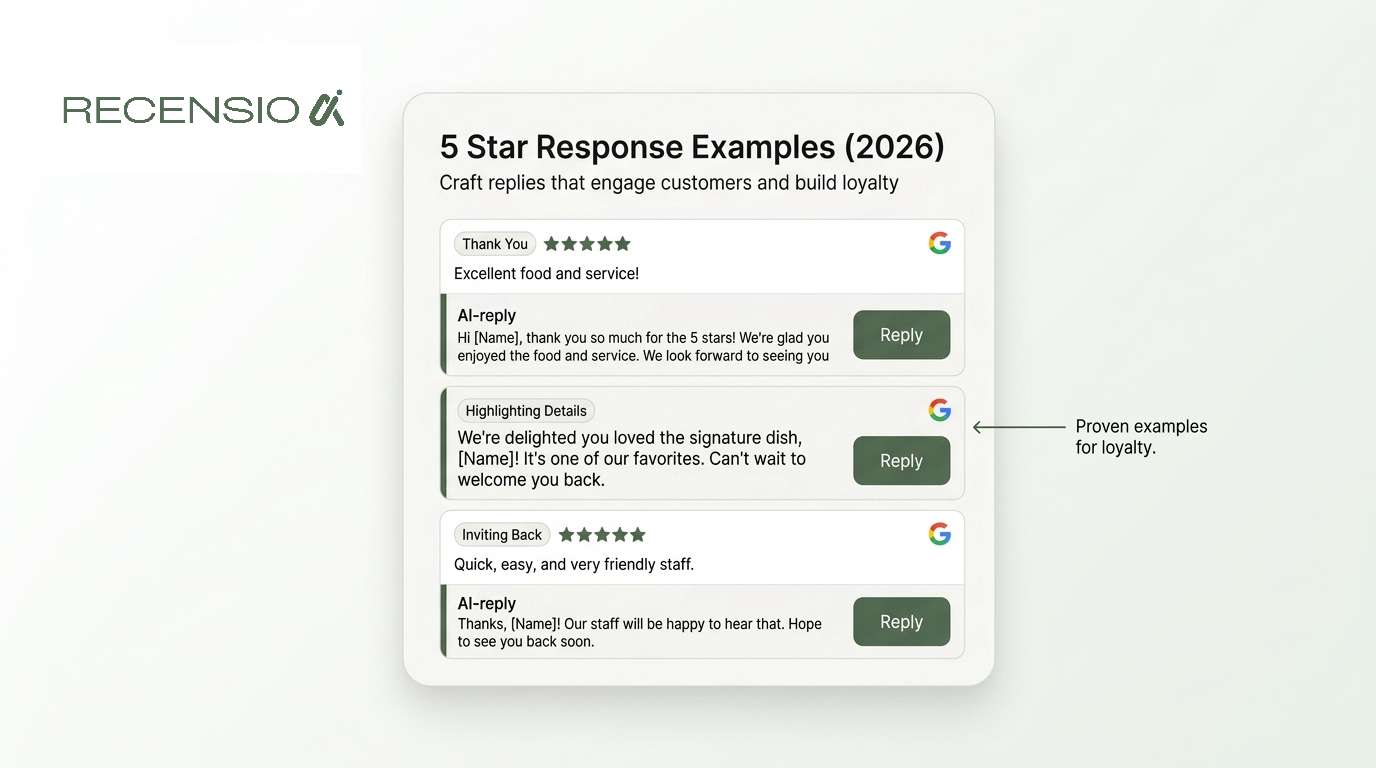
Table of Contents
- 1Introduction
- 21. The Thank You and Specific Detail Response
- 3Specific does not mean revealing
- 42. The Problem-Solving Response to Negative Reviews
- 5What other customers need to see
- 63. The Invitation to Share Experience Response
- 7Invite, don't pressure
- 84. The Educational Response to Uninformed Criticism
- 9Explain the record, not the customer
- 105. The Follow-Up and Measurement Response
- 11Ask one useful question
- 125-Star Review Response Comparison
- 13Make Every Reply Earn Its Place
Introduction
A five-star review arrives while you're seating guests, managing a busy salon, checking a hotel room, or driving between job sites. You read it, feel grateful, then tell yourself you'll reply later. Later often becomes next week.
A thoughtful reply doesn't need to be long. It needs to show that you read what the customer wrote, appreciate the effort, and understand what future customers will notice when they compare businesses on Google Maps. BrightLocal's 2024 Local Consumer Review Survey found that 93% of consumers expect businesses to respond to reviews, while 88% would use a business that responds to both positive and negative reviews, compared with 47% who would use one that doesn't respond at all. Those figures come from a U.S. consumer sample, but the practical lesson applies widely: visible responsiveness builds reassurance.
This guide gives you five star review response examples organized by the job each reply needs to do. You'll find ready-to-adapt templates for restaurants, salons, clinics, hotels, contractors, and multi-location businesses, plus the wording that can make a reply feel copied, promotional, or unsafe. For more ideas on turning positive feedback into customer trust, see these 5 star review examples to boost sales.
1. The Thank You and Specific Detail Response
The safest everyday reply starts with appreciation and one detail the customer mentioned. That detail might be a dish, a stylist, a check-in experience, a repair, or a particular member of your team.
A generic “Thanks for the five stars” acknowledges the rating but tells future readers very little. A specific reply shows that someone at the business read the review. Google's official guidance recommends thanking the customer, referring to a specific detail, keeping the tone conversational rather than promotional, and signing with your name or initials. It also says to protect the reviewer's privacy.
Use this structure:
Thank the customer, repeat one public detail, then invite them back naturally.
Restaurant: “Sarah, thanks for coming in Tuesday night and for the kind words about our house-made pasta. Marco takes pride in that dish, and we're glad it landed right.”
Salon: “Michelle, we loved having you in. We're glad you're happy with how the color turned out, and we'll share your kind words with Jessica.”
Hotel: “Thank you for staying with us, David. We're glad the check-in process made your arrival easy, and we'll make sure our front desk team sees your feedback.”
Clinic: “Thank you for sharing your experience. We're pleased that the team made your appointment feel comfortable.”
Contractor: “Thanks for the thoughtful review. We're glad the new door is working well and appreciate you recognizing the care our installation team took.”
Specific does not mean revealing
Don't repeat sensitive details just to make a reply sound personal. A clinic shouldn't confirm that someone was a patient or restate a medical condition. A hotel shouldn't publish a room number. A salon should be careful with details involving a child, a health issue, or a private consultation.
Echo public, non-sensitive details from the review. If the customer mentions a result, thank them for sharing that result without confirming private circumstances. For account-specific issues, move the conversation to a private channel.
A practical review process helps someone read the full review before replying, identify a safe detail, and use the customer's actual name when the reviewer has provided it. Keep a review reply examples library for structure, but don't let a library replace judgment.
Practical rule: If the detail wasn't in the public review, don't add it just to sound personal.
For a multi-location business, assign each profile to a named owner or manager. Keep the location, team, and service details accurate. One central template can provide the structure, but each reply should still reflect the review in front of you.
2. The Problem-Solving Response to Negative Reviews
A strong reputation process includes replies to criticism, not only praise. When a customer describes a food-quality issue, poor installation, missed appointment, or unsatisfactory color service, the public reply is also read by people deciding whether to contact you.
The response shouldn't try to win an argument or pressure the reviewer to change the rating. It should show that you understand what happened, accept responsibility where appropriate, and have taken a practical next step.
Restaurant: “You're right that the burger wasn't cooked to temperature. That's on us. I've reviewed the ticket procedure with the kitchen, and I'd like to make this right. Please call me directly at [number].”
Contractor: “The door frame wasn't square when we finished, and that's a quality issue we should have caught. I'm coming back Tuesday morning to reset it. I'll text you the evening before.”
Salon: “I understand the color isn't what you wanted. Let's get you in this week to correct it at no charge. Please text me at [number] with times that work, or call the salon directly.”
What other customers need to see
You don't need to publish every operational detail. You do need to state what you're doing differently. That could be reviewing kitchen ticket procedures, checking measurements before an installation is signed off, retraining a team member, or changing how appointments are confirmed.
The Harvard Business Review summary of research on review responses describes research by Davide Proserpio and Giorgos Zervas that associated business responses with better subsequent ratings, with particular relevance after negative feedback. The finding doesn't mean every complaint will disappear or that a reply guarantees a rating change. It supports a more useful view of replies: they're a visible part of how you handle service failures.
Avoid explanations about weather, suppliers, staffing, or difficult customers unless the context helps and you can state it without sounding defensive. Don't blame the reviewer. Don't promise a refund, repair, or callback unless you've assigned someone to complete it.
A calm reply followed by reliable action does more for trust than a polished paragraph followed by silence.
If you're angry, don't publish immediately. Have another manager read the draft. Never include private customer information, payment details, medical information, or personal attacks. If the review violates Google policy, use Google's reporting process instead of arguing in public. Google says only reviews that violate its policies are eligible for removal, and businesses must not offer incentives for changing or removing reviews.
Invite, don't pressure
A referral invitation works best when it connects to something the reviewer praised. If they mentioned a family meal, refer to returning with family. If they praised a haircut, invite them back for their next appointment. If they mentioned a quiet hotel location, refer to future visits or guests visiting the area.
Avoid inserting a discount, free item, or unrelated offer into the public response. Google prohibits offering free or discounted goods or services in exchange for posting, changing, or removing reviews. Promotional language can also weaken the sincerity of the reply, even when the original review is genuine.
You can use this guide to asking customers for a review without sounding awkward when you build a broader feedback process, but keep review requests separate from the reply itself. A reply thanks someone for feedback already given. It shouldn't turn that public conversation into an advertisement.
For multi-location teams, let local managers adapt the invitation to the actual location. A reply to a hotel guest can mention the area. A reply to a restaurant guest can mention the dining occasion. A franchise-wide phrase repeated under every review will feel less credible than a short local sentence.
4. The Educational Response to Uninformed Criticism
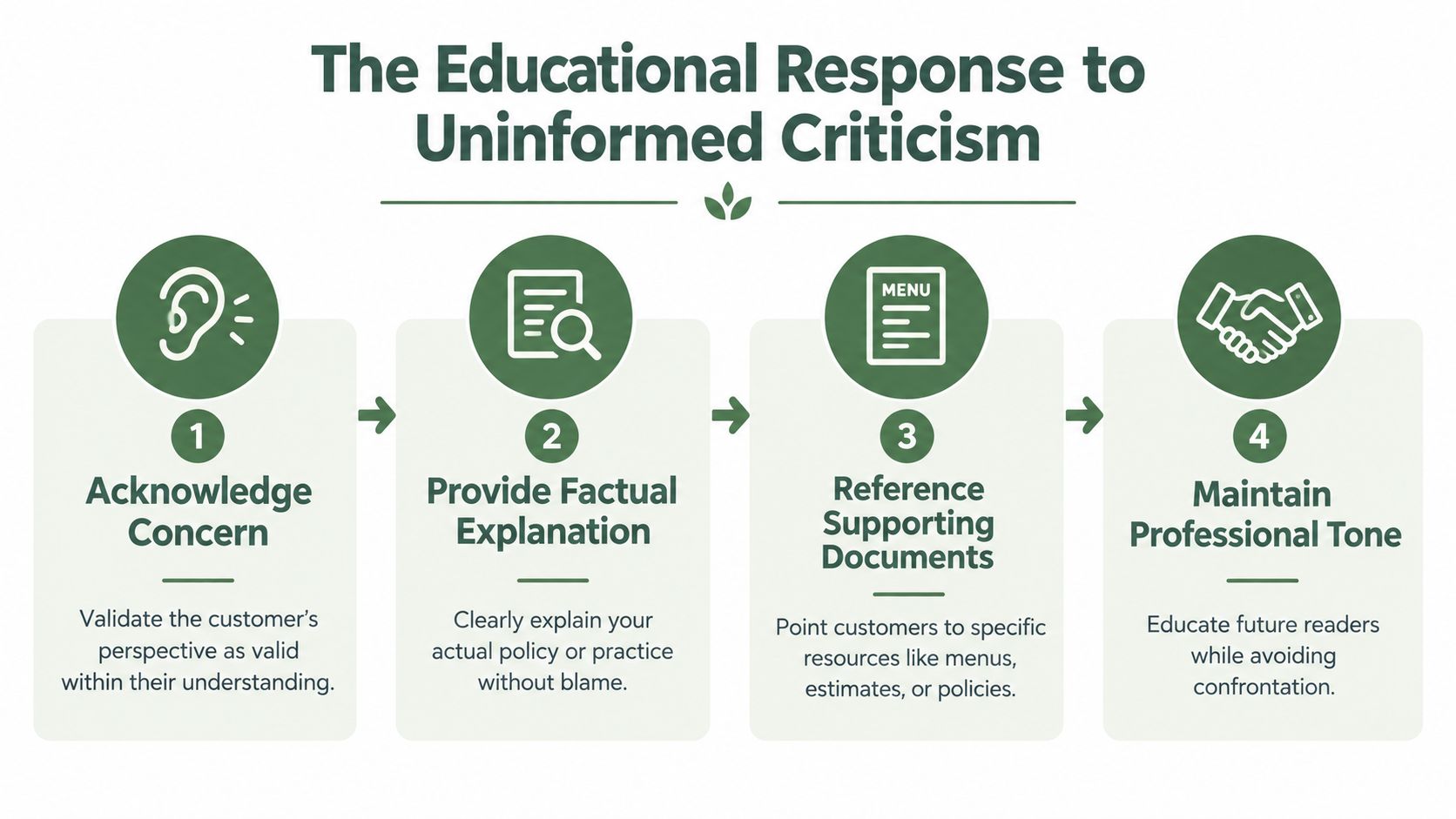
Not every complaint comes from poor service. Sometimes a customer misunderstood a menu charge, an estimate, an insurance arrangement, or a service policy. Your reply can provide context for future customers without making the reviewer feel foolish.
The key is to explain the business position in plain language, then offer a useful next step. Don't write “you should have known,” “it's in the fine print,” or anything that suggests the customer was careless.
Restaurant: “We appreciate your feedback. Custom modifications beyond our menu format require an upcharge because of the additional kitchen preparation. We list that information on the menu and our website, and we'd be happy to discuss alternatives on a future visit.”
Contractor: “When we opened the wall, we found the framing issue noted as a possibility in the estimate. The additional work was needed to meet code. We emailed photos and an itemized breakdown, and we're happy to review them with you.”
Clinic: “We understand the frustration about the out-of-pocket cost. Your plan has a high deductible, and we provided the estimate before treatment. Our billing team can discuss the available payment options with you.”
Explain the record, not the customer
Refer to the menu, estimate, policy, or cost estimate that supports your explanation. Keep the language factual. If your own documentation is unclear, improve the document or process instead of relying on a public reply to defend it.
A hotel might explain that a listed rate excludes a particular service charge, provided that information was displayed before booking. A contractor might clarify what the original scope included and what was discovered after work began. A salon might explain the difference between a consultation and a treatment, if that distinction appears clearly in the booking information.
Keep the public answer short. Long explanations often look defensive, especially when the reader can't verify every detail. If the matter involves an invoice, insurance record, contract, or personal account, invite the customer to continue privately.
Give future customers enough context to make an informed choice, but don't turn the review section into a courtroom.
This type of reply is especially important for multi-location businesses. Pricing and policy explanations need to be accurate for the specific branch, state, service, and date involved. A central template can create problems if local managers publish it without checking the underlying document.
5. The Follow-Up and Measurement Response
A positive review can tell you more than whether the customer was satisfied. It can reveal what customers value, what brought them in, and which parts of the experience deserve more attention. A follow-up reply thanks the reviewer and asks one focused question.
Restaurant: “Thank you for the wonderful feedback about our service. You mentioned that the pacing felt right. Is there anything else we could improve about the experience?”
Salon: “We're so glad Jessica gave you the result you wanted. What specifically made the difference for you? Understanding what worked best helps us train the team.”
Hotel: “We loved hosting you. You mentioned that the quiet location was perfect. If a friend asked about your stay, what other detail would you highlight?”
Contractor: “Thank you for recognizing the installation team. Which part of the project made the biggest difference for you?”
Ask one useful question
One question feels like a conversation. Several questions feel like a survey. Use an open question that lets the customer identify what matters instead of offering a list of answers.
If the customer responds publicly, thank them again and tell them you'll share the point with the team. If you follow up by phone or email, listen without arguing. The value comes from learning, not from persuading the customer that your process was already correct.
A multi-location operator can tag recurring themes by branch, service, team, or customer need. One comment is an anecdote. A pattern across reviews can guide training, staffing, menu decisions, appointment flow, room preparation, or project communication.
The guide to measuring online reputation and choosing useful KPIs can help you define a practical review process. Track response coverage for positive reviews separately from response coverage for negative reviews, then compare those measures with rating trends and business outcomes over time. A large-scale study of more than 150,000 online reviews and managerial responses associated responses to positive reviews with higher subsequent ratings and revenue, while also showing why negative-review response activity needs careful interpretation. The study is available through Springer.
Review the themes with your team during a regular operations meeting. Don't turn every compliment into a new initiative. Use repeated feedback to decide what deserves action, then tell staff which customer observations informed the change.
5-Star Review Response Comparison
| Response Type | Implementation complexity 🔄 | Resource & speed ⚡ | Expected outcome ⭐📊 | Ideal use cases | Key advantages 💡 |
|---|---|---|---|---|---|
| The Thank You and Specific Detail Response | 🔄 Medium, requires reading each review | ⚡ Medium, ~30s longer than generic | ⭐⭐⭐⭐ / 📊 Increases credibility and repeat visits | Positive reviews across restaurants, salons, clinics | Personalizes replies, shows engagement, differentiates from templates |
| The Problem-Solving Response to Negative Reviews | 🔄 High, careful wording and follow-through needed | ⚡ Low, may require callbacks, fixes, and time | ⭐⭐⭐⭐ / 📊 High impact on trust and profile management | 1–2 star service failures (food quality, installations, treatments) | Demonstrates accountability, can recover customers and signal reliability |
| The Invitation to Share Experience Response | 🔄 Low, simple thank-you + invite | ⚡ High, quick, minimal resources | ⭐⭐⭐ / 📊 Moderate impact on referrals and CLV | Positive experiences where word-of-mouth matters (restaurants, hotels, salons) | Encourages organic referrals at no cost; boosts repeat visits |
| The Educational Response to Uninformed Criticism | 🔄 Medium-High, factual and non‑confrontational explanation | ⚡ Medium, needs accurate policy references | ⭐⭐⭐ / 📊 Moderately reduces future misunderstandings | Policy/pricing misunderstandings (menus, estimates, insurance) | Clarifies policies publicly, increases transparency and informed customers |
| The Follow-Up and Measurement Response | 🔄 Medium, craft one targeted question per reply | ⚡ Medium, takes extra effort to read and aggregate responses | ⭐⭐⭐⭐ / 📊 High for actionable insights and trend detection | Multi-location operators; businesses seeking operational feedback | Converts reviews into business intelligence and training inputs |
The Thank You and Specific Detail Response
The Problem-Solving Response to Negative Reviews
The Invitation to Share Experience Response
The Educational Response to Uninformed Criticism
The Follow-Up and Measurement Response
Make Every Reply Earn Its Place
You don't need a complicated writing system. You need a small set of reply types and a clear owner.
Use the specific-detail response for straightforward praise. It works when a customer mentions a dish, stylist, technician, room, employee, or result. Use the invitation response when a return visit or personal recommendation fits the experience. Keep it gentle and customer-focused.
Use the follow-up response when you want to learn more. Ask one open question, record useful themes, and share relevant feedback with the team. Use the problem-solving response when the review describes a genuine service failure. Acknowledge the issue, state the action you're taking, and provide a direct contact method.
Use the educational response when the customer misunderstood a price, policy, scope, or coverage issue. Refer to accurate documents and explain the context without blaming the reviewer. If your policy or documentation is unclear, fix that operational problem instead of trying to write around it.
Google identifies relevance, distance, and prominence as the main local ranking factors. It says prominence can include the number of reviews and positive ratings, but its documentation doesn't confirm that replying to reviews, review wording, or posting activity directly improves ranking. A thoughtful reply can still help people evaluating your business in map results by demonstrating attentiveness and providing useful public context. Don't promise that a response will move your listing into the local pack.
Make privacy part of the process. Use only facts the customer has made public, don't confirm sensitive circumstances, and move account-specific conversations away from the review thread. Make sure each manager has access to the verified Google Business Profile for the location they serve, because Google requires verification before a business can reply.
This week, choose one recent five-star review, select the template that matches its purpose, and adapt the first sentence using only details in the review. Publish the reply, assign review ownership to a specific person, and add one recurring theme to your next team discussion. If you manage several locations, RecensioAI can help organize review requests, replies, theme analysis, and location-level reporting without replacing your judgment about privacy or tone. You can also use this customer support rep playbook to give the person handling responses a consistent operating framework.
---
RecensioAI B.V. helps local businesses manage review requests and replies across locations, with tools for public Google reviews, private customer feedback, response workflows, recurring-theme analysis, and reporting. If you want a more consistent way to put these five star review response examples into practice, visit RecensioAI B.V..
Frequently asked questions
You might also like
Handpicked articles for you
Why the Business Around the Corner Beats You on Google: What 21,373 Profiles Reveal
We compared 21,373 Google Business Profiles with their three strongest nearby competitors. The gap is smaller than most owners think, but it has two sides: rating and volume.
Treatwell Review Management for Salons: One Reputation View Alongside Google
Bring your public Treatwell rating and recent reviews into RecensioAI, then combine salon signals with Google for faster, better decisions.
Review Sentiment Analysis: Turn Scattered Feedback Into Clear Priorities
Combine reviews from Google, Treatwell and other platforms, detect recurring patterns, and see where your team and service can genuinely improve.