Review Reply Examples: 8 Templates for Any Business
Need review reply examples? Get 8 templates for positive, negative & neutral reviews. Respond professionally and build trust with customers in 2026.
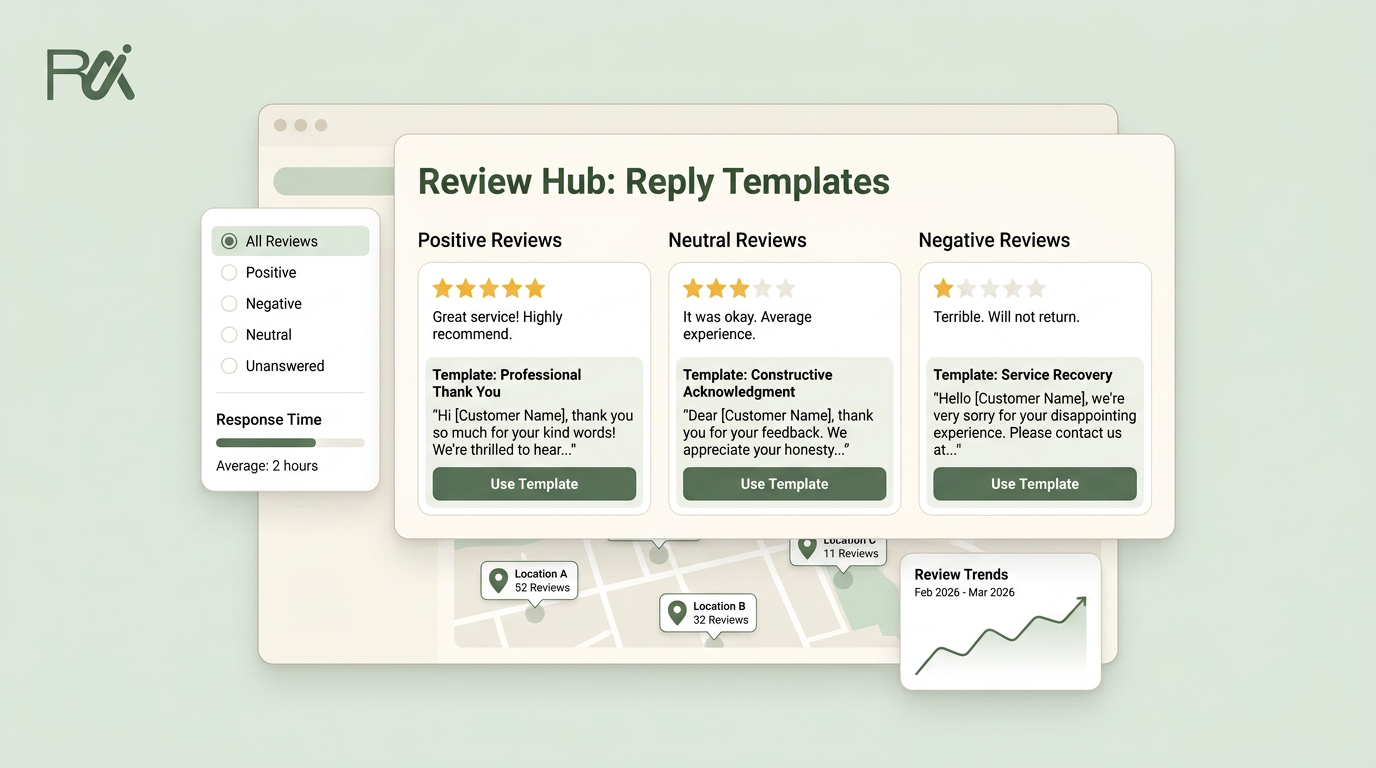
Table of Contents
- 1Introduction
- 21. The Thank You and Action Reply
- 3Keep it specific and short
- 42. The Apology and Fix Reply
- 5Apology first, fix second
- 63. The Negative Review Redirect Reply
- 7Give one real person to contact
- 84. The Clarification Reply
- 9Explain the rule, not the argument
- 105. The Multi-Location or Franchise Override Reply
- 11Protect the brand without attacking the site
- 126. The Limited Scope Acknowledgment Reply
- 13Set expectations without sounding dismissive
- 147. The Rare Issue or Anomaly Reply
- 158. The Invitation Back Reply
- 16Make the return easy
- 17Comparison of 8 Review Reply Types
- 18Your Next Step Make Replies Consistent
Introduction
You get the notification while you're in the middle of service, a site walk, or a stack of invoices. A new review is up on your Google Business Profile, and now every future customer can read your reply right next to the comment. That's why review reply examples matter. A good reply shows you're paying attention. A bad one makes the original review look worse.
Owners already know the rough math here. Google review readers also read business responses, and most consumers say businesses never responded to their review, which means a decent reply stands out fast in the local pack and on Maps. If you run a restaurant, salon, clinic, hotel, or contracting business, you need words you can use without overthinking it. The good news is you don't need a library of clever lines. You need a few repeatable patterns that fit common situations.
How social customer service habits translate to review replies
1. The Thank You and Action Reply
Positive reviews are the easiest place to build trust, but most businesses waste them with a flat “Thanks for the review.” That reply technically counts, but it doesn't tell the next person anything useful. A better response confirms you read the detail, names the part you'll keep doing, and closes the loop in a way staff can repeat.
For a restaurant, a good reply might be, “Thanks for mentioning our salmon special. Your feedback tells us to keep that on rotation, and we will.” For a salon, try, “We're glad Marcus made you feel welcome. We'll make sure he's booked for your next visit.” For a clinic, “Hearing that our check-in process felt smooth helps us know what's working. Thank you for taking the time to say so.” These work because they sound like a real operator wrote them, not a template dump.
Keep it specific and short
The 2026 guidance on reply structure is simple, acknowledge the reviewer, mention one concrete detail, and invite them back, usually in 2 to 4 sentences GetPin's 2026 review reply template guide. That shape fits busy businesses because it's fast to write and easy to standardize across locations.
Practical rule: if you can't point to one detail from the review, you're probably writing too generically.
Use we and our, not third person. Name a staff member when the review names one. Keep it honest. If the customer praised the front desk, don't suddenly thank them for “choosing us for all your needs.” That sounds canned and makes the whole reply weaker. For a local business, a short reply that feels human beats a polished paragraph that reads like marketing copy.
2. The Apology and Fix Reply
A negative review is where owners tend to talk too much. You want to explain the staffing shortage, the supplier delay, or the one night when three things broke at once. Leave that for the internal review. Start with ownership, then say what changed.
A restaurant reply could read, “You're right, our timing was slow that night. We've retrained our server team on table checks. Come back and let's show you the difference.” A contractor might say, “We missed the deadline you mentioned. We've restructured scheduling so this doesn't happen again.” A hotel can keep it simple, “The room wasn't cleaned to our standard. We've added a second quality check before guests arrive.” These replies work because they show management is doing something real, not just expressing regret. A good reference point is the hostAI negative review playbook, since it follows the same pattern of ownership, fix, and a clear next step.
Apology first, fix second
The common mistake is saying, “We're sorry you felt that way.” That softens the problem without owning it. A real apology names the failure. Then you add the fix. That order matters because future customers are reading for accountability, not theater.
The public reply should stay tight. The more you explain, the more it starts to sound like a defense. If the issue is still active, end with a clear path back, like “We'd like to make this right.” That keeps the door open without turning the review page into a back-and-forth.
An image can help staff visualize the kind of accountability customers expect.

3. The Negative Review Redirect Reply
Some complaints are too detailed, too emotional, or too tangled to work through on the public page. That is the point where you acknowledge the issue and move the conversation offline. It keeps your Google Business Profile from becoming a complaint thread, while still showing prospects that you take problems seriously.
A clinic can say, “Your experience wasn't what we aim for. Our manager wants to understand what happened. Please call us at [number] so we can dig into this properly.” A multi-location franchise might say, “This isn't how our team should have treated you. Reach out to our location manager at [email] and we'll make this right.” A salon could write, “The color didn't turn out the way we discussed. Text or call us at [number] so we can talk through what went wrong and fix it.” A restaurant can use the same approach when the review turns into a long back-and-forth about seating, timing, or service details, because the public reply should stay calm and short.
Use this style when the reply needs to protect the business and keep the door open. If you need a practical framework for that handoff, the hostAI negative review playbook follows the same pattern of ownership, next step, and a clear off-ramp. ReplyChampion's guidance is blunt on this point, don't debate numbers, dates, or who said what in public, and move the discussion to phone or email if you need more back-and-forth ReplyChampion's review response guide. That posture fits local businesses, because public arguments rarely help the next customer trust you.
Give one real person to contact
Use a name, a direct number, or a specific email. Don't make the customer hunt. Don't ask them to prove what happened. And don't invent details to fill in the gaps. If you know a manager should handle it, name that manager. If you can promise a callback, say when. “We'll call you within 24 hours” is useful. “Reach out anytime” is not.
A referral to the right person also keeps the reply from sounding generic. That matters for restaurants, salons, and contractors, where the issue often depends on who was on shift, who handled the booking, or who oversaw the job. If your team manages Google responses in batches, make sure the contact details are current in the Google Business Profile check before you post anything. A stale email or dead phone number turns a useful redirect into a dead end.
4. The Clarification Reply
Not every bad review is a service failure. Sometimes the customer missed a policy, overlooked a booking note, or didn't realize a price included specific work. You can clarify that, but only if you do it with restraint. If you sound defensive, the reader will side with the reviewer.
A restaurant might say, “We appreciate the feedback on our pricing. Our menu reflects local sourcing, which we detail in the description guests see when ordering. Happy to explain our sourcing on your next visit.” A contractor can write, “Your estimate included the prep work and permits. We detail this in the contract so clients know what's included. We're always happy to review the scope of work.” A hotel might say, “Our cancellation policy is visible at booking. We know it's strict, and that's intentional so we can hold rates low for guests who commit.”
Explain the rule, not the argument
The weak version starts with “We...” or “You misunderstood.” That turns a clarification into a correction, and correction sounds condescending. The stronger version names what the customer may not have seen, then explains how your business handles it.
Keep the tone like you're helping a future guest understand the setup, not proving the reviewer wrong.
This style is useful for restaurant menus, service scopes, booking policies, and contractor bids. It gives context without reopening the whole dispute. If you need to add more detail, end by saying you're happy to explain it further. Don't claim the final word on the page. The goal is to help the next customer read the review accurately, not to win the comment thread.
5. The Multi-Location or Franchise Override Reply
When you run more than one location, one bad review can spill over into assumptions about all your sites. That's why your reply needs to separate the location-specific problem from the brand standard. You're not saying the reviewer is wrong. You're saying the issue at one site doesn't define the whole system.
A hotel chain might say, “This falls short of our standard. Our team at [different location] operates to the same checklist. We'd like to make this right at the original location and show you that consistency elsewhere too.” A franchise salon can write, “This isn't the experience other clients get at our [other location]. We're retraining the team here and would appreciate a second chance.” A multi-location clinic might say, “Our wait time standard is 15 minutes. This location didn't meet it. Come see how we run our [other nearby location].”
Protect the brand without attacking the site
Use this only when you have stronger locations or a company-wide standard that one site missed. Don't imply the original location is garbage. Say it fell short. That difference matters. Customers can smell corporate blame-shifting fast.
For teams managing many Google Business Profiles, it also helps to audit the profile itself. A broken category, outdated hours, or missing services makes the reply work harder than it should. RecensioAI's Google Business Profile check is relevant here because a clean profile supports the message your reply is sending.
If you can offer a concrete alternative location, do it. If not, keep the focus on the local manager and the fix. The reply should reassure the reader that the issue is being handled at the site level, not brushed off as a one-off you don't care about.
6. The Limited Scope Acknowledgment Reply
Some complaints are about things you don't fully control. Weather, neighborhood parking, supplier swings, permit delays, downtown noise. If those are part of the business model, the reply should name the limitation clearly and offer the option you can control.
A restaurant can say, “We source locally, which means our menu changes with the season. Summer tomatoes are different than winter ones. That's what makes seasonal sourcing special, even when it surprises us.” A contractor might write, “Permit delays are outside our timeline, but they're required by code. We keep clients updated weekly on where things stand with the city.” A hotel can say, “Street noise is part of staying downtown. Our quieter rooms face the courtyard if that matters for your next visit. We always mention this at booking.”
Set expectations without sounding dismissive
Don't bury the limitation. Name it up front. That helps the next customer understand what kind of business you run. If you apologize for every built-in constraint, you make the business sound unstable when it's really just operating in a normal environment.
The strongest version acknowledges the boundary and still gives the customer a choice. For example, if you're a restaurant that changes menus with the season, offer a dish you know you can stand behind. If you're a contractor dealing with city permits, keep clients updated and explain the process early. If you're a hotel in a noisy area, point people to the room type that fits them better. That's practical, and it reads like you know your own operation.
7. The Rare Issue or Anomaly Reply
Every business gets the review that feels out of step with the rest of the feedback. Maybe the salon had a rushed appointment because a stylist ran behind. Maybe the restaurant had one slow night because the kitchen got slammed. Maybe the clinic's check-in system went down. Don't use the reply to say the reviewer is lying. Use it to show that the issue was real, unusual, and fixed.
A salon might write, “That level of service doesn't match what most guests experience here. We spoke with the stylist and made changes to prevent a rush situation like this from happening again.” A restaurant can say, “Our kitchen typically delivers food in 15 to 20 minutes. That delay that night was unusual and we've adjusted our table management to avoid overbooking.” A clinic might say, “Our check-in usually runs under 5 minutes. We experienced a system outage that day. We've since installed a backup system to prevent this.”
Practical rule: if you can name the unusual cause and the change you made, the reply feels credible.
Expert guidance from academic reviewer responses is useful too. Point-by-point replies and exact revision references are standard because they make it easy to verify what changed NIH guidance on writing a response to reviewers. The same mindset helps here. You don't need to argue with the reviewer. You need to show the event was handled and corrected.
Use the review as a pattern check, not as proof that the customer is wrong. If you already have strong reviews, say that carefully in your own head, not in a way that sounds like you're dismissing the complaint. The customer still had a bad experience. Your reply should acknowledge that and show control.
8. The Invitation Back Reply
Some low or mixed reviews are not the end of the story. The customer might have been disappointed once, but your process is better now. That's when a straight invitation back can work. It tells prospects you stand behind the business and gives the reviewer a simple path to reconsider.
A restaurant can say, “We heard you on the pace of service. Our kitchen has restructured how we time orders. Come back and let us know if things are different.” A contractor might write, “We want to show you the quality our regular clients know. Let's schedule a conversation about your next project.” A hotel can say, “We've trained new front desk staff since you stayed with us. We'd like another chance to show you how smooth check-in should be.”
Make the return easy
If the customer has to hunt for the next step, the invitation loses force. Give a phone number, a booking link, or a named contact. Keep the tone open, not pushy. You're inviting them back, not demanding a second chance.
The best invitation-back replies are tied to an actual change. If the kitchen changed its timing, say that. If the front desk trained new staff, say that. If the service team updated how estimates are reviewed, say that. The customer doesn't need a speech. They need a reason to believe the next visit could go better.
An elegant setup also helps when you're trying to reset a first impression.

Comparison of 8 Review Reply Types
| Reply Type | Implementation Complexity 🔄 | Resource Requirements ⚡ | Expected Outcomes 📊 | Ideal Use Cases 💡 | Key Advantages ⭐ |
|---|---|---|---|---|---|
| The Thank You and Action Reply | Low 🔄 (simple, templated) | Minimal ⚡ (30 sec, no cost) | Builds trust; signals engagement ⭐⭐📊 | Positive reviews praising staff, service, or dishes | Cost-effective; shows you listen and manage profile actively ⭐ |
| The Apology and Fix Reply | Medium 🔄 (specific, sincere wording) | Moderate ⚡ (time + operational changes) | High impact; can recover customers and reputation ⭐⭐⭐📊 | Clear business faults or service failures needing fixes | Demonstrates accountability and transparency; can regain business ⭐ |
| The Negative Review Redirect Reply | Medium 🔄 (validate + move offline) | Moderate ⚡ (follow-up, dedicated contact) | High, limits public escalation and enables resolution ⭐⭐⭐📊 | Complex, emotional, or information‑heavy complaints | Prevents public arguments; provides private remediation path ⭐ |
| The Clarification Reply | Low–Medium 🔄 (restrained, explanatory) | Low ⚡ (brief contextual info) | Moderate, educates prospects; rarely convinces reviewer ⭐⭐📊 | Misunderstandings about policy, pricing, or scope | Sets expectations and explains policies without blaming ⭐ |
| Multi‑Location / Franchise Override Reply | Medium 🔄 (balance corporate vs local) | Low–Moderate ⚡ (coordination across locations) | Moderate‑High, protects brand reputation system‑wide ⭐⭐📊 | Franchise or multi‑location complaints where one site underperforms | Shields brand from single‑location issues; affirms standards ⭐ |
| Limited Scope Acknowledgment Reply | Low 🔄 (state limits, offer alternatives) | Low ⚡ (concise, factual) | Moderate, clarifies boundaries and educates prospects ⭐⭐📊 | Complaints outside your control (suppliers, weather, parking) | Professionally sets expectations while offering feasible alternatives ⭐ |
| Rare Issue or Anomaly Reply | Low–Medium 🔄 (explain anomaly + fix) | Low ⚡ (describe fix, reassure) | Moderate, contextualizes one‑offs and preserves credibility ⭐⭐📊 | Isolated bad experiences that contradict broader reviews | Provides context and shows corrective action without dismissing reviewer ⭐ |
| Invitation Back Reply | Low–Medium 🔄 (acknowledge + invite) | Moderate ⚡ (follow‑through; possible incentive) | High, offers second chance; can convert reviewer and prompt edits ⭐⭐⭐📊 | Mixed or low reviews where improvements have been made | Encourages return, demonstrates confidence, can improve ratings ⭐ |
The Thank You and Action Reply
The Apology and Fix Reply
The Negative Review Redirect Reply
The Clarification Reply
Multi‑Location / Franchise Override Reply
Limited Scope Acknowledgment Reply
Rare Issue or Anomaly Reply
Invitation Back Reply
Your Next Step Make Replies Consistent
Replying to reviews doesn't have to be a daily headache. Pick one or two templates that fit most of your situations and keep them close. The point isn't to sound clever every time. It's to sound steady, clear, and human when customers are reading you on Google before they decide whether to call, click, or walk in.
For local businesses, consistency matters because your reply is part of the public face of the Google Business Profile. It tells people how you handle praise, problems, and everything in between. It also helps your team move faster. If the front desk, manager, or owner has a few approved patterns to use, the response gets written sooner and it sounds like one business instead of five different people.
That said, don't treat replies like a copy machine. A template is a starting point. You still need to swap in the detail from the review, use the customer's name when you have it, and keep the tone in line with your brand. A restaurant can sound warm and quick. A clinic can sound calm and precise. A contractor can sound direct and professional. The structure stays similar. The words should still fit the job.
If you get a lot of reviews across one or more locations, automation can help keep the page active without making the replies feel empty. RecensioAI B.V. is one option built for that kind of workflow, with review replies and profile management designed for local businesses that don't have time to write every response from scratch.
---
If you want a faster way to keep replies consistent, visit RecensioAI B.V. and see how it handles review responses for local businesses. It's built for owners who need practical review reply examples turned into a repeatable process, not another task that sits on the back burner.
You might also like
Handpicked articles for you
Hotel Review Management: Automate Post-Stay Requests with Apaleo, Mews and Your PMS
A practical guide to turning hotel checkouts into timely review requests, with Apaleo live, Mews early access and flexible PMS alternatives.
Why the Business Around the Corner Beats You on Google: What 21,373 Profiles Reveal
We compared 21,373 Google Business Profiles with their three strongest nearby competitors. The gap is smaller than most owners think, but it has two sides: rating and volume.
Treatwell Review Management for Salons: One Reputation View Alongside Google
Bring your public Treatwell rating and recent reviews into RecensioAI, then combine salon signals with Google for faster, better decisions.