10 Local Search Ranking Software Tools for 2026
Compare 10 local search ranking software tools for Google Business Profile audits, citations, reviews, tracking, and multi-location work.
Table of Contents
- 1Introduction
- 21. RecensioAI B.V.
- 3Where RecensioAI fits
- 42. BrightLocal
- 5What you'll manage
- 63. Whitespark
- 7Choose it for diagnosis
- 84. Semrush Local
- 9Watch the scan credits
- 105. Yext
- 11Best for governance
- 126. Uberall
- 13Useful for distributed teams
- 147. SOCi
- 15Corporate control with local action
- 168. Birdeye
- 17Check the scope before signing
- 189. Synup
- 19Useful if you manage many accounts
- 2010. Local Falcon
- 21Use it to prioritize the next job
- 22Top 10 Local Search Ranking Tools, Feature Comparison
- 23Choose the Stack You Will Use Every Week
Introduction
A salon owner searches “salon near me” from the parking lot and sees three competitors in the local pack. A clinic manager checks Google Maps and finds another practice above hers, even though her team has better availability. A contractor notices that an old phone number still appears on a directory listing. These are practical problems, but they don't all need the same tool.
Google's local-ranking system uses relevance, distance, and prominence. Relevance measures how closely a Google Business Profile matches the search. Distance depends on the searcher's location. Prominence reflects how well-known the business is, including signals such as links and reviews, according to Google's local ranking documentation. Software can organize profile work, review activity, listing accuracy, and measurement. It can't move your building closer to a searcher, and it can't guarantee a ranking result.
This comparison covers 10 local search ranking software tools by the job they help you complete. You'll find tools for map rank tracking, Google Business Profile audits, citations, review workflows, multi-location control, and reporting. You'll also get stack recommendations for a single location, a growing business, and a franchise or enterprise team, followed by a first-week setup plan.
For background on the practical work behind local visibility, see why Silva Marketing clients rank locally.
1. RecensioAI B.V.
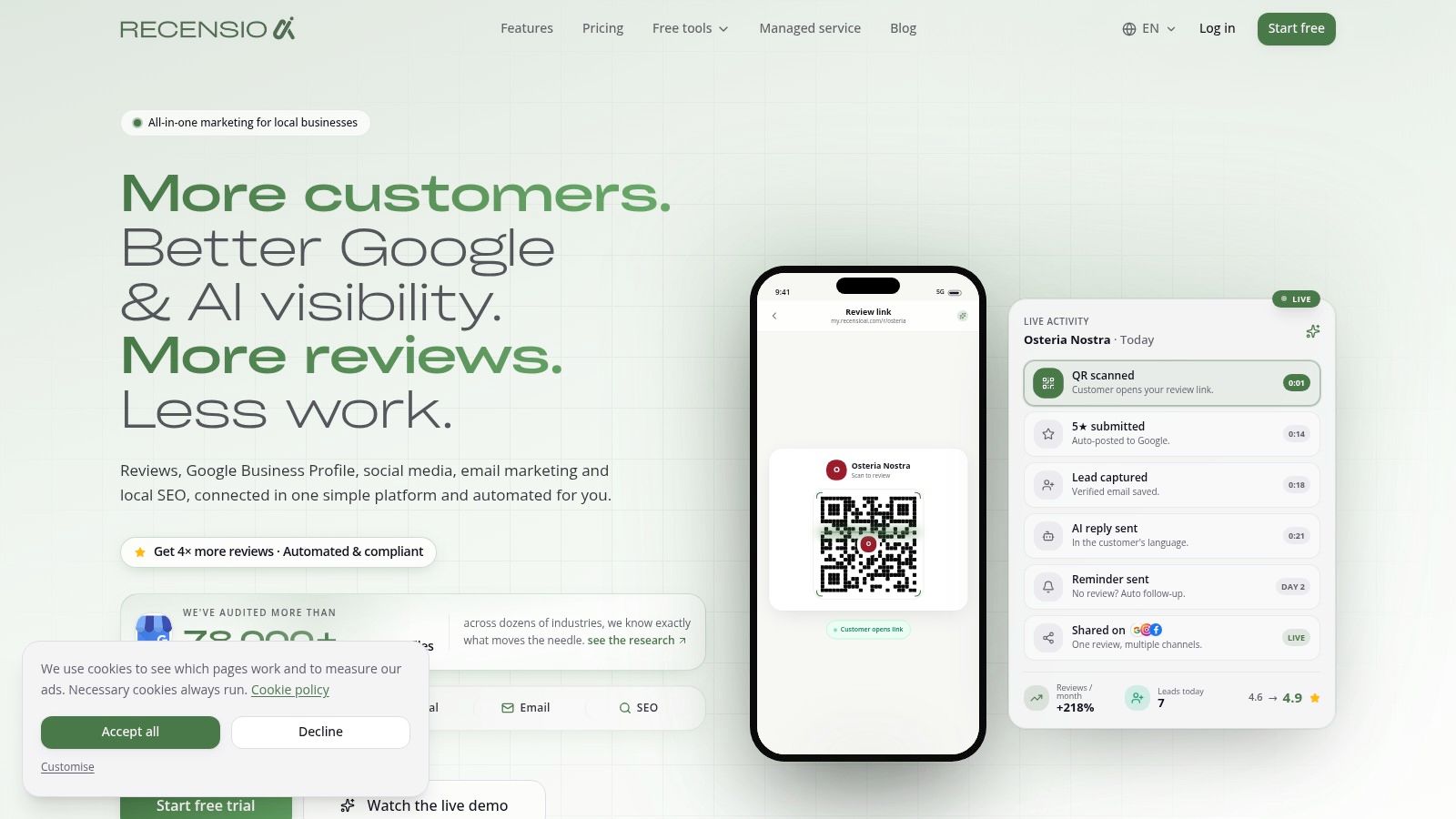
RecensioAI is the strongest fit when your main problem is keeping reviews, profile work, and local visibility organized without asking staff to remember every step. It combines review requests, review responses, profile audits, competitor tracking, and multi-location reporting in one system.
The platform sends review requests by email, SMS, QR code, or shareable link after a visit. The review page detects the customer's device language, which helps restaurants, hotels, clinics, salons, and retailers serving multilingual neighborhoods. Customers see a public Google review option and a private feedback option side by side. They choose which one to use. The process must not suppress unfavorable experiences or steer unhappy customers away from Google.
RecensioAI's review workflow also supports AI-generated replies in your brand voice, sentiment analysis, recurring-theme detection, and a workflow for suspected fake reviews. It can publish selected reviews to Google Business Posts, Facebook, and Instagram. Those functions support customer trust, engagement, and marketing. They aren't confirmed Google ranking factors.
Where RecensioAI fits
The profile audit checks details such as categories, hours, attributes, services, and photos. Profile Guard flags unwanted changes and may help restore them where possible. Competitor tracking shows which businesses appear above you for the same local searches, while the local ranking map helps you compare visibility across neighborhoods.
The platform supports more than one location, more than one review platform, POS and booking integrations, email and SMS marketing, and Wi-Fi lead capture. A managed tier adds website work, local SEO, content, backlink building, and senior support.
Pricing is relatively clear. The Pro plan starts at $77 per month for one location, includes 2,000 emails monthly, and has a 14-day trial with no card required. The Multi plan is $177 per month for three locations, with extra locations priced separately. Pro Managed starts at $249 per month. Prices are listed before VAT, and SMS uses pay-as-you-go top-ups. Plans are monthly with no lock-in, and the company says data export is available when you cancel.
The tradeoff is cost and execution. A very small business may find a recurring subscription unnecessary if the owner can manage a few tasks manually. Results also depend on consistent use, and no ranking or revenue lift is guaranteed.
2. BrightLocal
BrightLocal is the best broad local SEO suite for an owner or small team that wants audits, map tracking, citations, reviews, and reporting in one place. It's easier to start with than enterprise platforms, but it still has enough depth for agencies and growing location groups.
Its Local Search Grid shows visibility across a geographic area instead of giving you one citywide number. That matters because a hotel may rank near its entrance but disappear several blocks away. A contractor may appear strongly in one suburb and weakly in another. Traditional rank tracking, Google Business Profile audits, competitor comparisons, citation monitoring, review monitoring, review requests, auto-replies, and Google Business Profile post scheduling sit alongside the grid.
What you'll manage
BrightLocal works well when one person owns the weekly routine. You can check profile issues, compare competitors, review listing problems, and prepare a report without stitching together several systems. Its citation builder is available as an optional managed service, which helps if you don't want to correct directory listings yourself.
The platform also offers multi-location reporting and an API. That gives you a path from one restaurant or clinic to a larger group without changing tools immediately.
The main limitation is capacity. Keyword and geo-grid limits depend on the plan, so heavy scanning can push you toward a higher tier. Review and post features are useful, but you should still treat review replies and posting as trust and communication work, not as confirmed causes of higher Google rankings.
BrightLocal publishes plan information and offers a 14-day trial. Check the current plan limits before buying, especially if you need frequent scans across many neighborhoods.
3. Whitespark
Whitespark is the right choice when the main question is, “Where do I rank on the map, street by street?” It's a specialist toolkit rather than one large operating system. You can buy local ranking grids, traditional rank tracking, citation discovery, and citation services separately.
Its Local Ranking Grids show map positions across a defined area and let you compare competitors. The Local Rank Tracker covers Maps, local pack results, and organic results across search engines. The Local Citation Finder helps identify listings and citation opportunities, while done-for-you services handle citation building and cleanup.
Choose it for diagnosis
A plumbing company expanding into nearby towns can use a grid to see where visibility is strong, where it drops, and which competitor occupies the better position. A restaurant can compare several “restaurant near me” searches from different points around the neighborhood. This is more useful than checking one search from the owner's office and assuming the result represents the whole market.
Whitespark's strength is focus. You don't have to pay for a full review-management or listings suite if you only need map measurement and citation work. Its agency sharing and white-label options also suit businesses working with an outside provider.
The weakness is the same feature. Separate products mean separate subscriptions and more setup. You may need another system for review requests, response workflows, profile changes, or location-level operational reporting.
Before choosing any rank tracker, read this guide to local pack ranking factors. The important point is simple: a grid measures visibility. It doesn't explain every reason Google shows one business above another, and it doesn't promise that a specific change will produce a specific ranking.
4. Semrush Local
Semrush Local fits businesses that already use Semrush or want local tools connected to a wider SEO platform. It combines Google Business Profile management, listing synchronization, AI-assisted posts and review replies, and a Map Rank Tracker with credit-based scanning.
The wider Semrush ecosystem adds keyword research, website audits, and link analysis. That can help a growing contractor or clinic connect local profile work with its website. You'll manage more of the work from one account instead of switching between a rank tracker and a general SEO platform.
Watch the scan credits
Map tracking uses defined credit allotments. That makes the cost easier to understand, but it also means you need to plan scan frequency and geographic coverage. A single location with a small keyword set may be comfortable on a lower tier. A multi-location brand scanning several terms across many areas may need more credits or a higher plan.
Semrush Local also supports listing management and Google Business Profile posts. Use those features to keep information accurate and give customers current updates. Google's documentation confirms that Business Profile posts can be updates, offers, or events, and can be scheduled. Google doesn't identify posting frequency as a confirmed ranking factor, so don't buy this tool expecting posts alone to move your map position.
The advantage is integration. The drawback is complexity. If you only need a local map grid, Semrush may give you more software than you'll use. If you need local measurement alongside website and keyword work, its broader system makes more sense.
5. Yext
Yext is built for organizations with many locations, strict brand controls, and a real need to update business information across publishers from one central source. It uses a centralized Knowledge Graph and connects directly with more than 200 publishers, according to the product's positioning. That scale is useful for hotel groups, healthcare networks, retailers, and franchise systems.
You can manage information for Google, Apple, Yelp, Bing, and other publishers through bulk updates. Yext also identifies errors and duplicates, provides status and issue breakdowns, and supports review management, local pages, structured data, and analytics.
Best for governance
A headquarters team can control approved names, addresses, phone numbers, categories, hours, and services while giving local managers limited access. That matters when a brand needs consistency but each location still has local operating details.
Yext is not the practical first choice for one salon or one contractor. Pricing isn't listed publicly, so you'll need to contact sales and scope the package by location and features. The platform can also be more than a small business needs.
Choose Yext when duplicate listings, bulk changes, permissions, compliance, and location governance are more urgent than simple weekly rank checks. Ask for a clear explanation of publisher coverage, contract terms, data ownership, and what happens when a location opens, closes, or changes its hours.
6. Uberall
Uberall combines listings, reviews, local social publishing, location pages, analytics, and competitive visibility features. It's aimed at brands that want one system for local presence and engagement across many locations.
The listings tools support duplicate suppression and profile protection. The review inbox includes AI-assisted responses and review-generation flows. Local social templates help teams publish updates across channels, while location pages give each branch a controlled local destination.
Useful for distributed teams
A hotel group can give headquarters a reporting view while allowing each property to manage local updates. A restaurant chain can use templates for recurring promotions while keeping location-specific hours and details separate. Uberall also offers GEO Studio for competitive and AI-era visibility benchmarking, plus enterprise permissions and single sign-on options.
The platform's breadth is its strongest feature. You can coordinate listings, reviews, social content, pages, and reporting without asking each property manager to maintain separate tools.
The practical limitation is price and scope. Uberall is sold by quote, and advanced modules may make more sense once you operate across multiple locations. A single business probably won't use enough of the governance features to justify the system.
Treat its ranking and visibility reports as measurement. They show where your business appears and how that changes across locations or channels. They don't turn distance, competition, or Google's changing results into a predictable formula.
7. SOCi
SOCi is designed for franchise and enterprise teams that need local execution under corporate control. Its focus is not a solo owner checking one listing. It's a distributed organization managing hundreds or thousands of locations, local social publishing, reviews, and profile information.
The platform includes a local search agent for listings accuracy, category and keyword work, and Google Business Profile posts. A reputation agent helps draft review responses in the brand voice and analyze sentiment. Social workflows include approvals, role-based access, industry templates, and reporting for local teams and headquarters.
Corporate control with local action
A franchise system can define approved language and escalation rules while letting local managers respond to location-specific issues. A clinic network can separate routine review replies from sensitive cases that need corporate or compliance review. Those controls reduce the need for every location to invent its own process.
SOCi's main advantage is governance. It gives a large organization a framework for assigning work, reviewing content, and comparing locations. The tradeoff is fit. Pricing is by quote, the product is aimed at enterprise workflows, and a small business may pay for permissions and automation it doesn't need.
Review responses and posts can improve communication and show customers that a business is active. They shouldn't be described as confirmed Google ranking factors. Use SOCi when the operational problem is control at scale, not when you only need a simple map rank report.
8. Birdeye
Birdeye is a broad reputation and local presence platform for businesses that want reviews, listings, messaging, pages, social publishing, and reporting under one contract. It fits multi-location brands that want to generate review requests, monitor feedback, and connect reputation work with customer communication.
Its features include review generation, review monitoring, auto-replies, listing management, local pages, AI assistants, social publishing, and centralized dashboards. A medical group can use the system to monitor location-level reviews. A hotel group can combine reputation reporting with messaging. A retail brand can roll up local results for leadership while keeping branch detail available.
Check the scope before signing
Birdeye doesn't publish standard price cards. You'll need a sales conversation and a package built around locations and modules. That makes it harder for a small business to compare cost quickly. It may also be more complex than necessary if your only need is a Google Business Profile audit or neighborhood rank tracking.
The platform is best when your main operational issue is reputation and customer communication across many locations. Review responses should be checked for accuracy, privacy, and tone, particularly for clinics and other sensitive businesses. Automation saves time, but it doesn't remove the need for human escalation.
For a broader comparison of review workflows, see this review management software guide. Choose Birdeye when you want one large system and can justify a sales-led setup. Don't choose it solely because it uses AI in its feature names.
9. Synup
Synup is a listings-first platform with rank tracking, duplicate management, reputation tools, white-label features, API access, and visibility across AI assistants. It suits agencies, resellers, and businesses that need per-location controls rather than a consumer-facing review system alone.
The platform syncs information to major directories and helps manage duplicates. Its AI Listings feature monitors business facts across tools such as ChatGPT, Gemini, Perplexity, and Copilot. Rank tracking and share-of-voice reporting add measurement, while white-label tools and an API support agencies managing client accounts.
Useful if you manage many accounts
An agency can build a repeatable workflow for business names, addresses, phone numbers, categories, hours, and other listing facts. A multi-location operator can compare locations and identify inconsistent information. The AI visibility features also acknowledge that customers may discover a business in one channel and verify it somewhere else.
That broader view matters. Research from BrightLocal found that 75% of people used more than one channel during their latest local-business search, with 52% beginning on Google Search, 9% on Google Maps, and 39% starting elsewhere, including social platforms, review sites, and AI tools. The figures appear in BrightLocal's consumer search behavior research. A Google Maps position is important, but it isn't the whole customer journey.
The limitations are plan depth and geographic coverage. Advanced features require higher tiers, and publisher coverage can vary by country. Confirm the directories, AI platforms, API access, and location limits you need before signing.
10. Local Falcon
Local Falcon is the focused choice for visual Google Maps rank tracking. It scans a grid of points around a business, displays rankings on a map, overlays competitors, and helps identify neighborhoods where a business is close to stronger visibility.
A contractor can scan service areas instead of relying on one city-center search. A salon can compare map visibility around several nearby neighborhoods. A restaurant can identify whether competitors dominate around offices, hotels, or residential areas. The map makes the problem easier to explain to a busy owner.
Use it to prioritize the next job
Local Falcon uses credits for scans, which lets you choose lighter audits or more frequent monitoring. It supports scheduled reporting, suggested keywords, Google Maps and Google Business Profile rank tracking, and Apple Business Connect ranking data.
The software does not manage citations or review requests. You'll need another tool for listing corrections, review collection, response workflows, or profile changes. That separation is useful if measurement is your only priority, but it creates extra work if you want one weekly operating system.
Use Local Falcon when you need to answer three questions: where do we appear, where do competitors outrank us, and which area should we investigate first? Then connect the finding to a real profile or customer-experience task. A lower map position might reflect distance, category mismatch, incomplete services, weak prominence, or a competitor's stronger local presence.
For competitor workflows, see this competitor tracking software guide. Use the data to choose work, not to promise a fixed ranking outcome.
Top 10 Local Search Ranking Tools, Feature Comparison
| Product | Core features | Unique selling points (✨) | Pricing & value (💰) | Target audience (👥) | Quality (★) |
|---|---|---|---|---|---|
| 🏆 RecensioAI B.V. | Automated review requests (email/SMS/QR/link), AI replies, GBP audits, sentiment themes, auto-posting, integrations | ✨ Multilingual request detection; Profile Guard; auto-post 5★ to socials; Google One Tap lead capture; managed service | 💰 Free GBP scan + 14‑day trial; Pro $77/mo; Multi $177/mo (3 loc); SMS top‑up | 👥 Restaurants, hotels, salons, clinics, retail, multi‑location SMBs | ★★★★☆ |
| BrightLocal | GBP audits, Local Search Grid, citation tracker, review management, reporting | ✨ Clear per-location pricing; geo-grid + benchmarking; API & managed services | 💰 Transparent plans; 14‑day trial; per‑location limits | 👥 SMBs, agencies, local marketers | ★★★★☆ |
| Whitespark | Geo-grid rank maps, rank tracking, citation finder, citation build services | ✨ Best‑in‑class geo-grid UX; modular a‑la‑carte tools; white‑label | 💰 Modular pricing; separate subscriptions per product | 👥 Local SEO practitioners, agencies | ★★★★☆ |
| Semrush Local | GBP automation, listing sync, AI post/replies, Map Rank Tracker | ✨ Integrates with Semrush SEO suite; AI-assisted posts & replies | 💰 Per‑location pricing + credits for map scans | 👥 SMBs/teams using Semrush ecosystem | ★★★★☆ |
| Yext | Knowledge Graph listings, bulk publisher sync, duplicate/error remediation, analytics | ✨ 200+ direct publisher integrations; strong governance & enterprise workflows | 💰 Enterprise pricing (quote) | 👥 Mid‑market & enterprise multi‑location brands | ★★★★☆ |
| Uberall | Listings sync, review inbox, local social publishing, location pages, benchmarking | ✨ GEO Studio share‑of‑voice benchmarking; profile protection | 💰 Quote-based; modular add‑ons | 👥 Multi‑location brands, retail & service chains | ★★★★☆ |
| SOCi | Listings, reviews, social publishing, AI agents, role-based governance | ✨ AI agents for listings & reputation; HQ-vs-field workflows & approvals | 💰 Quote/enterprise pricing | 👥 Franchises, distributed brands, enterprise marketing teams | ★★★★☆ |
| Birdeye | Review generation & auto-replies, listings, messaging/chat, pages, marketing automation | ✨ End‑to‑end review + listings + messaging stack with AI assistants | 💰 Quote-based; packaged by outcomes | 👥 Multi‑location businesses, enterprises | ★★★★☆ |
| Synup | Listing sync, AI Listings (assistant coverage), rank tracking, duplicate suppression, API | ✨ AI‑assistant visibility scoring; white‑label & agency APIs | 💰 Per‑location tiers; higher plans for advanced features | 👥 Agencies, resellers, multi‑location brands | ★★★★☆ |
| Local Falcon | Geo-grid scans, street-level rank maps, competitor overlays, scheduled reports | ✨ Granular street-level visibility maps to prioritize local actions | 💰 Credits-based scanning; pay-as-you-go | 👥 Local SEO auditors, agencies, SMBs needing pinpoint ranking | ★★★☆☆ |
🏆 RecensioAI B.V.
BrightLocal
Whitespark
Semrush Local
Yext
Uberall
SOCi
Birdeye
Synup
Local Falcon
Choose the Stack You Will Use Every Week
Pick the tool based on the job you'll complete. If one person handles profile updates, review responses, listing corrections, and reporting, choose a broad suite. BrightLocal is the most balanced general option in this list. RecensioAI is stronger when review requests, multilingual feedback, customer follow-up, and profile activity are the daily bottlenecks.
If your main problem is map visibility by neighborhood, choose a focused rank tracker. Whitespark and Local Falcon are the clearest choices for grid-based diagnosis. Local Falcon is especially practical when you want a visual answer to, “Where do we rank around this location?” Whitespark gives you more specialist local SEO and citation options.
Choose an enterprise platform when headquarters needs permissions, bulk updates, publisher governance, and roll-up reporting. Yext, Uberall, SOCi, and Birdeye belong in that conversation. Synup is a strong option for agencies and operators that want listings management plus AI-assistant visibility and API access.
Your stack should match your operating model.
Keep ranking measurement separate from review and profile work in your reports. Google documents review count and rating as factors that can contribute to prominence. Review replies, review text, and posting activity should be framed as trust, engagement, customer communication, and profile completeness. They aren't confirmed ranking causes. Google also states that it doesn't publish a fixed weighting or numerical formula for relevance, distance, and prominence, so no dashboard can turn those signals into a guaranteed score.
Mobile and speed matter to your weekly checks. BrightLocal reports that 73% of local searches begin on mobile, 72% of consumers examine three or fewer businesses before deciding, and 75% make a decision within 30 minutes in its aggregated 2026 statistics. The figures are available in BrightLocal's local SEO statistics. Check whether customers can see accurate hours, services, photos, reviews, directions, and call options quickly on a phone.
This week, audit one Google Business Profile. Record its current review count, rating, review response coverage, and map visibility across a small set of local searches. Fix the most important profile gap, then schedule a weekly check. For a restaurant group, that may be incorrect hours at one location. For a clinic, it may be a missing service. For a contractor, it may be inconsistent contact information. The best tool is the one your team will use every week.
For restaurant groups considering broader customer acquisition work, see this guide to influencer marketing for restaurant chains.
---
RecensioAI B.V. helps local businesses manage review requests, customer responses, Google Business Profile audits, competitor tracking, and multi-location reporting in one system. If you want to connect weekly local search work with compliant review workflows and neighborhood visibility checks, visit RecensioAI B.V..
- Single-location owner: Use one broad tool for the Google Business Profile audit, review requests, responses, competitor checks, and basic reporting. Add Local Falcon or Whitespark only if neighborhood-level map visibility is a major concern.
- Growing multi-location operator: Use a platform with per-location reporting, review workflows, listing controls, and competitor comparisons. Keep a central dashboard, but assign one person responsibility for checking branch outliers every week.
- Franchise or enterprise team: Prioritize permissions, bulk updates, approval workflows, publisher coverage, duplicate suppression, and headquarters reporting. A rank tracker alone won't solve the governance problem.
Frequently asked questions
You might also like
Handpicked articles for you
Hotel Review Management: Automate Post-Stay Requests with Apaleo, Mews and Your PMS
A practical guide to turning hotel checkouts into timely review requests, with Apaleo live, Mews early access and flexible PMS alternatives.
Why the Business Around the Corner Beats You on Google: What 21,373 Profiles Reveal
We compared 21,373 Google Business Profiles with their three strongest nearby competitors. The gap is smaller than most owners think, but it has two sides: rating and volume.
Treatwell Review Management for Salons: One Reputation View Alongside Google
Bring your public Treatwell rating and recent reviews into RecensioAI, then combine salon signals with Google for faster, better decisions.