How Do I Respond to a Negative Review Online
How do I respond to a negative review so the next customer still trusts you. Use a five-part public reply, then take the fix offline.
Table of Contents
Introduction
A fresh two-star review says dinner took 40 minutes and the entree arrived cold. Your first impulse may be to explain that the kitchen was short-staffed or the dining room was full. But people comparing your Google Business Profile with other businesses in the map results for a “near me” search are reading the reply, too. They want to see whether you heard the complaint and what you'll do about it.
The job isn't to win an argument in public. It's to acknowledge the experience, state a real next step, and show future customers how you handle a problem. That matters whether you run a restaurant, salon, clinic, hotel, or contracting business.
Why the Next Customer Reads Your Reply
The review is blunt: a guest waited, the entree came out cold, and dinner was spoiled. You may know the kitchen was backed up. You may also know the team corrected the problem before the guest left. Neither fact changes what the next customer sees when comparing your profile with two others in the local pack.
In BrightLocal's 2019 Local Consumer Review Survey, 97% of people who read local-business reviews also read businesses' responses, and 46% said they always read them, up from 29% the previous year. The same survey found that 82% of consumers were put off by negative reviews, while 91% were encouraged by positive ones. The reply is part of the public impression, not a private exchange with one unhappy customer.
Google identifies review count and star rating as local ranking factors. A business's response to a review is not a confirmed ranking factor, so treat the reply as customer service and accountability, not a trick to climb the map results. A calm, specific response helps people judge whether the complaint looks like one bad visit or a business that brushes off problems.
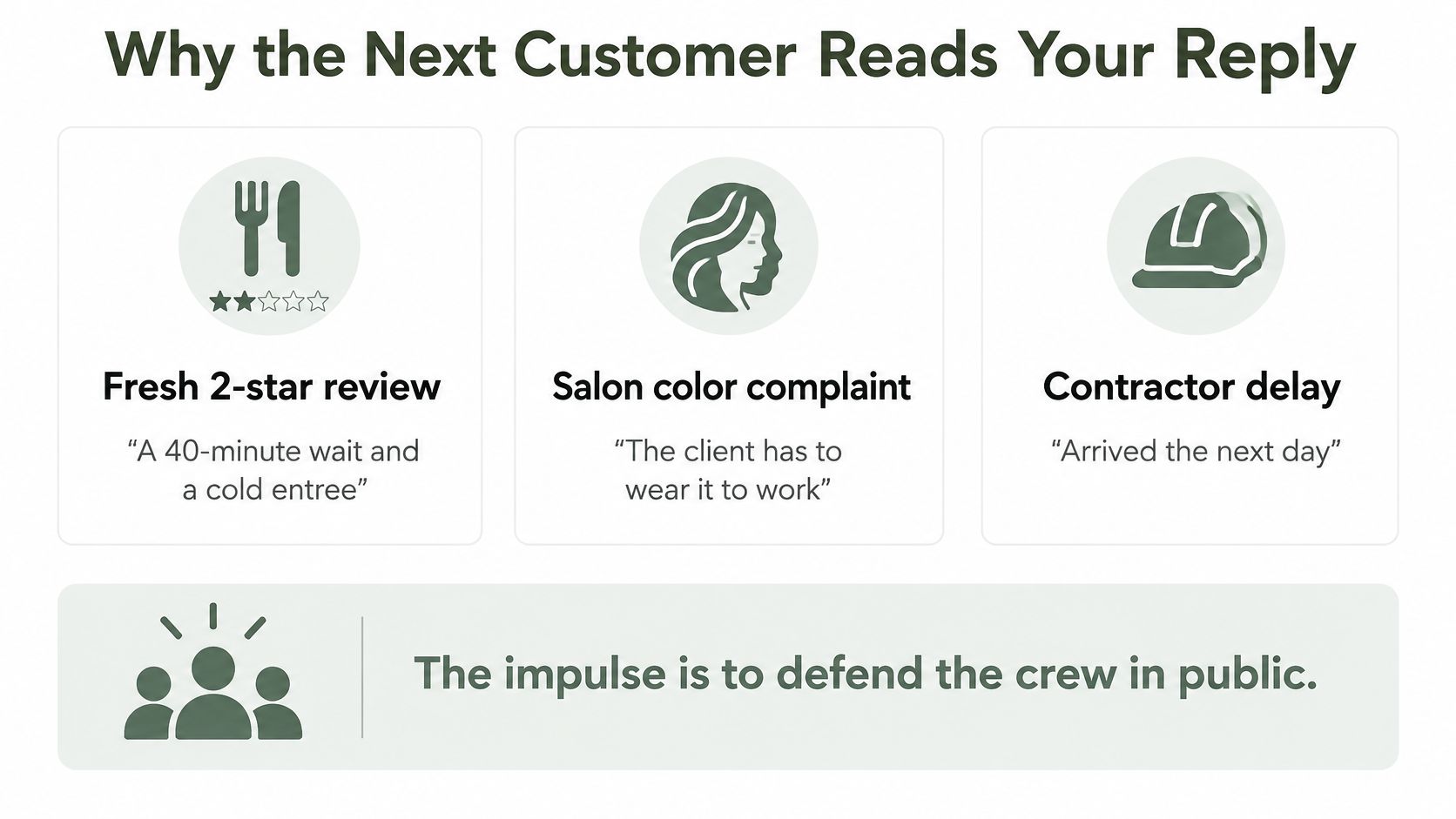
Start by naming the issue without disputing the customer's account. A restaurant can recognize a long wait and cold food. A salon can acknowledge that the color came out lighter than booked. A contractor can address a missed arrival window. Then state one thing you're doing and move details to an official private channel.
The same discipline applies when customers criticize a paid social campaign in public comments. Exerta's guide to negative ad comments offers useful context for handling that other kind of public complaint without letting the exchange turn into a fight. For review responses, the practical point is simpler: write for the next person who's deciding whether your business takes feedback seriously. For more on that operating habit, see why businesses should always respond to their reviews.
The Five Parts of a Public Reply
| Part | Write this | Leave this out |
|---|---|---|
| Thanks | Thank them for telling you. Use a first name only if it's already public. | A sales pitch, coupon, or request to change the star rating |
| The issue | Restate the specific complaint in neutral words. | A debate about who's right |
| The apology | Apologize for the impact on their visit or job. | A legal admission you haven't verified |
| The fix | Name one concrete change you can actually make. | A promise the team can't keep |
| The handoff | Ask them to call or email your official line. | Order numbers, medical details, payment data, or staff accusations |
Thanks
The issue
The apology
The fix
The handoff
Use the five parts as a writing checklist, not a script to paste under every review. A guest who reports a cold entree needs a different response from a patient who reports a long wait. If you use a name, use only one that already appears publicly. Don't identify a customer using booking or transaction records.
The apology should recognize the effect, not make a legal conclusion you haven't checked. “We're sorry your dinner was disrupted” addresses the guest's experience. “We caused the injury” makes a claim that may require investigation and manager review. For a tone that feels direct rather than canned, this practical guide to connecting with readers through tone can help you think about how wording lands.
Personal details matter more than polished phrasing. A TripAdvisor survey of 23,292 users across 12 markets, conducted in 2019, found that 77% were more likely to book when owners gave personalized responses. For negative reviews, 67% said context and an apology helped, and 90% said polite, respectful replies made them believe the owner cared, according to TripAdvisor's survey. Address the complaint's actual details. A generic paragraph that could fit any business may sound evasive.
A restaurant reply could look like this:
Thank you for telling us about the 40-minute wait and cold entree. We're sorry the delay and meal disrupted your dinner. We're checking how tickets moved through the kitchen and will have the shift lead verify plates before they leave the pass on busy nights. Please email our manager at the address on our profile so we can learn more and follow up directly.
That reply names the problem, apologizes for its impact, states an operational change, and gives the guest a private route to follow up. It doesn't argue about how busy the restaurant was or promise a free meal in public.
How to Post the Reply This Week
A reply is public, so write for the next person comparing your business in the local pack. State what you can do and where your limit is. Don't promise a win-back you cannot deliver.
For Yelp, Facebook, and other platforms, apply the same care with facts, privacy, and approvals. Post through that platform's business tools, not Google's.
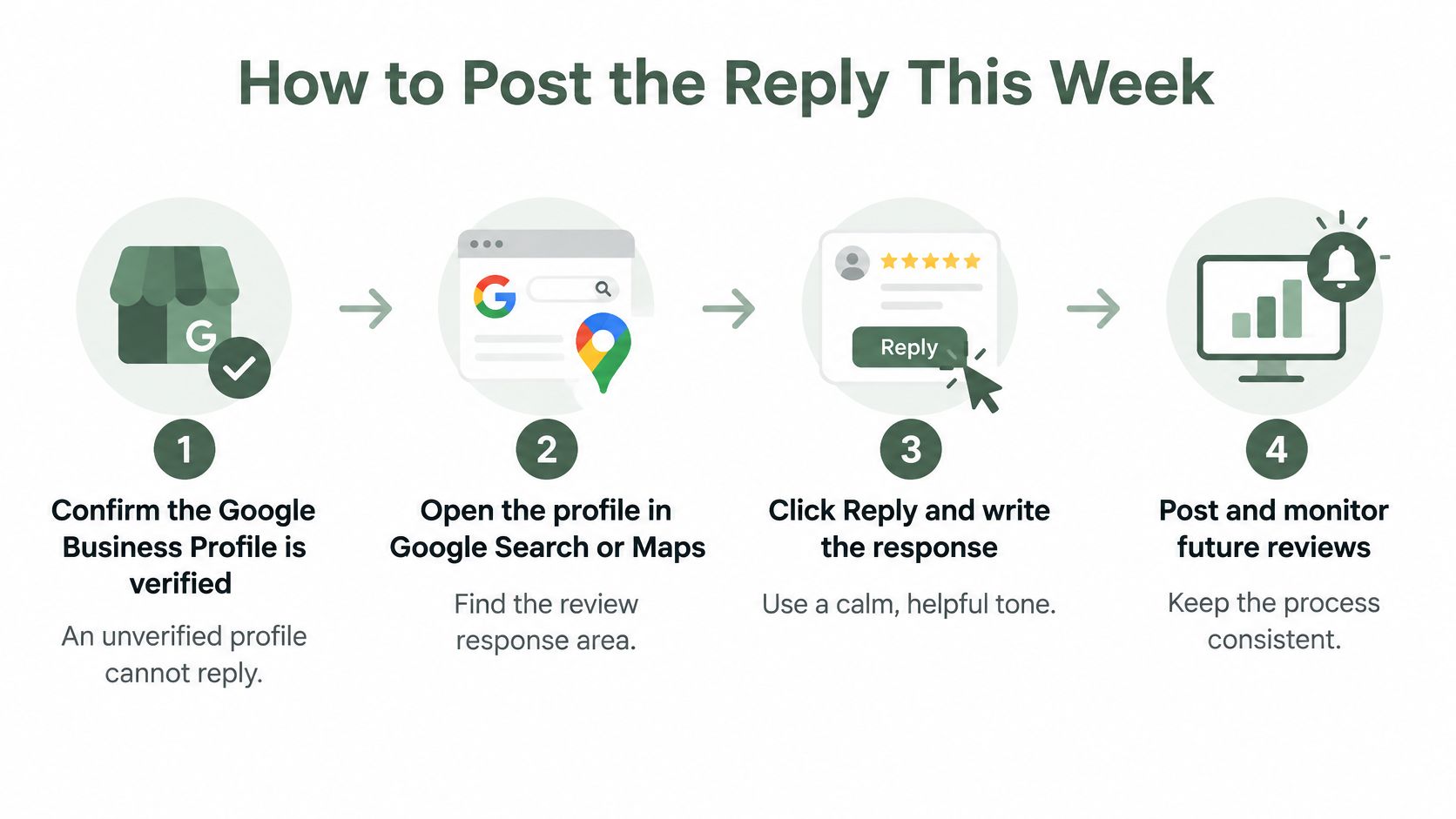
- Confirm the profile is verified. Verify your Google Business Profile before preparing to post. An unverified profile cannot be used to reply to reviews.
- Open the profile and find the review. In Google Search or Google Maps, open your Business Profile, select “Read reviews,” then choose “Reply” beside the review. Follow Google's instructions for responding to reviews. Avoid outdated “Google My Business” walkthroughs.
- Check the facts privately. Match the complaint to a visit, appointment, support ticket, or job using its date, location, and details. If you cannot find a match, don't publicly say the reviewer was never a customer. You could expose information or dismiss a genuine experience.
- Classify the issue before drafting. Decide whether the complaint describes a service failure, misunderstanding, policy limit, or possible policy violation. Use the relevant facts to shape the reply. A low rating or angry wording alone does not show that a review is fake.
- Get approval for sensitive allegations. Have a manager approve replies involving injury, discrimination, privacy breaches, lawsuits or legal threats, or employee misconduct. Staff and automated drafts should not speculate, expose private information, or promise an outcome the business cannot deliver.
- Submit a short, specific reply. Replies can take some time to appear, so don't keep rewriting yours while you wait. Before submitting, check that the wording names the issue, gives an accurate next step, and does not promise more than the team can provide.
- Follow up through the channel you named. Call or email using your official business contact information. Keep private details off the public profile.
- Log the case and prevent a repeat. Record the date, location, visit or job reference, staff owner, cause, remedy, and intended process change. Never offer money, discounts, or free goods in exchange for changing or removing a review.
Filled Replies for Common Local Complaints
Use these as starting points, then replace the operational detail with something your team can do. Keep public replies focused on the issue and next step. Don't use the review reply to negotiate compensation or explain every internal complication.
| Business | Complaint | Apology focus | Line to cut |
|---|---|---|---|
| Restaurant | 45-minute wait and cold entree | The ruined dinner and checking the pass before plates leave | We were slammed |
| Salon | Color lighter than booked | The result the client has to wear and a corrective visit with a senior stylist | Any line blaming the client's hair |
| Clinic or dental office | Long wait and curt front desk | The wait and the tone at the desk | Any discussion of care in a public reply |
| Contractor or hotel desk | Missed arrival window | The blown time and a same-day text when a job or room slips | Any argument about traffic or the contract |
Restaurant
Salon
Clinic or dental office
Contractor or hotel desk
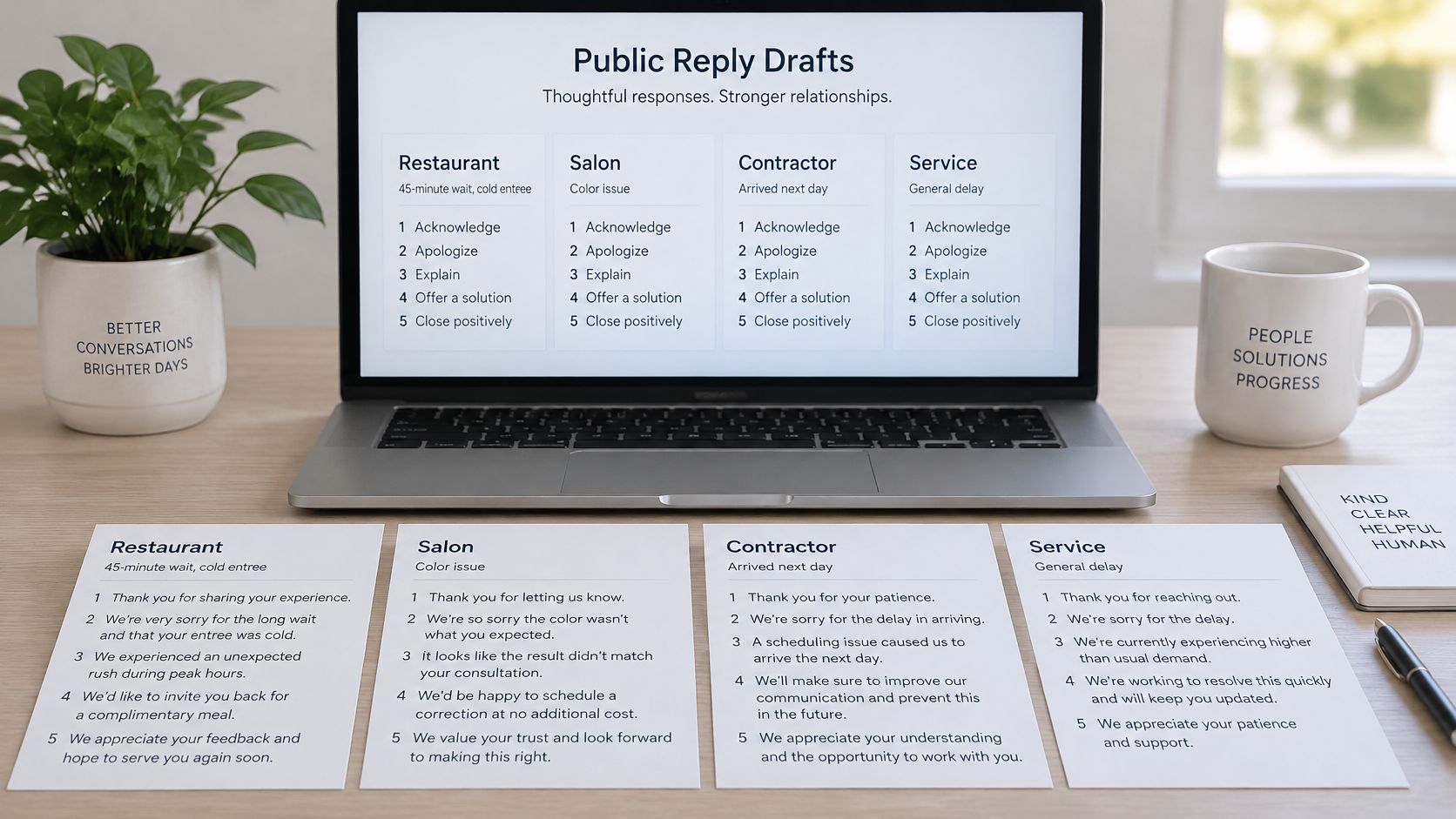
Restaurant: “Thank you for telling us about the 45-minute wait and cold entree. We're sorry your dinner was disrupted. We're checking how orders move through the kitchen and will have the shift lead check each plate before it leaves the pass. Please email our manager through the contact details on our profile so we can follow up.”
Cut: “We were slammed.” It may explain the delay to staff, but to future readers it sounds like an excuse.
Salon: “Thank you for letting us know the color came out lighter than you booked. We're sorry you're left wearing a result you didn't expect. Please call the salon and ask for our manager. We can arrange a corrective visit with a senior stylist this week and review the service details privately.”
Cut any line blaming the client's hair. That shifts responsibility without helping the client or future readers understand what happens next.
Clinic or dental office: “Thank you for sharing your concern about the wait and the front-desk interaction. We're sorry for the delay and the way you were spoken to. We can't discuss care in a public review reply, but please call the office line and ask for the practice manager so we can follow up privately.”
Cut any public discussion of the person's care, appointment, or health information. Even confirming a detail can expose private information.
Contractor: “Thank you for raising the missed arrival window. We're sorry we kept you waiting. When a job runs behind, we're adding a same-day text so customers know the updated timing. Please call our office line if you'd like to discuss the appointment privately.”
Cut any argument about traffic or the contract. Acknowledging the missed window and changing the update process gives future readers a clearer answer.
When the Remedy They Want Is Not Possible
A customer asks for a cash refund, but the facts haven't been checked and your posted policy doesn't allow that remedy. Don't promise money publicly to quiet the complaint. Acknowledge the impact, explain the limit plainly, and offer the nearest useful next step.
| Situation | Public reply focus | Do not do |
|---|---|---|
| Genuine service miss | Name the impact and one real fix | Argue line by line |
| Ask you can't meet | State the limit and the closest real step | Invent a refund on the spot |
| Third party, weather, or safety rule | Explain the constraint in plain words | Blame the guest |
| Can't verify the visit | Neutral note plus official phone or email, then report if it breaks policy | Accuse them of fraud in public |
| Injury, discrimination, or legal threat | Short acknowledgement and a private channel, manager-approved | Speculate or share private details |
Genuine service miss
Ask you can't meet
Third party, weather, or safety rule
Can't verify the visit
Injury, discrimination, or legal threat
For a genuine service miss, apologize for the effect and state what you can change. If weather, a supplier, a safety rule, or an inventory shortage limited what you could do, explain that constraint without blaming the customer or claiming the issue wasn't your responsibility. When privacy rules prevent details from being discussed, say so briefly and invite a private conversation.
Google advises businesses to protect privacy, avoid personal attacks, acknowledge mistakes when they occurred, explain limitations clearly, and move complex cases to phone or email. Its guidance for responding to negative reviews is clear that sensitive order, medical, employee, booking, and payment details should stay off the public profile. The public reply needs to identify the concern and the next step, not reproduce the case file.
For a review you can't match, use neutral language: “We can't verify the visit from the review alone. Please contact our office at the number on our profile so we can look into this.” If the review appears to violate platform rules, report the specific policy concern through Google. Don't call the reviewer fake in public. A low rating, angry tone, or disputed detail alone doesn't establish manipulation. For examples of when a platform may remove a review, see when Google removes a review.
Keep the public reply honest: Compensation is a private decision after you check the facts. Don't put money or a free item in the reply when it could look like payment for changing a rating.
Answer the Oldest Negative Review Today
Choose who owns replies before the next complaint arrives. Write down the official phone number and email the team should use for handoffs. Save the five-part structure where the closing manager can find it, and name who approves sensitive drafts.
If you run a dental office with two locations, the front-desk manager should confirm which office handled the visit, use that office's contact line, and keep the response free of care details. At a restaurant or salon, the same rule applies: the person who knows the shift can confirm the facts, while the manager reviews any risky allegation.
For the next few negative reviews, log the complaint theme and bring any recurring issue to the next staff meeting. That turns a public reply into a practical operating note, without making the review thread a place to disclose customer records or debate policy.
If drafting takes too long, RecensioAI can suggest a reply in your business's tone for a manager to review. Keep human approval for sensitive cases, and don't let a draft promise a result your team can't deliver.
Open your Google Business Profile today and answer the oldest unanswered negative review before the shift ends. Use the five parts, verify the facts, and ask a manager to approve the draft if it raises a sensitive issue.
---
RecensioAI B.V. offers local businesses review-response drafting, review management, and tools to organize recurring feedback across locations. If you want a practical way to prepare replies for manager review, visit RecensioAI B.V..
Frequently asked questions
You might also like
Handpicked articles for you
Hotel Review Management: Automate Post-Stay Requests with Apaleo, Mews and Your PMS
A practical guide to turning hotel checkouts into timely review requests, with Apaleo live, Mews early access and flexible PMS alternatives.
Why the Business Around the Corner Beats You on Google: What 21,373 Profiles Reveal
We compared 21,373 Google Business Profiles with their three strongest nearby competitors. The gap is smaller than most owners think, but it has two sides: rating and volume.
Treatwell Review Management for Salons: One Reputation View Alongside Google
Bring your public Treatwell rating and recent reviews into RecensioAI, then combine salon signals with Google for faster, better decisions.