Best Hotel Review Management Software: 10 Tools Compared
Compare 10 hotel review management software tools by features, integrations, pricing and pros and cons. Practical picks for hotel owners and managers.
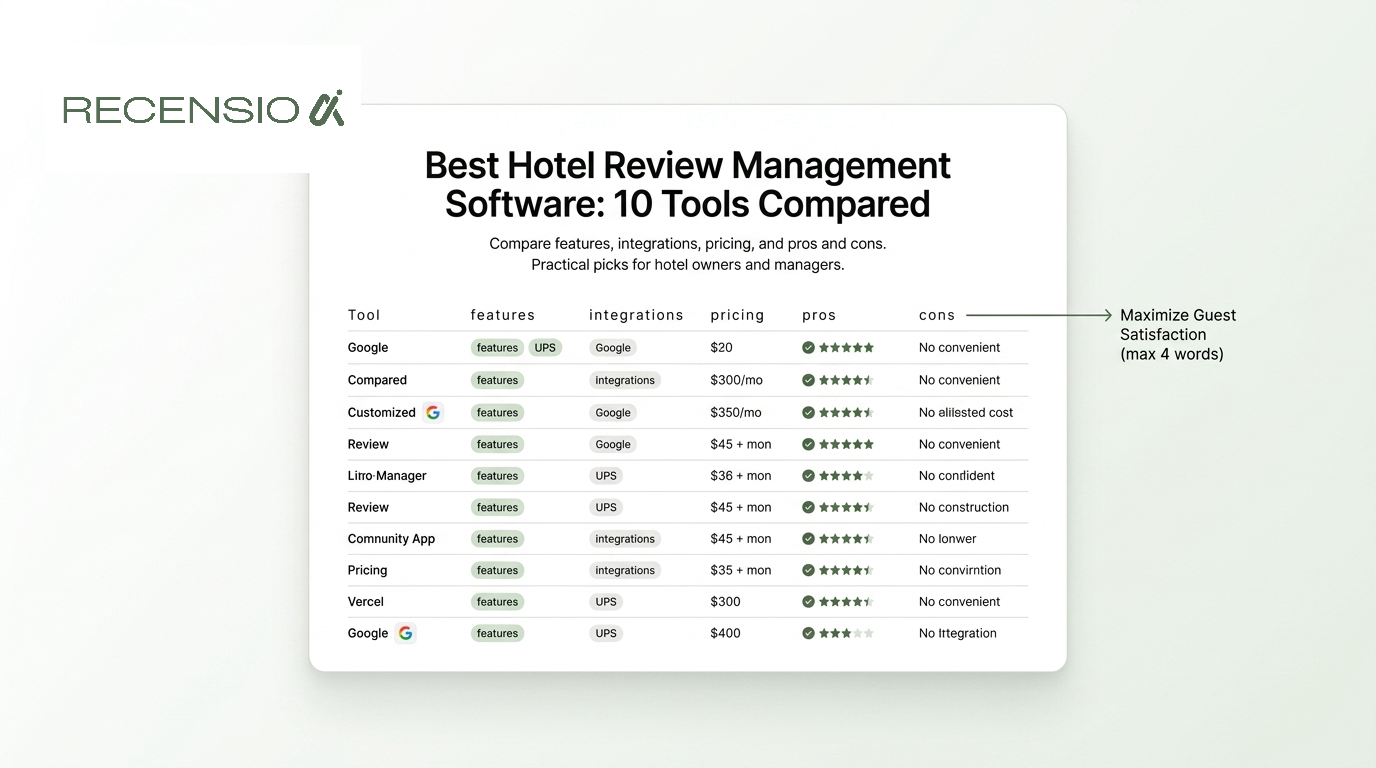
Table of Contents
- 1Introduction
- 21. RecensioAI B.V.
- 3Where it saves front desk time
- 42. Shiji ReviewPro
- 53. TrustYou CXP
- 64. Revinate Guest Feedback
- 75. Tripadvisor Reputation Pro
- 86. GuestRevu
- 97. ReviewTrackers by InMoment
- 108. Reputation
- 119. Customer Alliance
- 1210. Medallia Experience Cloud
- 13Top 10 Hotel Review Management Comparison
- 14Pick Two Tools and Test Them This Month
- 15Ask the same five questions
Introduction
You open the front desk inbox at 7 a.m. A new two-star review is waiting on Google. Two more came through Booking.com. There's another on Tripadvisor, plus a reply still owed to a guest from Tuesday. The shift starts in ten minutes, and nobody has spare time to open four sites, copy guest details, check the facts, and write four careful replies.
That's the problem hotel review management software is meant to solve. The right tool puts reviews in one working queue, helps you request feedback after real stays, flags recurring complaints, and gives the right person ownership. The wrong tool adds another dashboard that nobody checks.
Google identifies review count and rating as documented local ranking factors through prominence in local search. More reviews and positive ratings can help local ranking, according to **Google's explanation of local ranking. Replies still matter for trust, transparency, and guest engagement**, but they aren't confirmed ranking levers. This guide compares ten platforms by the property they fit, from one independent hotel to a large portfolio, and by the questions you should ask before signing.
1. RecensioAI B.V.
RecensioAI B.V. suits a single hotel or a small group that wants one system for review requests, replies, Google Business Profile work, and local visibility. If you run a front desk with a lean team, that matters. You are not buying only a review inbox. You are buying a way to keep review flow, profile updates, and local search work in the same daily routine.
The review request setup is practical. You can send invites by email, SMS, QR code, and through booking or POS integrations. The hosted review page shows a public Google review path and a private feedback path side by side, and the guest decides which one to use. That approach matters because Google prohibits selectively soliciting only positive reviews.
Where it saves front desk time
The time saving comes from the workflow, not from AI alone. The system can draft or publish replies in your brand voice and in the guest's language. It also groups comments by theme, such as housekeeping, breakfast, staffing, Wi-Fi, or maintenance, so you can spot repeat problems faster. If three reviews mention slow check-in, you can assign that issue to the right manager and see whether the complaint rate drops after the process changes.
There is also more here than review management. RecensioAI includes Google Business Profile audits, post generation, competitor tracking, per-location reporting, and Profile Guard to watch key profile fields and restore unwanted changes. For a small group, that can be easier to run than one tool for reviews and another for local profile work.
One reason this tool stands out is pricing transparency. Many vendors ask you to book a demo first. Here, pricing is listed publicly at publication time: Pro starts at $77 per month for one location, Multi starts at $177 per month with three locations included, and Pro Managed starts at $249 per month. The vendor also lists a free profile scan and a 14-day trial with no credit card.
Use automation carefully. Routine replies are fine to automate. Complaints about safety, discrimination, billing, privacy, compensation, or a serious service failure should go to a manager before anything is sent.
Best fit: Independent hotels and small groups that want review management tied closely to Google Business Profile work.
Honest limitation: Costs rise as you add locations, and SMS fees may sit outside the base plan. You still need human checks during setup and for sensitive cases.
Demo question: Can I set approval rules by rating, topic, property, and language, and see a full audit log for every automated reply?
2. Shiji ReviewPro
Shiji ReviewPro is built for hotel operators rather than general local businesses. It suits a small group that has outgrown spreadsheets, or a larger portfolio that needs property managers and central leadership to work from the same reputation data.
The platform brings reviews from OTAs, Google, Tripadvisor, and other sources into a centralized workflow. Teams can draft replies with AI assistance, use sentiment and topic analysis, and manage guest surveys across the stay. Case and issue management helps move a complaint from public feedback to an internal owner.
Its strongest point is hotel benchmarking. ReviewPro uses the Global Review Index and Competitive Quality Index to compare performance across properties and competitive sets. That gives a regional manager a useful question to answer: which hotel is struggling with service, cleanliness, or breakfast compared with similar properties, not just compared with its own history?
A study using ReviewPRO's Global Review Index and STR sales and revenue data found that a 1% increase in online reputation score was associated with increases of up to 0.89% in average daily rate, 0.54% in occupancy, and 1.42% in RevPAR. The source presents these as associations, not guarantees, in the Virginia Tech research document.
Best fit: A hotel group that needs hospitality benchmarks, surveys, and structured issue workflows.
Honest limitation: Pricing isn't public, and the internal GRI benchmark isn't a marketing asset you can publish on your website.
Demo question: Can a property manager assign a review theme to a department, track resolution, and compare the result with the right competitive set?
3. TrustYou CXP
TrustYou CXP suits a hotel group or portfolio that wants reviews, competitive analysis, and guest-facing reputation data connected to the booking journey. It's less about a simple front desk inbox and more about building a shared reputation view across properties and teams.
The platform aggregates reviews at portfolio scale and adds AI summaries, sentiment drivers, and topic analysis. TrustYou's TrustScore and Meta-Review assets can be used across booking journeys and partner environments. That gives commercial and operations teams a common way to discuss what guests value and where a property falls short.
The main practical benefit is structure. A regional director can organize properties, set goals, and compare themes without asking every hotel to build its own spreadsheet. A single hotel can also use the analysis to find patterns that are easy to miss when staff read reviews one by one.
Hotel review management software is most useful when it leads to a property-level decision. If Wi-Fi complaints rise, you need to know which hotel, room area, season, language group, or guest segment is involved. You also need an owner and a follow-up date. A dashboard that only says “Wi-Fi sentiment is down” won't fix the service.
For a deeper look at this category, see reputation management software for hotels.
Best fit: A portfolio that wants hospitality data products and shared reputation reporting.
Honest limitation: Pricing isn't public, and advanced modules may require onboarding, training, and internal change management.
Demo question: Can I export a property-level action list from a theme such as Wi-Fi or maintenance, with an owner and due date?
4. Revinate Guest Feedback
Revinate Guest Feedback makes the most sense when your hotel already uses, or plans to use, Revinate's CRM and marketing tools. It combines public review monitoring with post-stay and in-stay surveys, so guest feedback can feed into follow-up campaigns and guest relationship work.
The interface is designed around hotel workflows. You can collect reviews from several sources, reply inside the platform, watch trends, and study the drivers behind satisfaction or dissatisfaction. The CRM connection is the differentiator. A review isn't only a public reputation event. It can also tell you which guests may be ready for a return-stay message, which service failed, or which segment needs a different communication approach.
That broader stack works well for a small group with a real guest marketing process. It's less attractive if your only need is to see new Google and Tripadvisor reviews and answer them before the front desk gets busy.
Post-stay requests need a reliable trigger. They should connect to checkout or a confirmed stay, not depend on someone remembering to send a message after a difficult shift. If you're evaluating PMS connections, compare the workflow in this guide to post-stay requests with Apaleo, Mews, and your PMS.
Best fit: A hotel or group that wants review management connected to CRM, email, and guest marketing.
Honest limitation: Public pricing isn't listed, and the most useful setup may require buying and managing additional Revinate products.
Demo question: Can my front desk use the review workflow without opening the CRM, and which CRM features are required for the advertised process?
5. Tripadvisor Reputation Pro
Tripadvisor Reputation Pro is a sensible starting point for an independent hotel where Tripadvisor is a major source of traveler attention. It gives you a unified interface for reviews on Tripadvisor, Google, and Facebook, so you don't have to treat Tripadvisor as a separate daily chore.
The native connection is the main reason to consider it. Your team already understands the Tripadvisor owner environment, and the product keeps reputation work close to the site travelers use when comparing hotels. It can help an independent property maintain a steady response habit and make review volume easier to monitor.
It's a narrower choice than a full guest experience suite. You won't get the same depth of hotel benchmarking, operational case management, or portfolio analytics offered by platforms such as ReviewPro, TrustYou, or Medallia. That may be a benefit if your team needs fewer features and a shorter learning curve.
Tripadvisor's own research found that 96% of Tripadvisor users considered reading reviews important when planning trips and booking hotels, while 83% usually or always consulted reviews before choosing a property, based on a 2015 Phocuswright survey of 14,991 travelers across 13 markets. Those figures appear in Tripadvisor's survey summary. They're older research, but they explain why a hotel that lets Tripadvisor replies sit for days has a visible trust problem.
Best fit: An independent hotel that wants a straightforward multi-channel inbox with strong Tripadvisor relevance.
Honest limitation: It has less cross-stack functionality than a full guest experience platform, and pricing requires contacting Tripadvisor.
Demo question: Which Google, Facebook, OTA, and Tripadvisor actions can I complete from the inbox, and which still require a separate login?
6. GuestRevu
GuestRevu fits an independent hotel or small group that wants clear survey automation, PMS connections, and a simpler entry point. Its LITE option and published packaging make it easier to evaluate than platforms that reveal nothing until a sales call.
The workflow starts with automated post-stay surveys connected to hotel systems. You can monitor public reviews in one place, use AI-assisted replies, and review feedback in several languages. The useful distinction is that the survey data can show you what happened before a guest writes publicly. That's valuable only if someone owns the follow-up.
A small hotel might use GuestRevu to tag comments about breakfast, noise, room cleanliness, or check-in. The manager can then review those themes each week with the department leads. A small group can compare properties without buying a large enterprise analytics system.
Software won't replace a service recovery process. Decide who handles a billing complaint, who contacts a guest after a maintenance issue, and when a manager must approve a public reply. Google allows you to report policy-violating reviews, but a low rating by itself isn't enough. Google's removal process requires you to identify a specific policy issue.
Best fit: A single hotel or small group that wants practical surveys, review monitoring, and visible packaging.
Honest limitation: It has fewer enterprise data products than the largest hotel suites, and some PMS connections may carry extra fees.
Demo question: Which PMS integrations are included, what does each integration cost, and can survey answers create assigned tasks for staff?
7. ReviewTrackers by InMoment
ReviewTrackers by InMoment fits a hotel group with several properties, a franchise office, or an operator managing different locations under one team. It is built around multi-location workflow first, not hotel-specific benchmarking.
The value shows up in day-to-day control. Reviews from major platforms come into one place, then your team can set alerts, assign follow-up, and report by property. A franchise office, for example, can spot three hotels with unanswered Booking.com complaints in the same week, send each case to the right manager, and still keep a clean roll-up view for regional leadership. For the hotel-specific counterpart to that workflow, see this guide to online reputation management for hotels.
That reporting structure suits operators who need local action with central oversight. Corporate can monitor response gaps and recurring complaint types. Property managers can stay focused on their own queue instead of sorting through every location.
There is also a practical upside if your company already uses InMoment more broadly. ReviewTrackers can sit closer to wider guest experience work, which may reduce the split between public review handling and other feedback programs.
The trade-off is fit. If you want hotel benchmarks, survey depth, or hospitality-specific analysis to guide weekly decisions on breakfast, housekeeping, maintenance, or service recovery, you need to test how far it goes before you sign.
Best fit: A growing group or franchise team that needs location-level routing, alerts, and reporting more than hotel-only benchmarking.
Honest limitation: Pricing is not public, and the hotel-specific depth may fall short of hospitality-focused suites.
Demo question: If three properties miss replies this week, how do alerts, assignments, and corporate roll-up reports work in practice?
8. Reputation
A portfolio runs into a different problem than a single hotel. One property has stale holiday hours. Another has the wrong phone number. A third is sitting on a string of public complaints with no reply. Reputation is built for that kind of operating model, where corporate wants standards and local teams still need room to act.
The platform brings reviews, listings, social activity, AI-assisted replies, and reporting into one system. That matters when profile accuracy and guest feedback affect the same guest journey. If a traveler finds outdated amenity details or calls the wrong number, your front desk feels the fallout before the stay even starts. Reputation is strongest when you want one place to manage those issues across many properties, not just one hotel.
The question is governance. You need clear rules on who can reply, who signs off on sensitive cases, which team owns listings, and what regional or corporate users see in roll-up reports. Central standards also extend to how your brand appears in AI answers. See this overview of the best brand monitoring tools for AI visibility. If those rules are fuzzy, a big platform can create more alerts than action.
One practical point to test is the listings module. For large groups, the value is often in bulk updates, such as changing hours or profile details across many locations without chasing each property one by one. That is more useful here than another generic ranking discussion.
Best fit: A large hotel group or brand that needs central controls, multi-property listings management, and roll-up reporting.
Honest limitation: Pricing is not public, annual contracts are common, and the platform can be too heavy for one independent hotel.
Demo question: If corporate needs to update hours across the portfolio today, what can be changed in bulk, what needs approval, and what sits behind an add-on?
9. Customer Alliance
Customer Alliance is a strong option for hotel operators with a European footprint or a portfolio that wants surveys, review replies, AI insights, and competitor benchmarking in a hotel-focused system. Its Direct Reply capability is designed to help teams respond to reviews on portals such as Google, Booking.com, and Expedia.
The product combines review collection, monitoring, guest surveys, alerts, and central analytics. PMS and CRM integrations help connect feedback with the systems already used to operate the property. Multi-unit organization is useful when you need local execution with central visibility.
The platform's European focus can be a practical advantage for properties serving several languages and markets. Still, ask for a real workflow demonstration. Don't settle for a list of supported portals. You need to know whether a manager can see the review, understand the issue, assign it, draft an appropriate reply, and record what happened next.
Customer Alliance says it serves more than 5,000 hotels in its product information. Treat that as a vendor-reported company figure, not as proof that it's the right fit for your property or region.
Best fit: A European hotel or group that wants hotel-specific reputation work with multilingual and multi-unit support.
Honest limitation: Pricing can combine a base subscription with per-unit charges, and there may be fewer North American case studies than some global competitors.
Demo question: Show me the full path from a Booking.com complaint to an assigned operational task, approved response, and portfolio report.
10. Medallia Experience Cloud
Medallia Experience Cloud is for large hotel brands that need a broad customer experience system, not just an inbox for reviews. It can combine reviews, social signals, surveys, text analytics, alerts, roles, and benchmarking across complex organizations.
That depth helps when a brand wants to study public comments alongside structured survey answers and other guest signals. Operational teams can use alerts and case workflows, while corporate teams study patterns across properties, regions, and business units. Tripadvisor integration supports compliant review-generation activity within a larger experience program.
Medallia can make sense when you already have an experience management function and people who can own implementation. It can also help a large group connect review themes with service recovery, training, and brand standards. For one hotel, the same depth may slow adoption rather than improve it.
The operational case for learning from reviews is strong. Research on hotel feedback found that positive reviews were commonly associated with location and service, while negative reviews were linked to price, maintenance, and Wi-Fi, as reported in HospitalityNet's summer 2025 guest experience snapshot. Use that kind of theme analysis to decide what to fix, not merely to produce another score.
Best fit: A large brand with complex reporting, governance, and cross-channel experience requirements.
Honest limitation: Pricing is custom and enterprise-level, and Medallia is excessive if you only need review monitoring and replies for one property.
Demo question: What implementation team and internal roles do we need before the first property can use the review workflow?
Top 10 Hotel Review Management Comparison
| Product | Core features | Quality (★) | Price & value (💰) | Target (👥) | Unique strengths (✨) |
|---|---|---|---|---|---|
| RecensioAI B.V. 🏆 | Automated review requests (QR/SMS/email/One Tap), bilingual review page, AI replies, GBP audit & Profile Guard, social & marketing automation | ★★★★☆ | 💰 From $77/mo (Pro); Multi $177 (+$59/loc); Pro Managed $249; 14‑day free trial + free tools | 👥 SMBs & multi-location brands (restaurants, hotels, salons, clinics, retail) | ✨ Google-compliant two-path flow, language-aware AI replies, Profile Guard, auto-posting |
| Shiji ReviewPro | OTA/Google/Tripadvisor aggregation, AI-assisted replies, GRI & CQI benchmarks, guest surveys | ★★★★ | 💰 Quote/demo | 👥 Hotels & multi-property teams | ✨ Hospitality benchmarking (GRI/CQI), hotel-focused workflows |
| TrustYou CXP | Portfolio dashboard, AI summaries, sentiment/topic analysis, TrustScore/Meta-Review assets, competitor benchmarking | ★★★★ | 💰 Quote | 👥 Hotel groups & brands | ✨ Recognized TrustScore dataset + booking-journey assets |
| Revinate Guest Feedback | Aggregated reviews, in-stay/post-stay surveys, trend/driver dashboards, CRM/marketing integration option | ★★★★ | 💰 Quote; often bundled with Revinate CRM | 👥 Independent hotels & groups | ✨ Reputation + CRM marketing path for direct revenue |
| Tripadvisor Reputation Pro | Unified inbox (Tripadvisor/Google/Facebook), review volume tools, owner ecosystem access | ★★★☆ | 💰 Contact sales | 👥 Independents seeking Tripadvisor visibility | ✨ Native Tripadvisor owner tools to boost traveler trust |
| GuestRevu | PMS-driven automated surveys, consolidated review monitoring, AI responses, multilingual support, LITE tier | ★★★☆ | 💰 Published tiers; SMB-friendly (LITE) | 👥 Single properties & small groups | ✨ Transparent packages, easy/PMS-centric setup |
| ReviewTrackers (by InMoment) | Centralized review aggregation, alerts & workflows, location-based reporting, path into InMoment XI | ★★★★ | 💰 Quote | 👥 Multi-location businesses & agencies | ✨ Proven multi-site scale, strong integrations |
| Reputation (formerly Reputation.com) | Review requests & monitoring, AI responses, listings & social management, enterprise governance | ★★★★ | 💰 Enterprise pricing; annual contracts | 👥 Enterprises & large hotel groups | ✨ Broad CX toolset + enterprise roll-up reporting |
| Customer Alliance | Review collection & direct reply to portals, surveys + AI insights, competitor benchmarking, PMS integrations | ★★★☆ | 💰 Subscription + per-unit add-ons | 👥 Hotels (strong EU footprint) | ✨ Direct Reply to major portals, strong European support |
| Medallia (Experience Cloud) | Aggregates reviews/social/surveys, deep text analytics, alerts/workflows, Tripadvisor integration | ★★★★ | 💰 Enterprise (EDR) pricing | 👥 Large hotel groups & enterprises | ✨ Deep cross-signal analytics and enterprise-scale workflows |
RecensioAI B.V. 🏆
Shiji ReviewPro
TrustYou CXP
Revinate Guest Feedback
Tripadvisor Reputation Pro
GuestRevu
ReviewTrackers (by InMoment)
Reputation (formerly Reputation.com)
Customer Alliance
Medallia (Experience Cloud)
Pick Two Tools and Test Them This Month
Start with the constraint you feel at the front desk. A single hotel usually needs one inbox, fast alerts, simple approvals, and review requests tied to real stays. A small group needs property separation, roll-up reporting, and clear ownership. A portfolio needs governance, benchmarking, permissions, and a way to turn recurring themes into operating decisions.
Don't choose because a vendor shows the largest feature list. Choose the tool your team will use on a busy Tuesday. If staff still need to copy reviews into a spreadsheet, forward complaints by email, or log into several channels to publish replies, the software hasn't solved the main problem.
Use the first month to test a real workflow. Connect the review sources you depend on, map each property, set response owners, and import or capture enough feedback to expose the weak points. Ask the front desk manager to use it during a normal shift, not during a polished sales demo.
Ask the same five questions
Review requests must remain genuine and unbiased. Google prohibits payment, discounts, free goods, or free services in exchange for a review, edit, or removal. It also prohibits asking only happy customers or discouraging negative reviews, as explained in Google's review policy.
Shortlist two or three tools that match your property count and budget. Book a demo with each one and ask the same five questions: what it costs per property, which review sites it connects to, who writes the replies and how, how review requests reach guests, and how you cancel. Then start the trial of the one that fits your inbox this week.
---
RecensioAI B.V. combines hotel review requests, multilingual AI-assisted replies, public Google and private feedback options, profile monitoring, and multi-location reporting in one dashboard. Visit RecensioAI B.V. to run a free Google Business Profile scan and see whether it fits the way your front desk already works.
- What does it cost per property? Ask about setup, extra locations, SMS, PMS connections, user seats, onboarding, and annual commitments.
- Which review sites does it connect to? Confirm Google, Tripadvisor, Booking.com, Expedia, Facebook, and any channel that matters to your guests. Ask what you can do from the platform.
- Who writes the replies and how? Check AI drafting, automatic publishing, approval thresholds, brand voice, language handling, escalation rules, and audit logs.
- How do review requests reach guests? Confirm email, SMS, QR codes, WhatsApp, booking integrations, checkout triggers, consent handling, and whether every guest sees an honest public review option.
- How do you cancel? Get the notice period, data export process, deletion terms, contract length, and renewal rules in writing.
Frequently asked questions
You might also like
Handpicked articles for you
Hotel Review Management: Automate Post-Stay Requests with Apaleo, Mews and Your PMS
A practical guide to turning hotel checkouts into timely review requests, with Apaleo live, Mews early access and flexible PMS alternatives.
Why the Business Around the Corner Beats You on Google: What 21,373 Profiles Reveal
We compared 21,373 Google Business Profiles with their three strongest nearby competitors. The gap is smaller than most owners think, but it has two sides: rating and volume.
Treatwell Review Management for Salons: One Reputation View Alongside Google
Bring your public Treatwell rating and recent reviews into RecensioAI, then combine salon signals with Google for faster, better decisions.