
Online Reputation Management for Hotels: A Practical Guide
A practical guide to online reputation management for hotels covering review acquisition, responses, sentiment-driven ops, tools, and KPIs
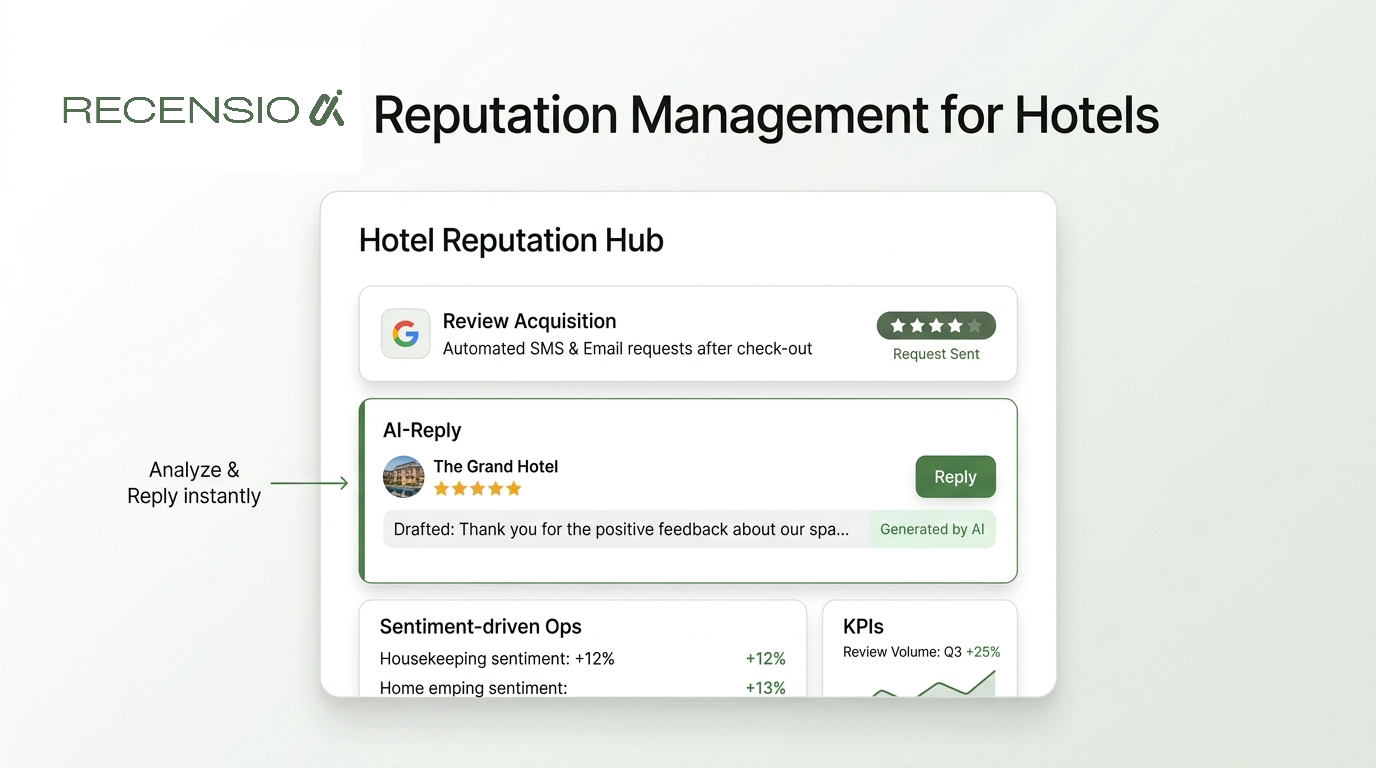
Table of Contents
- 1Introduction
- 2The Booking That Went to the Hotel Across the Street
- 3What Online Reputation Management Actually Means for a Hotel
- 4The five parts that matter
- 5Single property thinking breaks at brand level
- 6Why Reputation Scores Move Revenue, Not Just Perception
- 7Rating is a yield variable
- 8The expensive mistake operators keep making
- 9The Review Platforms That Decide Your Hotel's Reputation
- 10One guest experience can show up as different scores
- 11Platform differences that change workflow
- 12Set priority by qualified traffic
- 13A Practical Playbook for Reviews and Responses
- 14Set the request timing and stop improvising
- 15Use one response model, not twenty
- 16Build theme templates, then force personalization
- 17Handle language and escalation properly
- 18Keep the tools boring and centralized
- 19Turning Guest Feedback Into Operational Decisions
- 20Run a 90-day theme loop
- 21Make the GM chair a weekly review stand-up
- 22Use praise as operating data too
- 23Recency, Fake Reviews, and Policy Risks Most Guides Skip
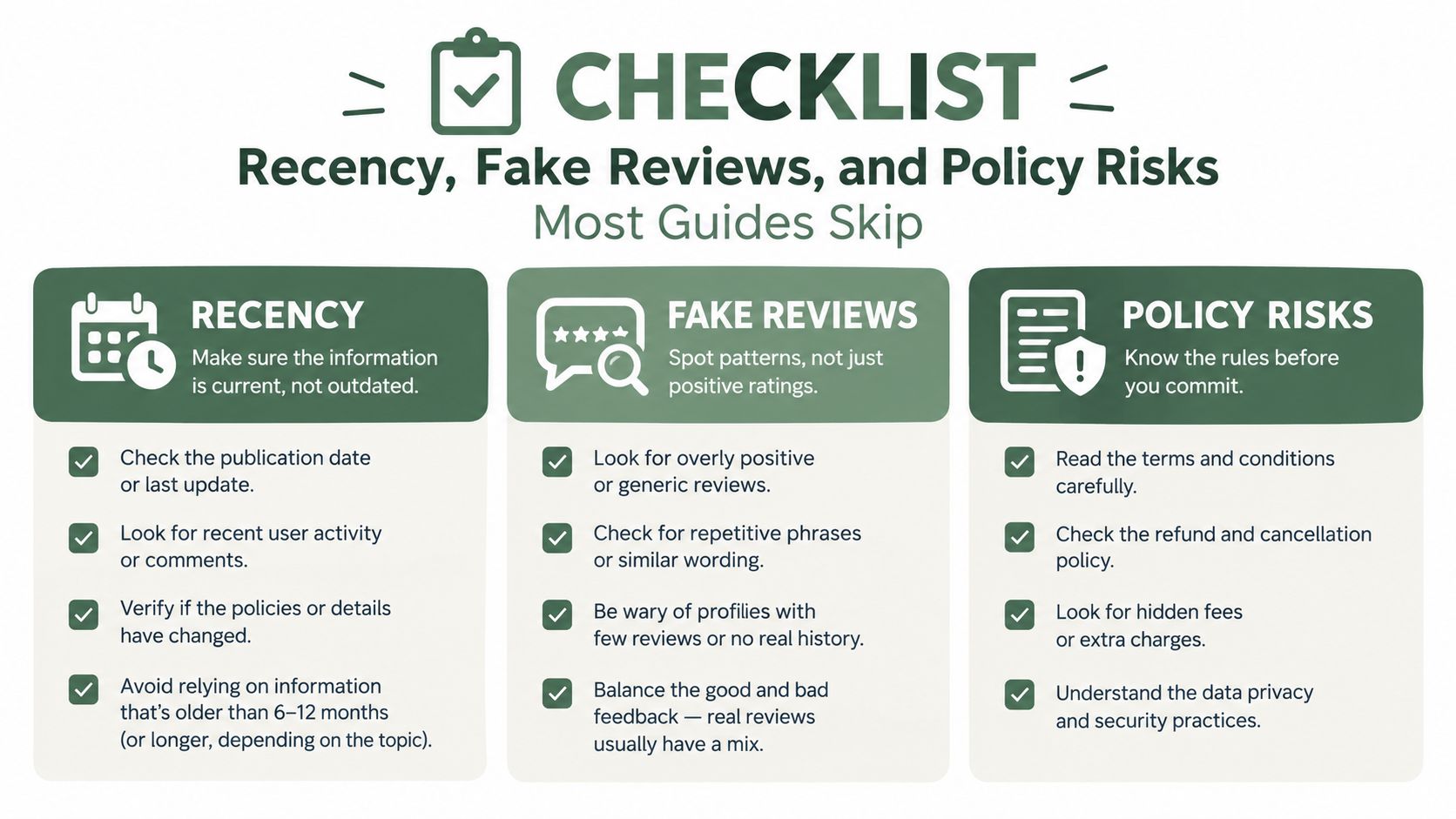
- 24Recency now matters more than many teams realize
- 25AI-generated reviews and bad automation are now real risks
- 26Know Google's line and stay on the right side of it
- 27The KPIs to Track and One Move to Make This Week
- 28The dashboard that matters
- 29One move to make this week
Introduction
You know this situation. One property in your group is doing the work. Another is letting reviews pile up unanswered. A third has a decent score on one platform and a weak one on another. Then a corporate planner compares two tabs, sees a small rating gap, and your sales team loses the block before rate even becomes the issue.
That loss usually gets blamed on marketing. It shouldn't. Online reputation management for hotels is an operations job with brand oversight. If you run more than one property, you need one system for requests, responses, escalation, and follow-through. Otherwise each hotel invents its own habits, and the weakest workflow drags down the whole portfolio.
The Booking That Went to the Hotel Across the Street
A regional sales manager sends a front desk GM a note about a corporate group. Nothing huge, but a useful piece of business. The planner has a shortlist of similar hotels in the same submarket. Same meeting space. Same parking situation. Same chain scale. Same rough rate band.
Before your GM even quotes, the planner says the other hotel across the street looks stronger online. Their Google score is 8.7. Yours is 8.2. The block moves.
That kind of loss doesn't come from one bad weekend. It comes from months of drift. Reviews sat unanswered. The same complaints showed up again and again. Housekeeping issues never made it from the review feed into the morning ops meeting. Noise complaints kept getting the same polite reply and no actual fix. The brand team looked at averages. The property team looked at daily fires. Nobody owned the gap.
In a single-property hotel, the GM can sometimes muscle through this with personal attention. In a multi-location brand, that approach breaks fast. One hotel responds in a day. Another responds when the AGM remembers. One property asks for reviews after checkout. Another leaves it to front desk staff who are busy with arrivals.
Practical rule: If a booking shifts because of a score gap, the problem isn't PR. It's your operating system.
The hard truth is simple. Guests and planners compare you side by side. They don't care that one property is short-staffed, another changed managers, and a third is still waiting on maintenance approvals. They see the rating, the recent comments, and whether management looks present.
Every tenth of a point is a quiet revenue decision.
What Online Reputation Management Actually Means for a Hotel
Most hotel teams define reputation work too narrowly. They think it means answering reviews on Google and TripAdvisor. That's one slice of it. The actual job is bigger and more useful.
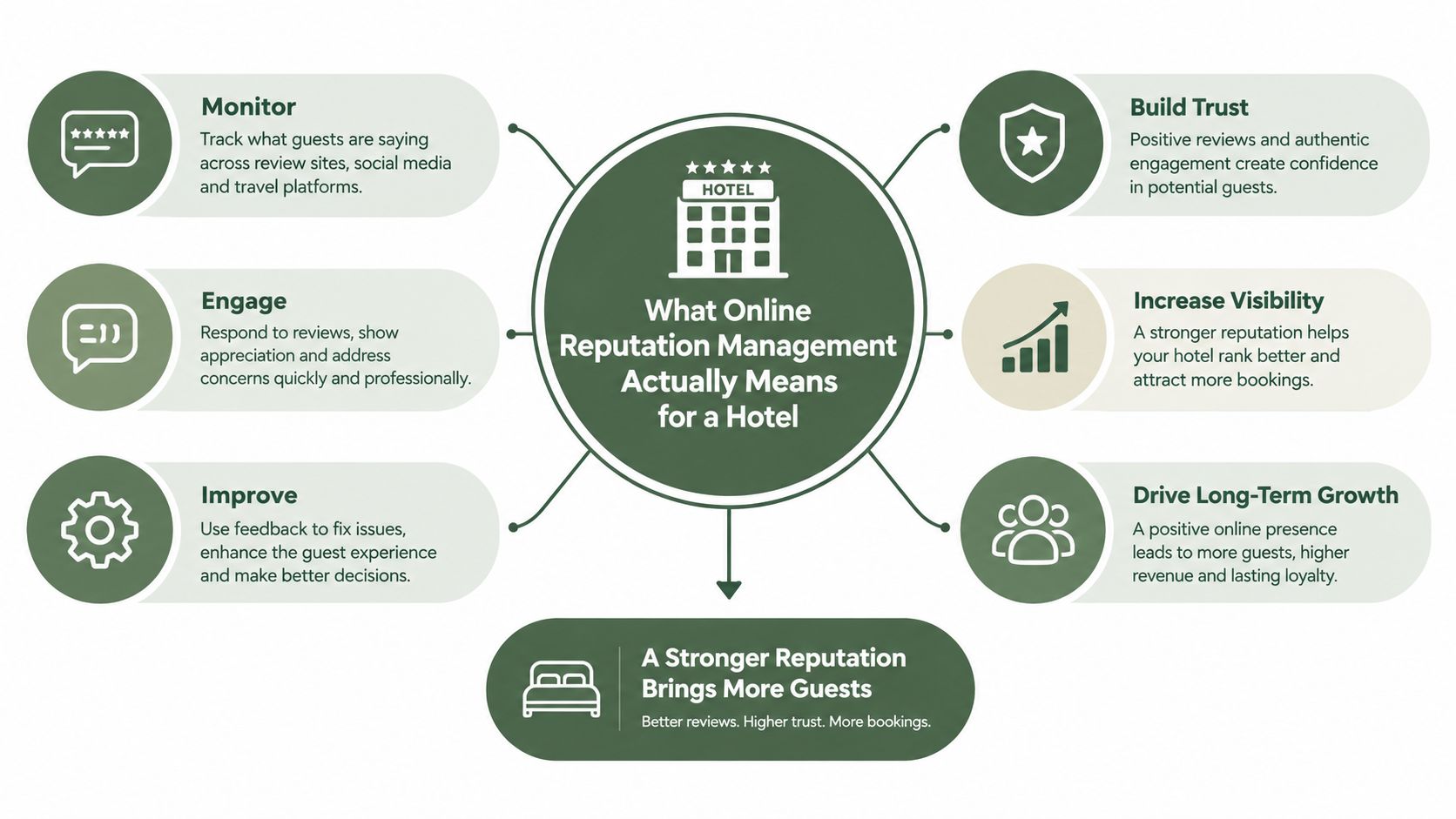
Online reputation management for hotels has five working parts.
The five parts that matter
You need a consistent way to ask guests for feedback after the stay across every property. Not randomly. Not only when staff remember. A review request process belongs in the guest journey like folio delivery or post-stay receipt email.
Every platform has public replies, but speed alone isn't the goal. You need a reply standard, a tone standard, and a clear owner by property.
Reviews are wasted if they stay in a dashboard. Comments about breakfast, shower pressure, check-in delays, valet, or noise need to reach the department head who can fix them.
Your Google Business Profile, OTA pages, and review site listings need accurate hours, amenities, categories, photos, and descriptions. Guests notice when the listing doesn't match the stay. Google also says local results are mainly based on relevance, distance, and prominence, and prominence reflects signals such as review volume, as explained in Google's local ranking guidance for Business Profiles.
If your team tracks only star ratings, you're missing the point. You need measures that connect review activity to conversion, pricing, and property performance.
- Review acquisition
- Response strategy
- Sentiment feedback loops
- Profile upkeep
- KPIs tied to commercial results
Single property thinking breaks at brand level
One hotel can get away with a hands-on GM who reads every review at night. A regional brand can't. Multi-location reputation work needs shared rules with local judgment. The brand team should set cadence, templates, escalation paths, and reporting. The property team should own the actual guest follow-up and service changes.
If you need a plain-language primer on the basics before you build that system, this guide on how to monitor your online reputation is a useful starting point.
Good hotel ORM isn't a monthly report. It's the system that turns guest feedback into operating changes that move scores and bookings.
The departments involved are broader than most owners expect. Front office affects check-in sentiment. Housekeeping drives cleanliness mentions. Engineering owns temperature, water pressure, and noise fixes. F&B shapes breakfast reviews. Revenue and sales need to watch score gaps because those gaps change what rate the market will bear.
Why Reputation Scores Move Revenue, Not Just Perception
If you still treat review scores as soft brand fluff, you're leaving money on the table.
Hospitality research has already settled the basic argument. A Cornell-based finding summarized by Hospitality Net reported that a 1-point increase in a hotel's online reputation score on a five-point scale could let the property raise room rates by up to 11.2% without hurting occupancy, and related research in the same stream found that a 1-point improvement in rating was associated with a 5.5% rise in demand measured by room-night bookings in the summary published by Hospitality Net on the Cornell research stream.
A separate Boston College paper linked a 1-point increase in hotel review rating with a 1.6% rise in revenue, a 1% increase in bookings, and a 0.4% to 0.6% increase in prices in the Boston College hospitality research paper.
Rating is a yield variable
Revenue managers obsess over rate fences, channel mix, and comp set pricing. Fine. Keep doing that. But don't pretend reputation sits outside yield. It doesn't.
When guests compare similar hotels, score quality changes what rate feels justified. It also changes whether a planner, family traveler, or business guest bothers clicking through at all. If your score is weaker and your recent comments are messy, you often need to discount just to stay in the conversation.
| Rating Change | ADR Impact | Occupancy/Conversion Impact | Source |
|---|---|---|---|
| 1-point increase on a 5-point scale | Up to 11.2% room rate increase without hurting occupancy | No occupancy loss in the cited finding | Cornell research summary via Hospitality Net |
| 1-point improvement in rating | Not stated in that finding | 5.5% rise in demand measured by room-night bookings | Cornell research summary via Hospitality Net |
| 1-point increase in hotel review rating | 0.4% to 0.6% increase in prices | 1.6% rise in revenue and 1% increase in bookings | Boston College paper |
1-point increase on a 5-point scale
1-point improvement in rating
1-point increase in hotel review rating
The expensive mistake operators keep making
Owners often assign reputation work to whoever has time. That's backwards. The commercial value is too direct.
Large benchmark work cited by PwC found that in a global sample of 11,006 hotels, the average management response rate to online reviews was only 18%, while the overall Guest Review Index score was nearly 80% in the PwC report on why hotel reviews matter. That tells you two things. First, many hotels still under-manage this. Second, the hotels that build discipline here can separate themselves without changing the building.
The portfolio mistake is thinking each hotel will sort this out alone. It won't. One property may improve because it has a strong GM. Another will drift the moment that GM transfers out. Multi-property operators need process, not heroics.
The Review Platforms That Decide Your Hotel's Reputation
Hotels don't have one reputation. They have several, and they don't behave the same way.
Google Business Profile matters because that's where guests look in map results and "near me" searches. Booking.com matters because guests use it as a sorting engine. TripAdvisor still influences trust for many leisure travelers. Airbnb matters if you operate in that category. Expedia matters where OTA share is heavy. The mistake is treating them like mirrors. They're not.
One guest experience can show up as different scores
A 4.5 on Google and an 8.5 on Booking.com can describe roughly the same guest experience because the scales are different and guest behavior differs by platform. If you run multiple hotels, stop chasing display numbers without context. Create one internal scorecard so regional teams can compare properties fairly across platforms.
I prefer a unified internal view that maps platform scores into one common band and then layers in recency, review volume, and sentiment themes. The exact formula matters less than consistency. What matters is that your brand team can compare Hotel A and Hotel B without getting fooled by different scales.
Platform differences that change workflow
Booking.com changed the game by rolling out a new scoring model in early 2025 that gives more weight to recent reviews, as explained in this breakdown of Booking.com's new review scoring model. That means old praise decays faster. If one property had a bad month, the fix isn't just "respond to everything." The fix is to stabilize the guest experience and generate fresh, genuine feedback quickly.
For Google, the operational point is different. Google publicly explains local visibility through relevance, distance, and prominence. You can't move your building. You can keep the profile complete and build genuine review activity over time. If your hotel relies on drive-market, last-minute, or branded "near me" demand, this matters.
For a closer look at how hotels can approach Google specifically, this guide on Google reviews for hotels is worth reading.
| Platform | Rating Scale | Recency Weighting | Response Limits | Strategic Priority |
|---|---|---|---|---|
| Google Business Profile | 1 to 5 | Guests often see recent reviews prominently. Google doesn't publish a numeric recency formula publicly. | Public owner replies are supported | High for map results, branded search, and direct trust |
| Booking.com | 1 to 10 | Recent reviews carry more weight under the model rolled out in early 2025 | Public management responses are supported on platform terms | High where OTA demand drives occupancy |
| Expedia | Varies by display format and market presentation | Treat recency as operationally important | Public response mechanics vary by platform setup | Important where Expedia share is material |
| TripAdvisor | Commonly displayed in its own review format | Recent guest commentary strongly shapes perception | Management responses are supported | Strong trust signal for leisure comparison shopping |
| Airbnb | Platform-native host and guest review structure | Recency matters because guests review active hosting quality | Host responses follow platform rules | Important only if this is a meaningful channel for your inventory |
Google Business Profile
Booking.com
Expedia
TripAdvisor
Airbnb
Set priority by qualified traffic
Don't let teams chase the platform with the most notifications. Prioritize by booking influence. In some city hotels, Google and Booking.com deserve most of the attention. In some resorts, TripAdvisor still punches above its weight. In mixed portfolios, the right answer changes by property.
If a platform sends qualified shoppers, it deserves process. If it doesn't, don't let it dominate your team's time.
A Practical Playbook for Reviews and Responses
Most hotel groups either get disciplined or get sloppy. You need a repeatable review request and response process that works across all properties, including the ones with weak managers and busy front desks.
Set the request timing and stop improvising
Use a post-stay request on the day of checkout at 10:00 local time. That's late enough that the guest is usually out, and early enough that the stay is still fresh. Keep the ask short. One message. One link.
On the landing page, give guests two equal options side by side: leave a public Google review or send private feedback. The guest chooses. That's the safe setup. It also gives you a cleaner flow of public reviews and operational feedback without drifting into review gating.
Don't make staff ask manually unless it's a backup process. They forget, they cherry-pick, and they ask only when the line is short.
Use one response model, not twenty
Set service levels by review severity. My rule is simple:
The actual text should follow one rule across every property: the first sentence must reference something specific about the stay. Room view. late arrival. breakfast mention. conference stay. family weekend. If the first line could fit any guest, it's too generic.
- Serious negative reviews: Assign an owner and answer fast. These are the ones that can shape future bookings quickly.
- Mixed reviews: Respond after you've checked the stay details and know what happened.
- Positive reviews: Reply consistently, but don't let five-star thank-yous crowd out urgent service recovery.
Build theme templates, then force personalization
Templates are fine. Scripted nonsense isn't. You need core response patterns for:
Each template should cover the essentials. Acknowledge the issue. Reference the stay. State the next internal action if appropriate. Invite offline follow-up when needed. Then let the property manager personalize it.
A fast generic reply can look worse than a slower informed one.
- Cleanliness issues
- Noise complaints
- Service delays
- Billing disputes
- Maintenance problems
- Staff praise
- Service recovery after a problem was fixed
Handle language and escalation properly
If your hotels serve international guests, support at least English, Spanish, Mandarin, and French in your review workflow. But don't let machine translation publish unchecked on sensitive reviews. For properties with stronger premium positioning, have a native-speaking manager or approved reviewer sign off when nuance matters.
Escalation can't sit with the property alone. Route these straight to the brand or corporate team within four hours:
That bypass matters. A tired MOD should never improvise a public reply to a guest claiming assault, fraud, or discrimination.
- Legal threats
- Safety or security mentions
- Harassment claims
- Discrimination allegations
- Suspected fake reviews
- Media or influencer pressure tied to a complaint
Keep the tools boring and centralized
The best tooling isn't flashy. It does four jobs well.
If you're comparing systems, look for tools that support hotel-relevant platforms, language handling, theme tagging, and one dashboard for property and regional teams. RecensioAI is one example in this category. It can send post-visit review requests, support public review and private feedback side by side, and centralize review monitoring for multi-location operators. The specific tool matters less than whether it enforces your process.
- Collects review requests automatically after checkout
- Pulls reviews from key platforms into one queue
- Tags recurring themes like noise, cleanliness, or breakfast
- Creates an approval workflow for escalations and multi-location reporting
Turning Guest Feedback Into Operational Decisions
A review dashboard is useless if it ends with a reply.
Value starts when recurring comments become tasks for the people who run the building. If ten guests mention weak shower pressure and nobody in engineering sees that pattern, you don't have online reputation management. You have digital paperwork.
Run a 90-day theme loop
Use the last 90 days of reviews for each property. Tag them by theme. Keep the categories plain:
Then compare those themes with the prior quarter. Don't chase every complaint. Send the top two negative themes to the department head who can fix them, with a 30-day remediation target.
- Room cleanliness
- Bathroom condition
- Breakfast
- Front desk
- Noise
- Maintenance
- Parking
- Value perception
Make the GM chair a weekly review stand-up
Once a week, spend 30 minutes on reviews with department heads. Not an hour. Not a quarterly postmortem. A short operating meeting.
The only question that matters is this: which themes are getting worse, and who owns the fix?
That one habit changes behavior. Housekeeping stops seeing reviews as "marketing stuff." Engineering hears the guest's language, not just a work order number. Front desk managers can tie review comments to shift coverage and training.
A good software platform can help you consolidate those themes across properties. If you're evaluating category-specific tools, this overview of reputation management software for hotels shows the kind of workflow support operators should look for.
Use praise as operating data too
Negative feedback gets attention. Positive feedback should guide training.
If one property keeps getting comments that staff remembered names, solved requests quickly, or handled late arrivals smoothly, that's not fluff. That's proof of behaviors worth copying to the rest of the brand. The same applies when one market produces repeated complaints about the same room defect. That usually points to a property issue, not a review issue.
Reviews are unsolicited and timestamped. That's why they often tell you more than a formal survey ever will.
Recency, Fake Reviews, and Policy Risks Most Guides Skip
Most ORM advice says the same thing. Respond to every review fast. That's too simplistic.
The better rule is this: respond based on risk, recency, and platform rules.
Recency now matters more than many teams realize
Booking.com's scoring change in early 2025 put more weight on recent reviews. That's a meaningful operational shift, not a cosmetic one. A strong score built on old praise won't protect you as much if recent stays go sideways.
Consumer behavior also punishes unresolved bad news more than it rewards praise. Experimental evidence published in Tourism Management found that negative information influences booking intention more strongly than positive information, and travelers were especially sensitive to early negative reviews, according to the Tourism Management study on review asymmetry. If a bad weekend triggers a run of fresh complaints, you need issue resolution first and public replies second.
AI-generated reviews and bad automation are now real risks
The fake review problem isn't just some old-school competitor scam anymore. Recent reporting says more than 20% of luxury hotel reviews were AI-generated in 2025, and it warns that coordinated bursts of glowing reviews can bury legitimate complaints, as reported by USA Today on AI hotel reviews. The same reporting also notes that AI-written hotel responses don't automatically help if the tone doesn't match the review sentiment.
That means two things for your team:
If you need a process for documentation and reporting, this guide on how to spot and deal with fake reviews is a practical reference.
- Document suspicious patterns such as bursts of near-identical praise, reviewer profiles with thin history, or reviews describing amenities your property doesn't have.
- Don't over-automate public replies to serious complaints. A mismatched AI response can make a real problem look ignored.
Know Google's line and stay on the right side of it
Google says businesses that violate its Fake Engagement policy can face restrictions on the Business Profile, including removal of violative reviews and temporary unpublishing of existing reviews or ratings, and the profile may display a warning to consumers, as stated in Google's policy on fake engagement and review abuse.
Google also explains that if you want a review removed, you should report it through the Business Profile review flow, and that reviews you dislike or disagree with aren't eligible for removal, as explained in Google's review reporting guidance.
So keep your collection process clean. Don't buy reviews. Don't script staff to pressure guests. Don't try to get clever with selective asks.
My response triage is simple:
That protects the score, the guest, and your team.
- Under 3-star equivalent: answer first
- 3 to 4-star equivalent: answer the same day if possible after checking facts
- 5-star: next day is fine unless there's a strategic reason to move faster
The KPIs to Track and One Move to Make This Week
Most hotel dashboards are too busy. Cut them down.
If you run multiple properties, track the handful of measures that tell you whether reputation work is under control.
The dashboard that matters
| KPI | What It Measures | Target | Owner |
|---|---|---|---|
| Weighted average rating across Google and OTAs | Overall reputation strength by property and portfolio | Upward trend and stable gaps between properties | Regional operations |
| Review velocity | How consistently each property generates fresh reviews | Steady flow at every property | Property GM |
| Response rate | Whether reviews are being acknowledged consistently | High and consistent by property | Front office leader or assigned responder |
| Median response time | How quickly the team addresses public feedback | Faster on serious negatives than on praise | Property management |
| Sentiment theme frequency | Which operational issues are repeating | Fewer recurring negatives over time | Department heads |
| RevPAR correlation | Whether score movement lines up with commercial performance | Clear review in owner reporting | Revenue and regional leadership |
Weighted average rating across Google and OTAs
Review velocity
Response rate
Median response time
Sentiment theme frequency
RevPAR correlation
One move to make this week
Pick your lowest-scoring property.
Export the last 90 days of reviews. Tag each review by theme. Then walk into your next regional stand-up with the top three recurring problems and the department owner for each fix. Don't start with a new vendor. Don't start with a rebrand. Start with the evidence sitting in your reviews.
That single exercise usually tells you what kind of problem you have. Staffing. Maintenance. Training. Or a GM who needs a tighter process.
If you can't do that much this week, you don't have a reputation strategy yet. You have a score.
---
RecensioAI B.V. helps multi-location businesses automate review requests, manage Google Business Profile activity, reply to reviews at scale, and turn review themes into something operators can act on. If you want one system for keeping genuine review activity moving across locations without pushing risky shortcuts, visit RecensioAI B.V..
Frequently asked questions
You might also like
Handpicked articles for you
White-Label Local SEO Tools for Agencies
What RecensioAI offers agencies: an embeddable white-label Google Business Profile audit that works as a lead magnet on your own site, plus an agency account where you run every client workspace, report, SMS credit and invoice. With pricing, margin and a 30-day rollout.
How to Beat Your Competitors on Google in 2026
The complete playbook to outrank local competitors on Google Maps in 2026: how many reviews you need to overtake the business above you, how to break into the top 3, and how RecensioAI runs the work for you, with real screenshots from the app.
Connect Your POS or CRM and Get Google Reviews Automatically (2026)
Integrate your POS, online store, booking system or CRM with RecensioAI and every customer gets a review request automatically. How it works, every integration we support, and how to go live in 3 steps.