Local Pack SEO: A Practical Guide for Local Businesses
Learn local pack SEO fundamentals and practical steps to get your business found in Google Maps. Covers Google Business Profile, reviews, and citations.
Table of Contents
- 1Introduction
- 2Why the Local Pack Matters for Your Business
- 3Local searches can lead to offline business
- 4Visibility needs a working customer handoff
- 5How Google Chooses the Three Businesses in the Local Pack
- 6Relevance means matching the actual need
- 7Distance sets a practical constraint
- 8Prominence concerns how well-known you are
- 9Your Google Business Profile Is the Foundation
- 10Audit the details customers depend on
- 11Use posts to communicate, not chase a ranking shortcut
- 12Reviews and How They Influence Local Visibility
- 13Build an honest review request process
- 14Know when more requests aren't the main fix
- 15Citations, On-Page Content, and Local Signals
- 16Create a reliable business record
- 17Write pages that answer local questions
- 18Tracking Competitors and Measuring Your Progress
- 19What to Track Monthly
- 20Prepare for AI discovery without abandoning map results
Introduction
You're serving customers, managing staff, and trying to keep the schedule full. Meanwhile, someone nearby searches for “restaurant near me” on Google Maps and chooses a competitor without ever seeing your business. You don't need another marketing task that fills your afternoon. You need to know what's worth fixing and what can wait.
Why the Local Pack Matters for Your Business
A hungry customer doesn't necessarily want to compare every restaurant in town. They want somewhere nearby that's open, serves what they want, and looks worth visiting. A salon customer might need an appointment after work. A homeowner might need a contractor who handles their problem.
The local pack is the shortlist of three businesses Google displays alongside map results, described in Google's local ranking guidance. Appearing there puts your business in front of someone making a practical decision, often about where to go or whom to call.
Local searches can lead to offline business
In research involving more than 5,000 U.S. smartphone users, Google found that four in five consumers used search engines to find local information. 50% of smartphone local searchers visited a store within a day, compared with 34% of computer or tablet searchers, according to Google's local search study.
Those are study findings, not a forecast for your business. The useful lesson is the connection between a search and a physical visit. Hours, directions, availability, and service details aren't administrative clutter. They help customers decide whether they can use your business.
Operator's test: Can someone tell whether you meet their needs without calling to clarify basic information?
Visibility needs a working customer handoff
A visible contractor profile won't fill the schedule if nobody answers the phone. A hotel can attract interest and still lose a reservation through a confusing booking page.
Treat discovery and handling the inquiry as connected jobs:
For service businesses examining that handoff, Wojo Media's resource on local lead generation that books jobs is a relevant companion. Your priority is useful visibility, not visibility detached from revenue.
- Make contact usable. Check your phone number and booking destination.
- Match the promise. Advertise services your team can deliver.
- Follow the inquiry. Record whether calls become appointments or jobs.
How Google Chooses the Three Businesses in the Local Pack
Think of the local pack as a shortlist from a knowledgeable neighbor. You ask for a clinic, and the neighbor considers what treatment you need, how far you can travel, and which practices people know.
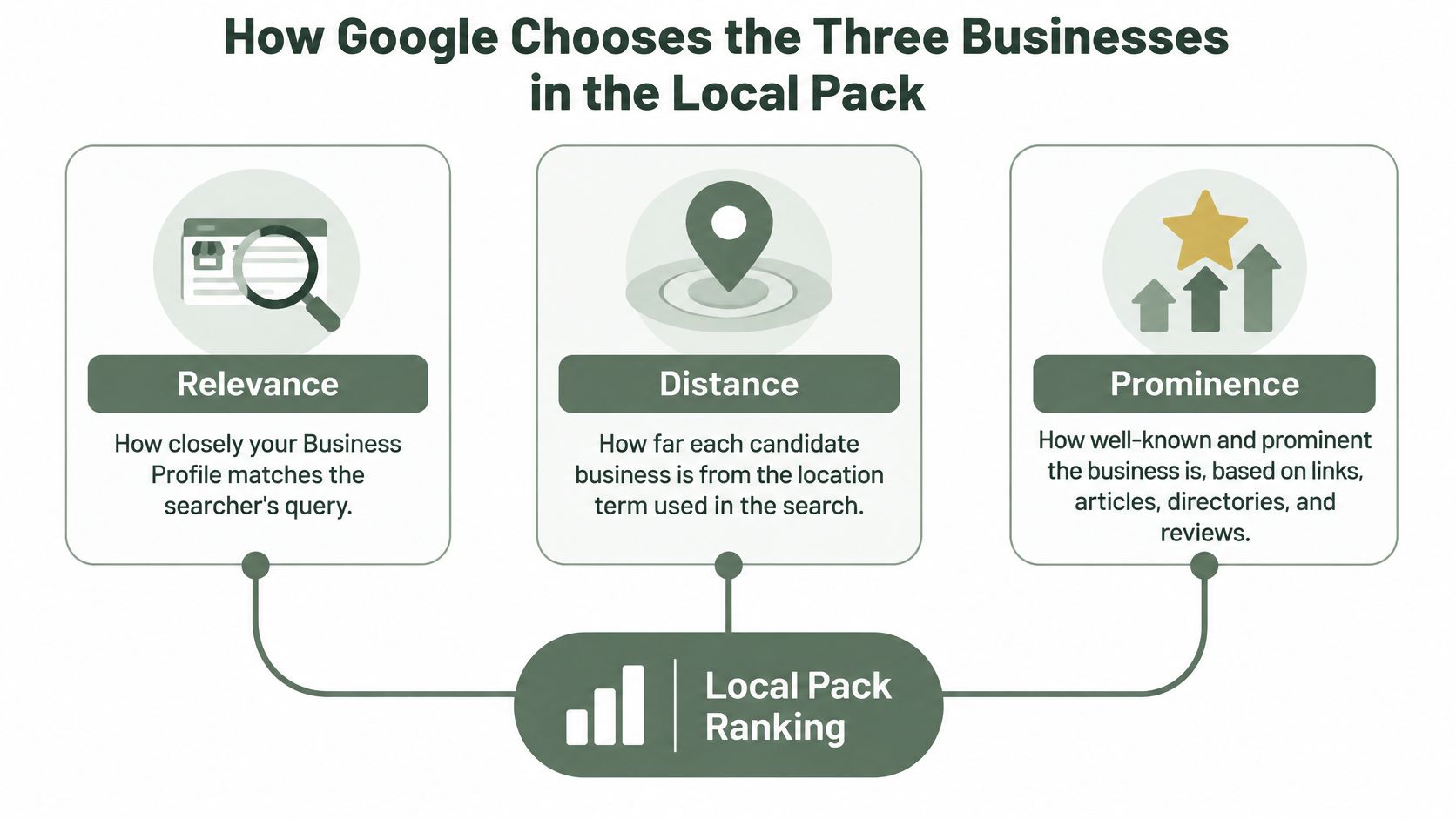
Google's documented framework uses relevance, distance, and prominence, as established in its ranking guidance linked above. These aren't interchangeable. Improving something you control doesn't remove a limitation elsewhere.
Relevance means matching the actual need
Relevance describes how closely your Google Business Profile matches the search. A customer searching for hair coloring needs a different match from someone searching for a barber.
Your categories, services, and business details should describe what you do. Don't make the customer, or Google, infer your main service from a vague description.
For a clinic, that means distinguishing the care available at that location. For a hotel, it means accurately describing the property and its amenities rather than relying on broad promotional language.
Distance sets a practical constraint
Distance concerns proximity to the searcher or the location specified in the search. You can't change that physical relationship by editing a description.
This is why checking your position from your own reception desk isn't enough. Customers elsewhere in the city may see different businesses. There isn't one fixed local position for your entire market.
For a contractor, adding a service area should communicate where you work. Don't treat it as a substitute for having a physical location closer to the customer.
Prominence concerns how well-known you are
Google says prominence can reflect links, articles, directories, and customer reviews. That gives you work beyond completing profile fields, but it doesn't make every online mention equally useful.
Consider the trade-off before choosing the task:
| Your situation | Practical priority |
|---|---|
| Nearby, but your services are unclear | Correct categories and service information |
| Relevant, but poorly represented online | Build credible references and genuine customer feedback |
| Well-established, but distant from the searcher | Test your realistic competitive area before spending more |
Nearby, but your services are unclear
Relevant, but poorly represented online
Well-established, but distant from the searcher
Don't use a strong result near your building as proof that customers across town can find you.
Local pack SEO works best when you diagnose the constraint first. Otherwise, you can spend time polishing a profile without addressing why it's a weak match for the searches you want.
Your Google Business Profile Is the Foundation
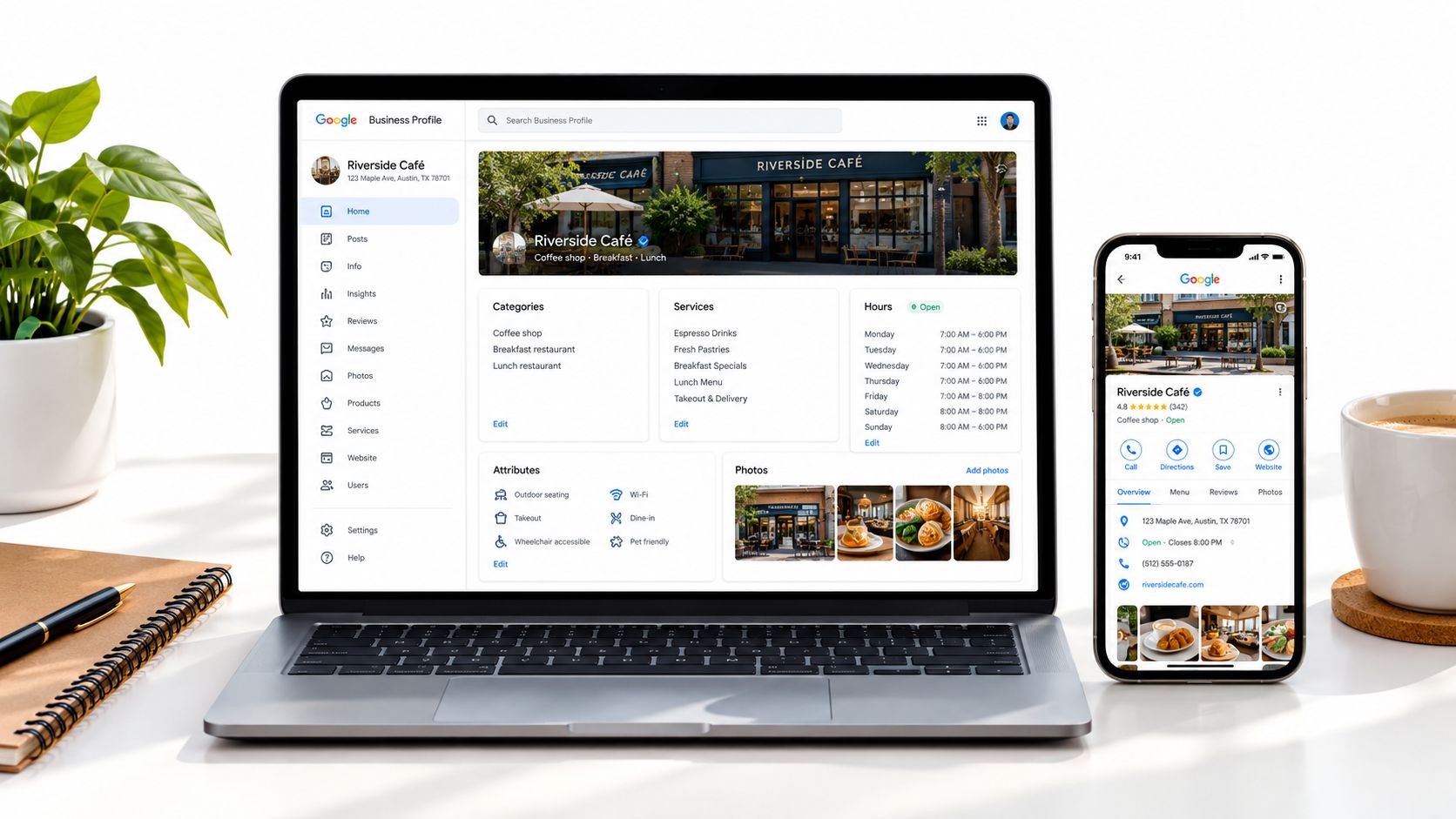
Open your profile as a customer would, not just inside the management screen. Try to establish whether you'd know what the business offers, when you could visit, and how to book.
Fix incorrect information before adding promotional material. An outdated closing time deserves attention before another photo of the reception area.
Audit the details customers depend on
Use this order to keep the work manageable:
For a more systematic review, use this Google Business Profile optimization checklist. Assign someone responsibility for corrections rather than leaving a list of gaps with no owner.
- Categories. Choose categories that describe the business you operate. Don't select unrelated categories just because those searches look attractive.
- Services. List the work customers can purchase. A salon should distinguish its available treatments rather than expecting a broad category to explain everything.
- Hours. Confirm regular hours, holiday changes, and temporary closures. Check these against your staffing plan.
- Attributes. Review accessibility, amenities, and other applicable details. Don't mark something available unless you can deliver it.
- Photos. Show the current entrance, interior, and relevant products or work. Use images that help customers recognize the location and understand the experience.
Use posts to communicate, not chase a ranking shortcut
Google's guidance on Business Profile posts says they appear on Search and Maps and support announcements, offers, updates, and events. Google supports Update, Offer, and Event posts, with publication statuses including Live, Pending, and Not approved.
Posting is a customer-information task, not a confirmed local ranking factor. Use a post when you have something useful to communicate, such as a restaurant event, a hotel offer, or a change in available services.
After publishing, check that the post is live and that its details are correct. Don't assume pressing publish means customers can see it.
| Fix first | Add when useful |
|---|---|
| Incorrect opening hours | An upcoming event |
| Missing service information | A current offer |
| A broken booking destination | Updated photos of the premises |
Incorrect opening hours
Missing service information
A broken booking destination
A busy owner needs that distinction. Maintain essential facts first, then add material that helps customers choose. A posting schedule shouldn't take attention away from inaccurate business information.
Reviews and How They Influence Local Visibility
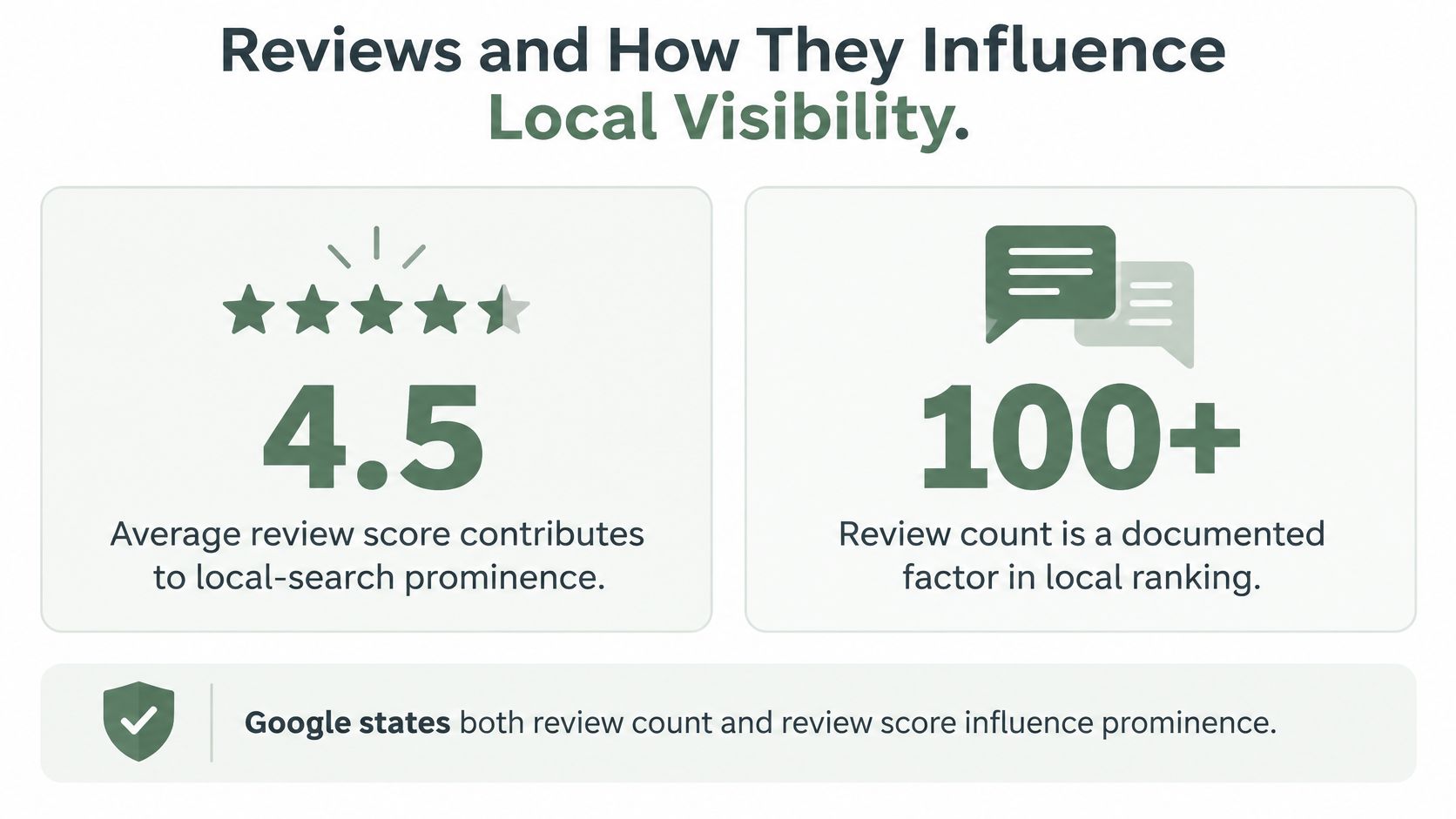
Review count and review score contribute to local-search prominence, according to Google's ranking guidance cited earlier. That makes genuine review activity relevant to visibility, not just to customer confidence.
Keep the boundary clear. Google doesn't identify owner replies, review text, or posting activity as confirmed ranking factors. Respond because customers read your public communications, not because inserting service keywords into every reply promises a better position.
Build an honest review request process
Google's fake engagement policy requires reviews to reflect genuine, unbiased experiences. It prohibits paid reviews and incentives such as discounts, free goods, or free services offered in exchange for a review.
Make the request part of your normal customer follow-up:
The distinction between ranking evidence and customer trust is also covered in this guide to how Google reviews influence local SEO.
- Ask real customers. Request honest feedback after an actual visit or completed service.
- Offer equal choices. Display a public Google review option and a private feedback option side by side. Let every customer choose.
- Keep rewards out. Don't exchange benefits for reviews or require a positive rating.
- Use the same process. Don't decide who gets the public review option based on how satisfied they seem.
Know when more requests aren't the main fix
Don't assume additional reviews will overcome a substantial proximity disadvantage. If nearby customers can find you but customers farther away can't, investigate location patterns before treating review volume as the only problem.
Budget rule: Fix an incorrect category or missing core service before expanding a review request process that already works.
Handle negative feedback professionally. Acknowledge the issue, explain an appropriate next step, and avoid disclosing customer details, especially in a clinic.
For suspected fake reviews, document specific discrepancies and use Google's reporting process. Google's Maps content standards prohibit fake content and personal attacks. A factual report is more useful than a public argument.
Citations, On-Page Content, and Local Signals
Your profile shouldn't describe a different business from your website. If a customer finds an old address in a directory or conflicting booking rules on your site, they have to decide which version to trust.
A citation is a mention of your business information on another website. NAP means name, address, and phone number. Treat consistency as an accuracy task, not a claim that every punctuation difference causes a ranking penalty.
Create a reliable business record
Keep an approved record for each location. Use it when updating your website, directories, and social accounts.
For a franchise, make someone at each location responsible for confirming operational details. Head office may maintain the website, but the local manager knows whether a service is available.
- Business identity. Check the actual business name and correct contact details.
- Location facts. Remove outdated addresses and distinguish branches clearly.
- Customer conditions. Align hours, service availability, accessibility, and booking policies.
- Commercial details. Check menus, published prices, and cancellation terms wherever you publish them.
Write pages that answer local questions
A location page should help someone use that branch. Include the services offered there, how to contact it, and practical arrival or booking information.
For contractors, describe the areas you serve and any relevant service limitations. Don't create pages that merely swap town names while leaving customers with the same vague promises.
Month17's guide to keyword placement for SEO is a useful reference when reviewing page wording. Keep service and location language natural. Customers shouldn't have to read repeated “near me” phrases to understand what you do.
Publish the facts your staff would otherwise have to explain on the phone.
Prioritize meaningful references over collecting directory entries for their own sake. Accurate listings and relevant local mentions fit the prominence framework already described. They aren't a substitute for clear information on your own site.
Tracking Competitors and Measuring Your Progress
Track the businesses customers see beside you, not just the competitor you know personally. Repeat relevant searches from consistent locations and record the date and search phrase. Treat those observations as samples, not a citywide verdict.
Use a competitor analysis checklist to keep comparisons consistent. Look for operational gaps you can fix rather than copying every competitor change.
What to Track Monthly
| Metric | What to Track | Why It Matters |
|---|---|---|
| Local visibility | Businesses appearing for your target searches and locations | Reveals where you compete |
| Competitor reviews | Review counts and ratings | Provides prominence context |
| Profile accuracy | Services, hours, and booking destinations | Identifies customer-facing gaps |
| Customer actions | Direction requests, calls, and completed bookings | Connects discovery with business outcomes |
| AI answers | Inclusion and accuracy of business facts | Checks how your business is represented |
Local visibility
Competitor reviews
Profile accuracy
Customer actions
AI answers
Keep customer actions separate. A direction request isn't a confirmed visit, and a phone click isn't a booked job. Compare discovery with your appointment or sales records where possible.
Prepare for AI discovery without abandoning map results
Google's June 2025 Small Business Bulletin says AI Mode and expanded AI Overviews can use Business Profile information, the wider web, and Google's knowledge base for recommendations and next steps such as reservations.
Check whether those answers describe your services, prices, and policies correctly. Accurate information is a sensible preparation, not a promise of inclusion.
If customers reach your website but struggle to act, consult Blu Dragonfly LLC's local web design guide while reviewing the booking path. This week, start with a profile audit and assign responsibility for each correction.
---
RecensioAI B.V. offers profile audits, competitor tracking, and automated review requests that give every customer public Google review and private feedback options side by side. If you'd rather manage those recurring tasks in one place, visit RecensioAI B.V. and start with its Google Business Profile audit.
Frequently asked questions
You might also like
Handpicked articles for you
Hotel Review Management: Automate Post-Stay Requests with Apaleo, Mews and Your PMS
A practical guide to turning hotel checkouts into timely review requests, with Apaleo live, Mews early access and flexible PMS alternatives.
Why the Business Around the Corner Beats You on Google: What 21,373 Profiles Reveal
We compared 21,373 Google Business Profiles with their three strongest nearby competitors. The gap is smaller than most owners think, but it has two sides: rating and volume.
Treatwell Review Management for Salons: One Reputation View Alongside Google
Bring your public Treatwell rating and recent reviews into RecensioAI, then combine salon signals with Google for faster, better decisions.