How to Get Customers to Write a Review That Actually Helps
The reviews that win you customers name the service, the staff and the moment. How to ask, when to ask and what to say, with examples for restaurants, salons, clinics and contractors.
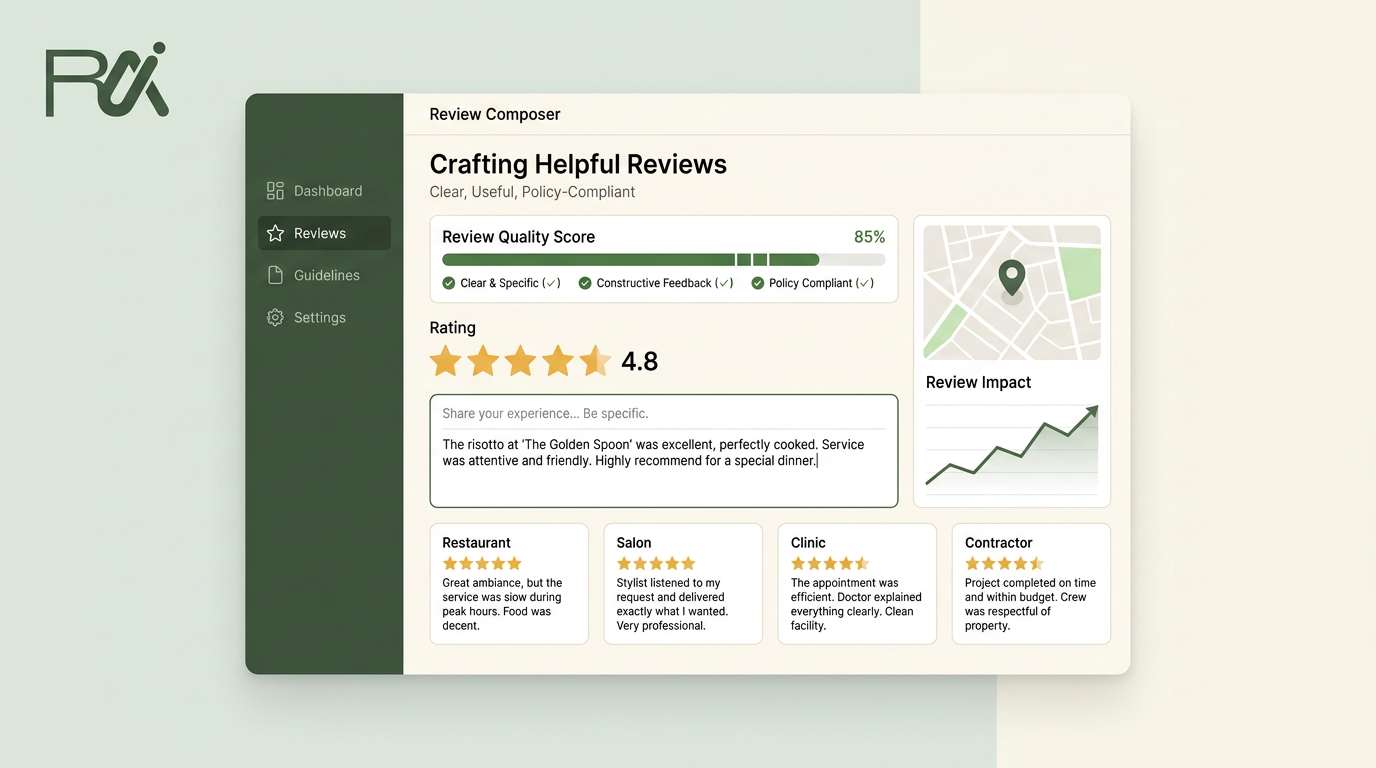
Table of Contents
- 1Introduction
- 2Why the Way a Review Gets Written Matters More Than You Think
- 3What Every Helpful Review Has in Common
- 4What Google Will Pull and What Gets Removed
- 5How to Ask Customers for a Review Without Sounding Desperate
- 6What to Write and What to Skip, Side by Side
- 7From a Better Review to a Busier Map
Introduction
A customer leaves your restaurant, salon, clinic, hotel, or job site happy. Your team thanks them. Then the door closes, the phone rings, and nobody asks for a review. A week later, your Google Business Profile still has the same vague comments, or no new comments at all.
That silence matters. A useful review gives the next customer a reason to choose you, while “Great place” gives them almost nothing to work with. If you manage a local business, teaching customers how to write a review is a practical service skill. You're not asking them to create marketing content. You're helping them explain what happened in a way that helps another person decide.
Why the Way a Review Gets Written Matters More Than You Think
A customer can leave five stars and still fail to answer the questions that stop a stranger from calling. Was the restaurant good for someone with allergies? Did the salon charge what it quoted? Did the contractor arrive when promised? Was parking manageable? Was the staff helpful when something went wrong?
A thin review such as “Good service” confirms almost nothing. It doesn't explain what the customer bought, who helped them, or why the experience was worth repeating. It also gives your profile little useful context for people comparing businesses in Google Maps.
Now compare two profiles. The first has fifty three-star reviews, most saying “good service,” “nice place,” or “okay.” The second has eight detailed reviews that mention a specific dish, the price, parking, the wait, and a staff member by name. The second profile gives a reader more to evaluate. It can pull more clicks and calls because the writing answers practical questions, not because the average rating is automatically higher.
Review-writing guidance consistently pairs a clear judgment with evidence, examples, background, and an organized structure in review-writing guidance from ReadWriteThink. Google also recommends specifics, comparisons, benefits, drawbacks, measurements, and first-hand evidence in its guidance for high-quality reviews, as summarized in Google review guidance reported by WiserNotify.
Practical rule: Ask customers to describe the experience they had, not simply to announce whether they liked it.
That's the skill you can teach. A customer doesn't need a script or polished writing. They need a simple prompt that helps them remember the useful details while the visit is still fresh.
What Every Helpful Review Has in Common
A helpful review usually contains five building blocks. You don't need to hand every customer the same sentence. Give them the pattern, then let them use their own words.
Here's how the same skeleton looks across different businesses:
| Business | Useful details |
|---|---|
| Restaurant | A corner table, a waiter who remembered an allergy, a pasta dish that felt worth the price, and whether the guest would return |
| Salon | The stylist's name, the consultation at the sink, the result, and whether the final bill matched the quote |
| Contractor | The quote, start date, crew lead, cleanup, and a small fix completed without an extra charge |
Restaurant
Salon
Contractor
A customer could turn any of those into three or four plain sentences without sounding rehearsed. The pattern is the takeaway. The wording should belong to the customer.
For a deeper look at why customers choose to post, share the psychology behind customer reviews. The motivation isn't always simple satisfaction. Research connects review intention with factors such as enjoyment, attitude toward reviewing, perceived control, and the desire to protect one's self-image, according to the consumer review motivation research.

- What they booked or bought. A restaurant guest can name the pasta, tasting menu, or takeout order. A salon client can identify a color service or haircut. A homeowner can explain whether they hired you for a panel upgrade, leak repair, or bathroom renovation.
- Who served them. Names make the account concrete. “Maria explained the color options” tells a future client more than “the staff was nice.” A contractor review can mention the crew lead who answered questions before work began.
- What stood out. This is the moment another buyer wants to understand. It might be a waiter remembering an allergy, a stylist catching an uneven layer before the client left, or a plumber explaining the failed part before replacing it.
- How the price or timing felt. Customers can describe whether the final bill matched the quote, whether the wait felt reasonable, or whether the crew started when promised. They don't need to publish private billing details or turn the review into an advertisement.
- Whether they'd return or hire you again. The closing judgment gives the details meaning. “I'd book this service again” is stronger when the reader already knows what happened.
What Google Will Pull and What Gets Removed
Google's basic rule is straightforward. Reviews should describe a genuine experience and shouldn't exist to manipulate ratings. Google prohibits fake content, duplicate content, and multiple-account reviews for the same product, as explained in its official review content policy.
Coach customers away from content that looks promotional, unrelated, or abusive:
| Review Snippet | Status | Why |
|---|---|---|
| “The technician fixed our furnace and explained the repair clearly.” | Stays | First-hand and specific |
| “Visit www.example.com and use code SAVE20.” | May be removed | Contains a URL and promotional material |
| “Call me at 555-0100 for the contractor I use.” | May be removed | Includes personal contact information |
| “Best deal in town. Buy today.” | May be removed | Reads like an advertisement |
| “This business is terrible because of their religion.” | Removed or restricted | Targets a protected group |
| “Go to our competitor instead.” | May be removed | Promotes or attacks another business |
| “I hated it.” | May be ignored or removed | Lacks useful experience details |
| “This review is for the downtown branch,” posted on the airport branch profile | May be removed | Reviews the wrong location |
| “Give me a discount and I'll leave five stars.” | Policy violation | Exchanges an incentive for rating manipulation |
“The technician fixed our furnace and explained the repair clearly.”
“Visit www.example.com and use code SAVE20.”
“Call me at 555-0100 for the contractor I use.”
“Best deal in town. Buy today.”
“This business is terrible because of their religion.”
“Go to our competitor instead.”
“I hated it.”
“This review is for the downtown branch,” posted on the airport branch profile
“Give me a discount and I'll leave five stars.”
The practical instruction is easy: write about the visit, leave the URL bar alone, and save the offer code for the receipt. A customer can mention that a service was expensive or that a wait was long. The problem starts when the review becomes a rant with no details, a discount advertisement, a competitor attack, or a post about another location.
If you're also concerned about text that looks automated or unnatural, review how Humantext.pro helps avoid penalties for broader writing-quality considerations. For the exact situations in which Google may remove a review, use this guide to when Google will actually remove a review.
How to Ask Customers for a Review Without Sounding Desperate
Ask after a visible win, while the customer can still describe what went well. The restaurant table has been cleared and the guest is smiling. The salon client keeps turning toward the mirror. The homeowner walks around the finished repair and sees that the problem is gone. These moments give customers a clear experience to report.
Ask in person first, then send the same short request by text or email that night. Make it part of a normal thank-you, rather than a separate campaign that creates pressure.
“Thanks for coming in today. If you have a minute, a review about what you ordered and how the visit went can help neighbors find us on Google Maps.”
Send a direct link to the Google review form, not the full profile. Every extra step, from searching for the listing to finding the review area and choosing an account, gives the customer a reason to stop. Keep the message short, and do not ask for a particular star rating.
Never offer a discount in exchange for a review. Send the request to customers based on the completed interaction, not only on whether you expect praise. RecensioAI presents a public Google review option and a private feedback option side by side, leaving the choice to the customer. That distinction matters because review gating violates Google's policy.
Timing and context affect whether customers post. Research found that extremely dissatisfied customers may post to complain, while generally satisfied customers may be more likely to post than extremely satisfied customers. Platform engagement and proximity to the experience also affect posting behavior, supporting a request made while the interaction is fresh, as described in the research on review-posting behavior.
A genuine review adds customer language to your profile and gives future buyers more context. Google says local results depend primarily on relevance, distance, and prominence, and that review quantity and positive ratings can help local ranking. Clear requests do not guarantee a position in the local pack. They help customers share information that other customers can use.
For a ready-to-use conversation, follow this guide to asking customers for a review without being awkward.
What to Write and What to Skip, Side by Side
Customers often ask, “How do I write a review?” They usually don't need a paragraph about grammar. They need to know which details are useful and which ones create risk or distract from the visit.
| Situation | What to Write (Do) | What Skips or Breaks the Review (Don't) |
|---|---|---|
| Restaurant visit | “Jordan handled my allergy question carefully, and the corner table worked well for our family.” | “Five stars, five stars, five stars.” |
| Salon appointment | “Tina noticed one uneven layer before I left and fixed it during the appointment.” | “The weather was awful and parking was annoying.” |
| Plumbing repair | “Luis showed me the failed part before replacing it and explained what to watch for next.” | “My old bill from another visit was ridiculous.” |
| Contractor project | “The crew started on the agreed date, cleaned up, and repaired a small issue without charging extra.” | “Use this company instead of the contractor down the street.” |
| Clinic visit | “The front desk explained the paperwork, and the appointment started close to the scheduled time.” | Private medical details that the customer wouldn't want public |
Restaurant visit
Salon appointment
Plumbing repair
Contractor project
Clinic visit
A good review names the service, staff member, and specific moment. It can also explain who the business suits. “A good choice for families managing food allergies” gives the next restaurant customer a useful reason to investigate. “Helpful for anyone renovating an older bungalow” gives a contractor profile practical context.
A bad review may still contain a legitimate complaint, but the writer should keep it tied to the purchase. “The wait was longer than expected during dinner” is relevant. A personal attack, private billing information, competitor name, or a rant about a separate old visit isn't.
Write the sharpest memory, not the longest story.
Don't ask customers to stuff in keywords, repeat a phrase, or add rows of five-star emojis. That makes the review look unnatural and can weaken trust. If you manage several locations, remind customers to select the correct branch before submitting.
If your team also needs help coordinating follow-up messages and other small-business communications, a tool for social media scheduling for startups may help organize the timing. Keep the review request itself direct and personal.
The best time to post is the day of the visit, while the staff interaction, service detail, and final impression are still clear. Three weeks later, the customer may remember the rating but forget the moment that would have helped someone else.
From a Better Review to a Busier Map
Reviews support local visibility in two different ways, and you should keep them separate. Google identifies relevance, distance, and prominence as the primary local ranking factors. Google also says prominence can reflect signals such as links and reviews, and that more reviews and positive ratings can help local ranking, as explained in Google's local ranking guidance.
The writing itself isn't a confirmed ranking lever. A detailed review doesn't guarantee a local-pack position, and responding to reviews isn't a documented cause of higher rankings. The practical benefit is that detailed customer language helps a buyer understand your business and can make your Google Business Profile feel more complete and credible.
A review that says “pedicure for thick toenails” gives a future client more context than “great salon.” A review that mentions a panel upgrade for an older home helps a homeowner decide whether to call. A hotel guest who describes parking, check-in, room noise, and staff response answers questions that a star rating cannot.
Google's own guidance says a complete profile helps match a business to relevant searches, while independent local SEO guidance explains the difference between relevance and prominence and treats profile completeness as an operating task, not a ranking promise. You can review that distinction in local SEO ranking factors.
Start this week with one habit. At the counter, front desk, chair, or job site, choose the next satisfied customer and ask for one specific moment from that day. Send a direct review request after the visit, keep the public and private feedback options equally available, and check that the customer is reviewing the correct location.
---
RecensioAI B.V. helps local businesses send review requests by email, SMS, QR code, or shareable link, while giving customers equal public Google review and private feedback options. Visit RecensioAI B.V. to see how it can help your team make review requests part of the normal customer follow-up process.
Frequently asked questions
You might also like
Handpicked articles for you
Hotel Review Management: Automate Post-Stay Requests with Apaleo, Mews and Your PMS
A practical guide to turning hotel checkouts into timely review requests, with Apaleo live, Mews early access and flexible PMS alternatives.
Why the Business Around the Corner Beats You on Google: What 21,373 Profiles Reveal
We compared 21,373 Google Business Profiles with their three strongest nearby competitors. The gap is smaller than most owners think, but it has two sides: rating and volume.
Treatwell Review Management for Salons: One Reputation View Alongside Google
Bring your public Treatwell rating and recent reviews into RecensioAI, then combine salon signals with Google for faster, better decisions.