How to Respond to Negative Reviews as a Local Business
Learn how to respond to negative reviews with a practical protocol, reply templates, timing targets, and escalation steps for local business owners.
Table of Contents
- 1Introduction
- 2Why a Negative Review Is Read by Future Customers
- 3Classify the Complaint Before You Write a Word
- 4Reply Templates for the Complaints You Actually Get
- 5How Fast to Reply and How Many Reviews to Answer
- 6What Happens After the Public Reply
- 7Handling Replies Yourself, Delegating, or Using Software
- 8Your Next Step This Week
Introduction
A one-star review lands on your phone during Friday dinner service. You're short-staffed, the kitchen is backed up, and the first impulse is to fire back or leave it alone until Monday. Neither choice tells future customers much about how you handle a problem.
When you respond to negative reviews, you're speaking to the reviewer and to the people deciding whether to call, book, or visit. A useful reply is calm, specific, and followed by action. It won't guarantee a better position in Google Maps, but it can show a prospective customer that your business takes concerns seriously.
Why a Negative Review Is Read by Future Customers
A restaurant owner might see a one-star review between tables and think it's a private complaint made public. It isn't. Someone comparing nearby restaurants, salons, clinics, hotels, or contractors can read the review and your response before making contact. Your reply gives that person evidence of how you handle a mistake or disagreement.
BrightLocal's 2024 Local Consumer Review Survey questioned a representative panel of 1,141 U.S. consumers. It found that 93% expected businesses to respond to reviews, 34% wanted a reply within two or three days, and 88% said they'd consider using a business that responded to both positive and negative reviews, compared with 47% for a business that didn't respond at all. The earlier pattern was similar: BrightLocal's 2019 survey found that 97% of consumers who read local-business reviews also read the business's responses.
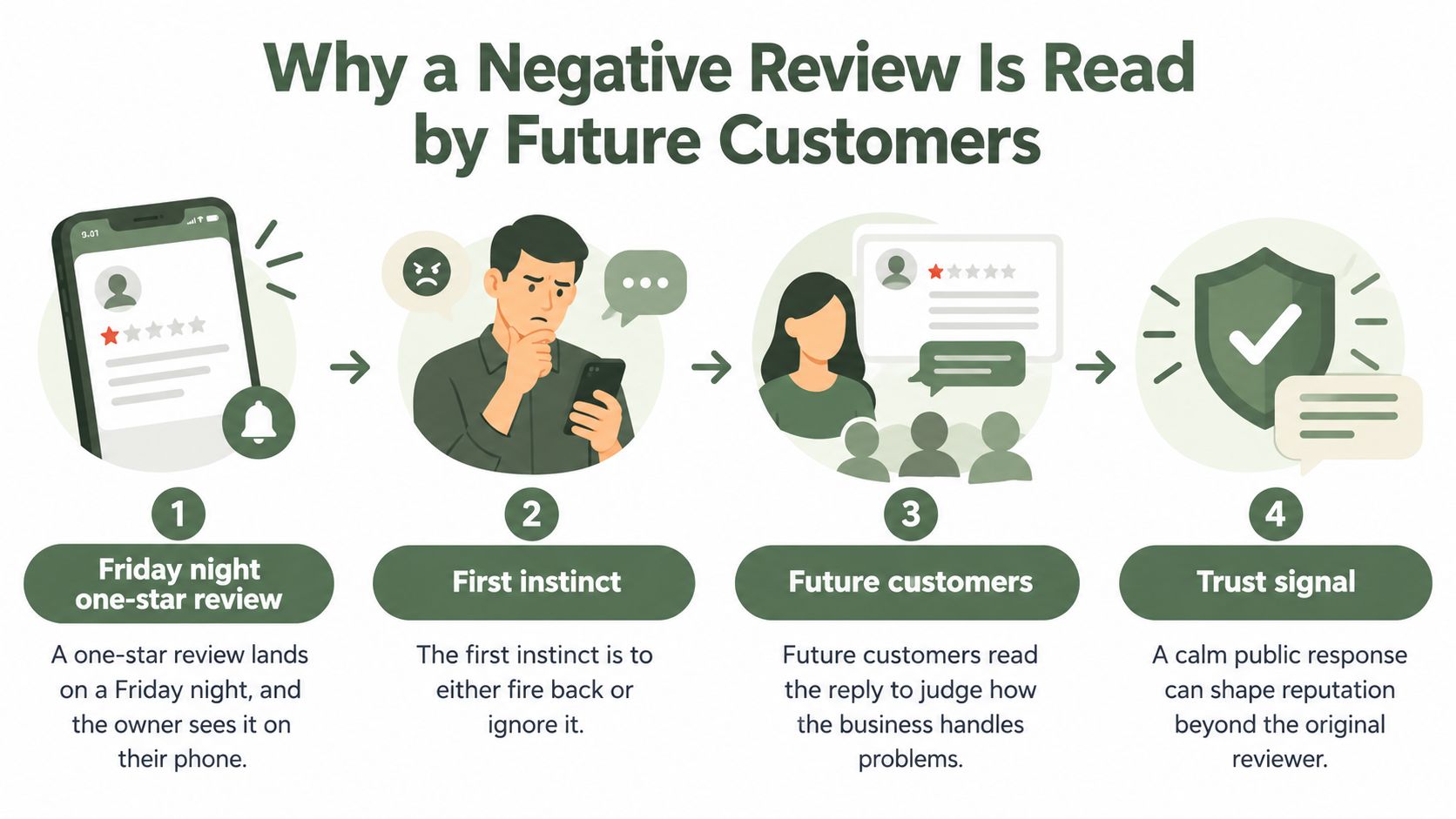
That makes the reply part of the customer's first impression. A short, professional answer can show that you listened and took a next step, even if the original review remains visible. If you're also working on how local customers find your business, this guide to attract more customers through local search offers broader context.
Keep the ranking claim honest. Google names relevance, distance, and prominence as factors in local results, and says review count and positive ratings can contribute to prominence. Its guidance doesn't list replying to reviews, reply wording, or posting activity as confirmed ranking factors. Respond for trust and useful communication, not a promised ranking gain. (Google's local ranking guidance)
Classify the Complaint Before You Write a Word
A generic apology falls flat when it doesn't match what went wrong. Before drafting, identify the complaint. Is it a technical outcome, such as a wrong dish, billing error, or treatment that didn't meet expectations? A functional interaction, such as a rude exchange or slow communication? A quality problem, a fulfillment delay, an allegation of dishonesty, or a review that may not describe a genuine visit?
Then build the response around four moves: acknowledge the specific issue, apologize without arguing in public, state one concrete action, and move private details to a direct channel.
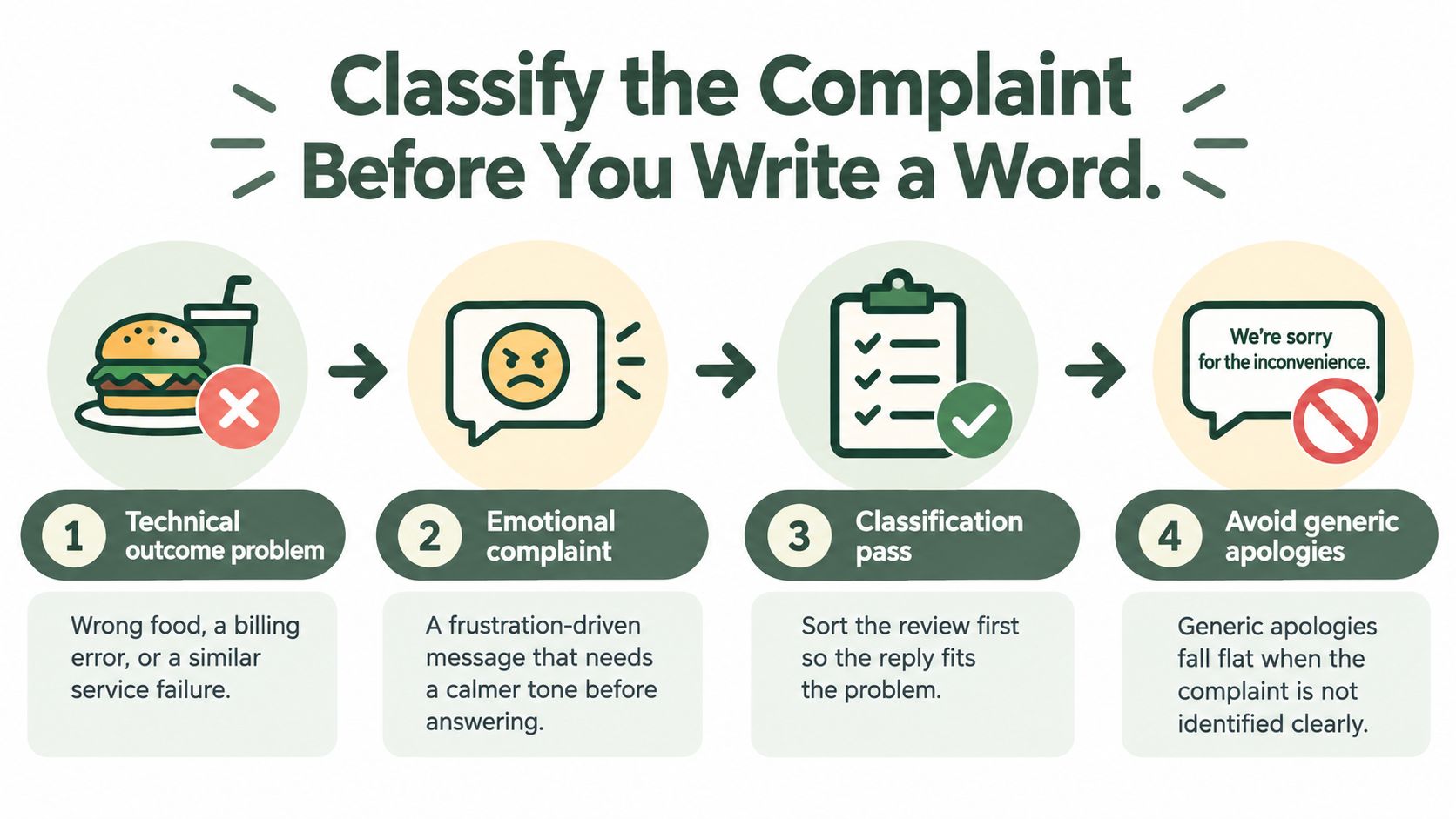
The response pattern should change with the failure. For a slow salon reply, acknowledge the delay, apologize, and say who will review the communication process. For a clinic billing concern, recognize the frustration and invite the patient to contact the office privately so staff can check the account without exposing personal information. A hotel dealing with a noisy room can acknowledge the disruption and explain that management will review how room concerns are handled.
Don't treat an apology as a complete remedy. A trust-repair study found that explanations were broadly effective across quality, attitude, and fulfillment problems; apologies mainly repaired perceived attitude problems; and compensation was most effective for quality problems. A separate study of 1,062 participants found that apologies increased emotional and rational trust, purchase intention, and recommendation intention. (Trust-repair research)
If the complaint is inaccurate, don't accept a false claim just to sound agreeable. Verify your records, then correct the point briefly and without attacking the reviewer. If you suspect a fake review, document what makes you question it before reporting it. This guide to spotting and dealing with fake reviews can help you think through that distinction. Restaurants can also consider practical service details, such as captive portals for better dining experiences, as part of improving the experience that reviews describe.
How Fast to Reply and How Many Reviews to Answer
Routine dissatisfaction should get a considered reply within a few days, rather than sitting unanswered while you search for perfect wording. That window matches the 34% of consumers in BrightLocal's survey who wanted a response within two or three days, and its finding that 87% expected a response within two weeks. Those expectations are useful planning markers, not a reason to rush an unverified answer.
Safety, discrimination, privacy, payment, or legal allegations need immediate escalation to an appropriate manager or specialist. A frontline employee shouldn't improvise an admission or publish sensitive details just to respond quickly.
Cornell hospitality research analyzed TripAdvisor reviews and operating-performance data from 80 hotels managed by five management firms. It associated management responses with improved sales and revenue, in part because consumers were more likely to click through to hotel listings on online travel agencies. The reported benefit had limits: revenue reached diminishing returns at approximately a 40% response rate, and was lower when managers replied to more than 85% of reviews than when they didn't respond at all. The researchers also found that consumers valued replies to negative reviews more than simple acknowledgments of positive ones. (Cornell's hotel review research)
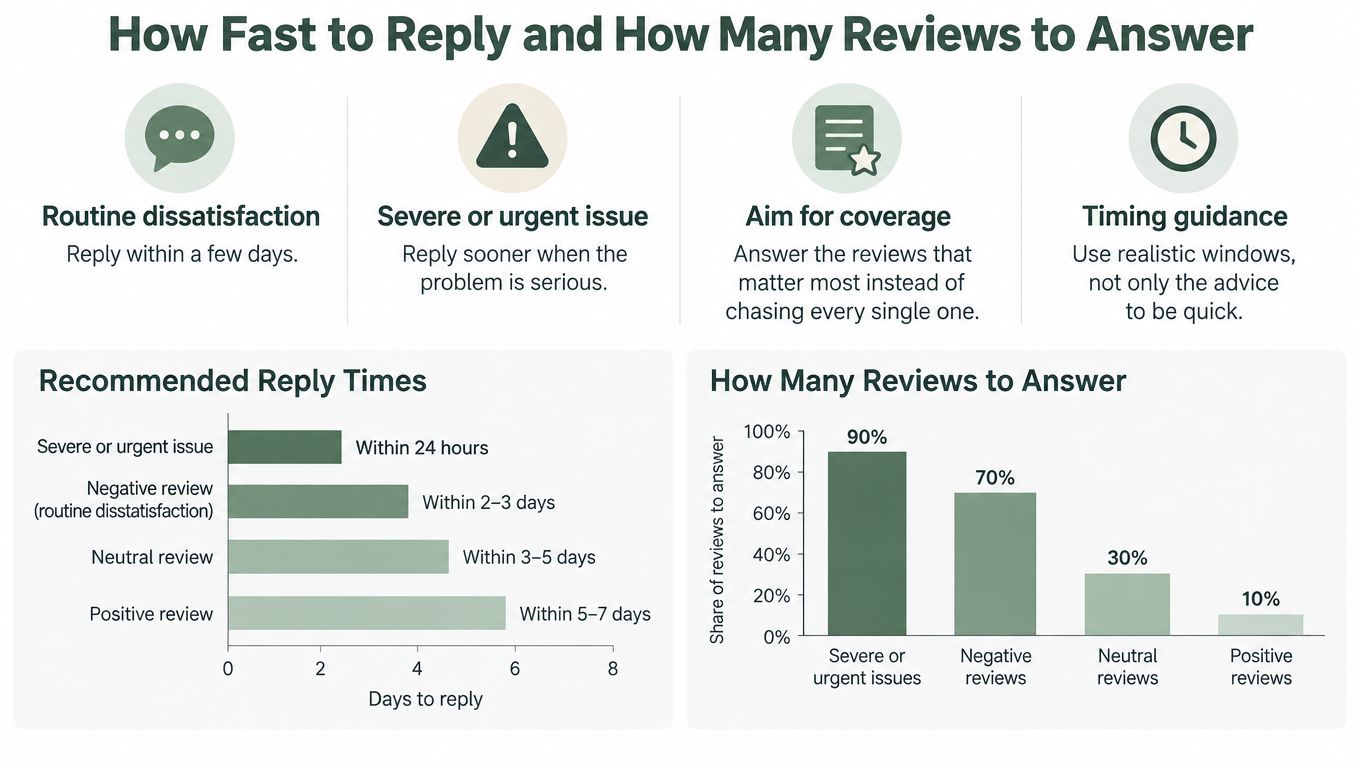
Don't chase a response percentage. Set a priority order: handle serious and repeated complaints first, then recent negative reviews, then other feedback as time allows. A Cornell study is a reminder that volume alone isn't a sound measure of quality. For a practical timing framework, see this guide to how fast to reply to a Google review.
What Happens After the Public Reply
A well-written public reply doesn't repair a billing process, shorten a queue, or fix a missed appointment. Use the response to acknowledge the issue, then do the work that prevents the same complaint from returning.
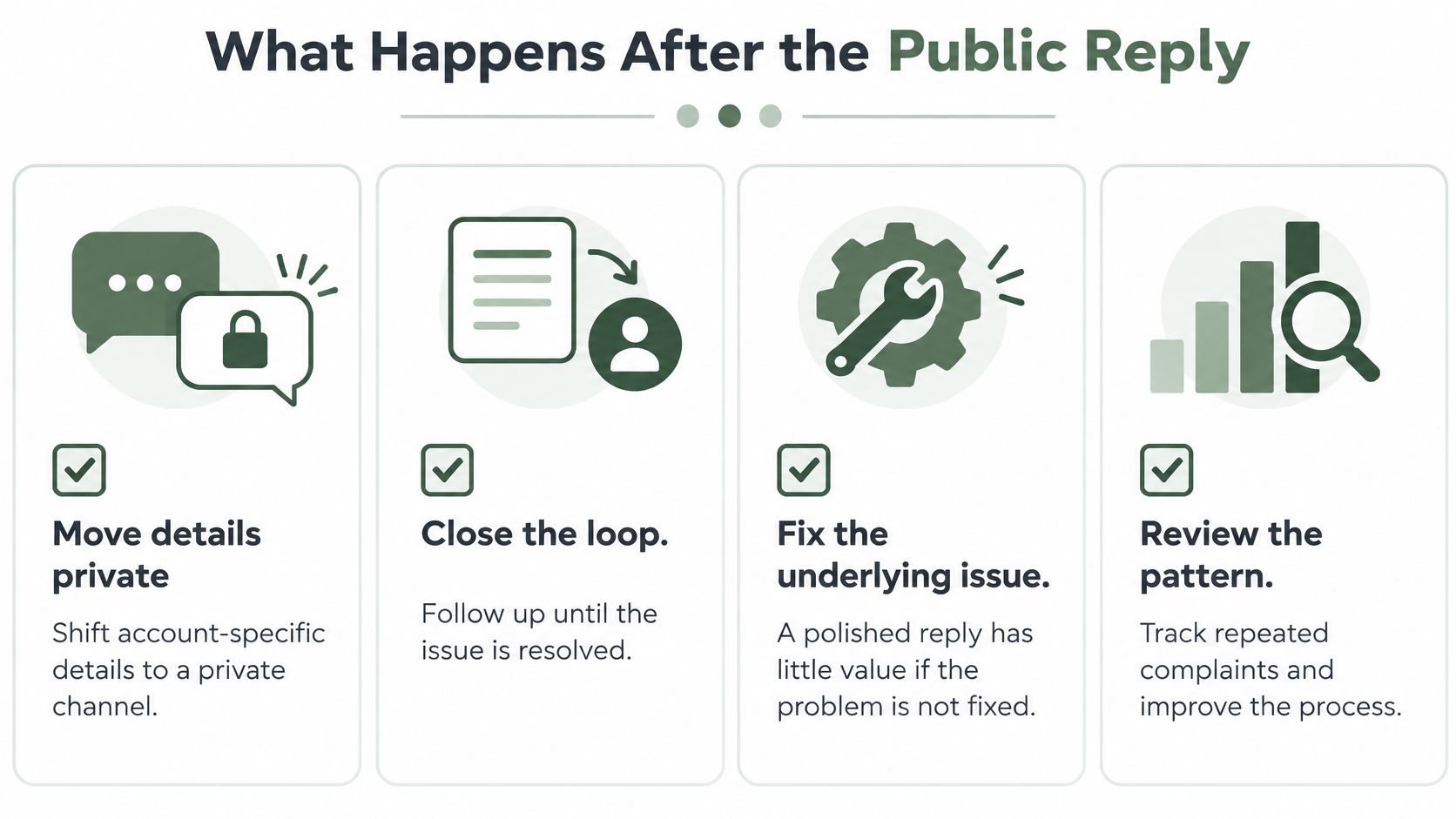
Move account-specific details to a private channel. If you verify a material service failure, follow up with the customer and offer a proportionate remedy where appropriate. Don't promise a fix publicly unless someone owns it and can carry it out.
Run a weekly theme audit. Group recurring complaints, such as missed callbacks, long waits, or confusing invoices, and assign each theme an owner, a deadline, and a process change. That turns scattered reviews into practical decisions about staffing, training, or procedures. If employees share response duties, a clear review process can also support support QA grading.
For a suspected fake review, keep notes on why you believe the reviewer may not have visited and whether the wording appears duplicated or promotional. Google requires reviews to reflect a genuine experience and be genuine and unbiased. It warns that fake or incentivized review activity can lead to profile restrictions, including preventing new reviews, temporarily unpublishing existing ratings, and displaying a warning to consumers. (Google's prohibited-content policy)
Measure follow-through, not just reply volume. Track median time to acknowledgment, the share of verified cases with documented corrective action, recurrence by complaint theme, and rating trends after resolution. Those measures help you see whether your process is improving the customer experience rather than just producing more replies.
Handling Replies Yourself, Delegating, or Using Software
There are three workable approaches, and each comes with a trade-off.
| Option | Control over tone and facts | Time cost per week | Consistency across locations | Escalation handling |
|---|---|---|---|---|
| Handle replies yourself | Highest, if you know the facts | Competes with running the business | Depends on you | Direct control, but can bottleneck |
| Delegate to staff | Good with clear approval rules | Shared across the team | Requires a written protocol | Needs named escalation contacts |
| Use review management software | Depends on settings and human oversight | Reduces repetitive work | Easier to standardize | Check that sensitive cases have a clear route |
Handle replies yourself
Delegate to staff
Use review management software
If you reply yourself, you'll have control over tone and context, but reviews may go unanswered when service gets busy. Delegating to a manager or front-desk employee spreads the work. Give that person a classification checklist, approved ways to move conversations private, and a rule for escalating sensitive allegations. Don't let staff improvise admissions or disclose customer information.
Software can help organize incoming reviews, draft replies, and identify repeated themes. It still needs sensible rules for what can be answered routinely and what should go to a manager. This guide to review management software can help you compare options.
Whichever route you choose, keep the business goal clear. Google documents review count and positive ratings as factors under prominence, but doesn't list replies as a confirmed ranking factor. Use replies to communicate with customers, build trust, and keep your profile useful, not to expect a ranking boost.
Your Next Step This Week
Write a one-page reply protocol for your business. Include the complaint categories, the four-part response structure, timing targets by severity, the person to contact for escalation, and who owns the weekly theme audit. Then apply it to the three most recent negative reviews on your Google Business Profile and check whether each reply matches the facts and the action taken.
Stop replying in arrival order. Stop using one apology for every complaint, counting replies as the success measure, or treating a public response as a substitute for fixing the problem.
Your Google Business Profile must be verified before you can reply. Replies are posted from the business profile, not the reviewer's account, and you can't directly delete someone else's review. If it violates policy, you can report it for Google to review. (Google's review reply and removal guidance) A timely, specific, professional reply is reputational evidence, even when the review stays visible.
---
RecensioAI B.V. offers review-response tools that can draft replies in your business's tone, group feedback into recurring themes, and support documentation of suspected fake reviews. If you want to see whether that fits your review process, visit RecensioAI B.V..
Frequently asked questions
You might also like
Handpicked articles for you
Hotel Review Management: Automate Post-Stay Requests with Apaleo, Mews and Your PMS
A practical guide to turning hotel checkouts into timely review requests, with Apaleo live, Mews early access and flexible PMS alternatives.
Why the Business Around the Corner Beats You on Google: What 21,373 Profiles Reveal
We compared 21,373 Google Business Profiles with their three strongest nearby competitors. The gap is smaller than most owners think, but it has two sides: rating and volume.
Treatwell Review Management for Salons: One Reputation View Alongside Google
Bring your public Treatwell rating and recent reviews into RecensioAI, then combine salon signals with Google for faster, better decisions.