Negative Google Review Response That Builds Trust
Learn a practical negative Google review response process with templates, escalation rules, fake-review guidance, and ways to measure what happens next.
Table of Contents
- 1Introduction
- 2Why a Negative Review Needs a Careful Response
- 3Build a Response Workflow You Can Use This Week
- 4Read and assess before drafting
- 5Reply publicly, resolve privately
- 6Match the Reply to the Service Failure
- 7Use examples that fit the actual problem
- 8Write a Calm Public Response With Templates
- 9Adapt these templates to the facts
- 10Keep the public thread clean
- 11Handle Defensive, Public, or Disputed Feedback
- 12Decide whether a report is appropriate
- 13Respond to Suspected Fake or Coordinated Reviews
- 14Report through the profile and keep the thread neutral
- 15Measure Whether the Response Process Is Working
Introduction
A restaurant owner checks Google after a packed dinner service and finds a complaint about a delayed order. A hotel manager reads that a guest couldn't sleep because of hallway noise. A clinic manager sees that a patient felt rushed. The first instinct may be to explain, correct the record, or defend the staff. Don't post while you're angry. Your reply is public, and future customers may read it before deciding whether to call, book, or visit.
Why a Negative Review Needs a Careful Response
A negative Google review doesn't tell the whole story, but the public thread gives you a chance to show how your business handles a problem. Someone searching Google Maps for a nearby restaurant, salon, clinic, hotel, or contractor may read both the complaint and your reply. A defensive response can make the business look dismissive, even when the reviewer's account is incomplete. A calm, specific reply gives readers something more useful to judge: whether you listened and took a practical next step.
Google identifies review count and review score as local-ranking inputs. It doesn't identify a reply to an individual review as a ranking factor. Treat responding as customer service and public accountability, not a shortcut to better map results. Google's local-ranking guidance explains the documented role of review count and score without claiming that responses improve ranking.
Your public reply is only one part of handling a complaint. The operational work happens when you check what went wrong, assign someone to resolve it, and follow up. If your staff need a broader process for listening and resolving issues, how to handle customer complaints offers a useful starting point. For more examples of response mistakes to avoid, see common mistakes businesses make when handling negative reviews.
Practical rule: A good negative Google review response acknowledges the specific experience, avoids speculation, states a practical next step, and moves private details out of the public thread.
That means you don't need to settle every disputed detail in public. You do need to show that you've read the complaint and know what you'll do next. Keep the reply measured, then do the work behind it.
Build a Response Workflow You Can Use This Week
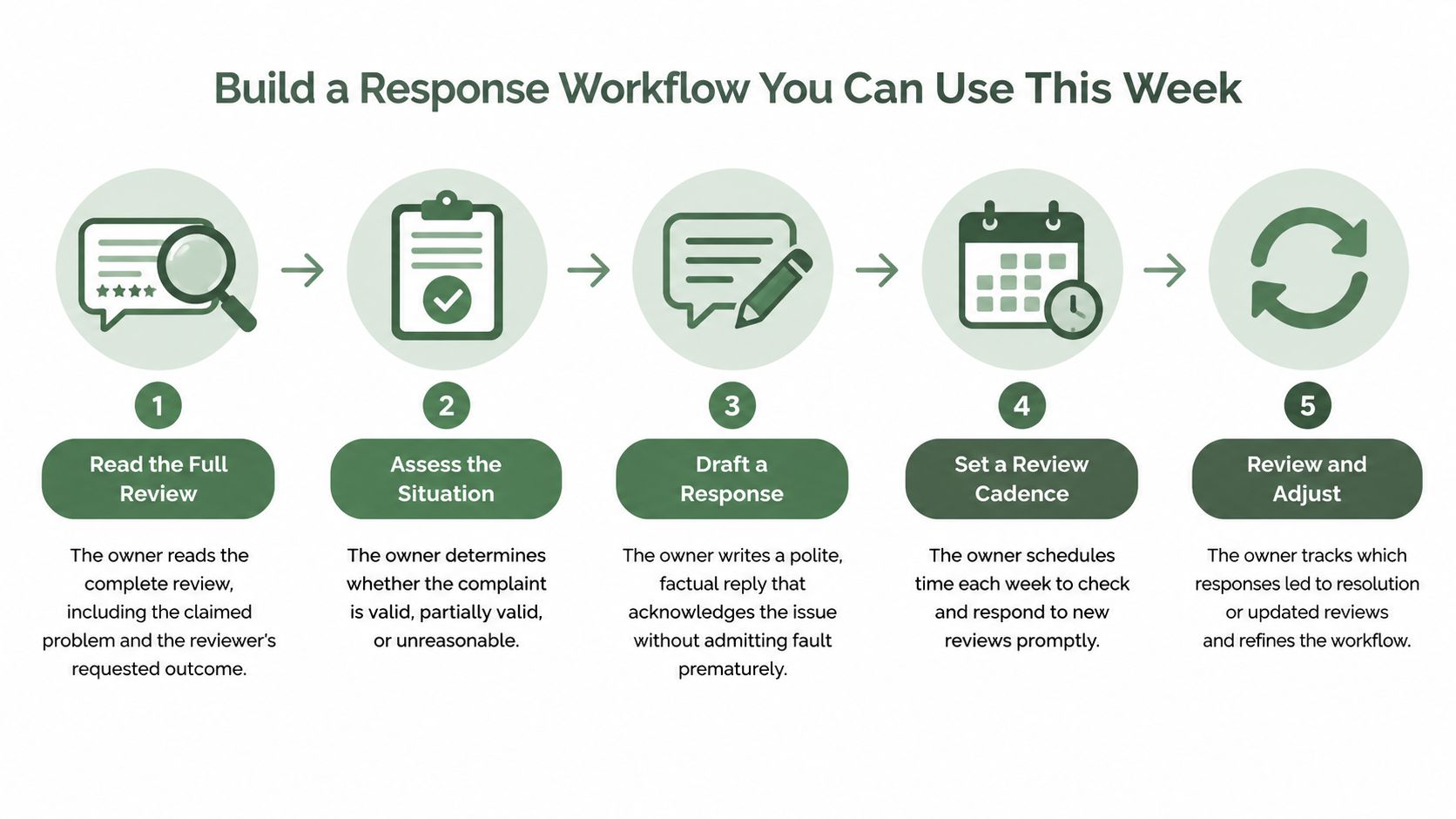
A review response shouldn't be a one-off writing task. Treat it as the public part of a service-recovery process: read, assess, assign, respond, and follow up. That keeps your team from posting an apology before anyone has checked what happened.
Read and assess before drafting
Read the complete review, including the specific problem and what the reviewer seems to want. Save an internal record of the wording and date. Separate what you can verify from what you're assuming. A restaurant manager might confirm a delayed ticket but still need to check why it happened. A clinic manager should not assume a patient's identity or visit details from a public post.
Check whether the complaint involves safety, privacy, discrimination, fraud, payment, or possible legal exposure. If it does, send it to a trained manager before replying. For other complaints, identify the failure type, assign an owner, and decide what you can accurately say in public. Acknowledging someone's concern isn't the same as admitting an unverified allegation.
Match the Reply to the Service Failure
The same apology won't solve every complaint. Diagnose the operational failure before choosing what to say. A food-quality problem calls for a different response from a stylist's brusque manner, a missed contractor appointment, or a booking error at a hotel.
| Failure type | Public reply | Private follow-up |
|---|---|---|
| Quality | Acknowledge the specific product or service concern. Say what you're checking. | Verify the order, treatment, or work performed. Offer proportionate recovery if the failure is confirmed. |
| Employee attitude | Recognize that the customer felt dismissed or disrespected. Don't defend the employee in public. | Speak with the staff involved, check available records, and decide whether coaching or escalation is needed. |
| Fulfillment or delay | Name the late order, missed appointment, or service delay. Explain only what you've verified. | Check the schedule, handoff, staffing, and any communication the customer received. |
| Billing or booking | Acknowledge the reported discrepancy without posting personal or payment details. | Verify the bill, reservation, or booking record through an official channel. Escalate disputed charges or sensitive records to a manager. |
Quality
Employee attitude
Fulfillment or delay
Billing or booking
Use examples that fit the actual problem
For a restaurant complaint about cold food, don't reply, “We're sorry you feel that way.” Say you're sorry the meal arrived cold, explain that you're checking the handoff or kitchen process, and invite the customer to contact the restaurant with the order details privately. If you confirm a quality failure, consider a proportionate remedy.
For a salon review about a stylist's tone, acknowledge that the customer felt uncomfortable and say a manager will look into the visit. Don't publicly identify the stylist or discuss an employee conversation. A clinic should be even more careful: acknowledge that the patient felt rushed, avoid confirming any treatment details, and move the conversation to an appropriate private channel.
A hotel facing a booking complaint should check the reservation record before explaining the mismatch. A contractor who missed an appointment should verify the schedule and contact the customer directly with a realistic next step. In both cases, don't blame another team or make a new appointment promise until you know someone can deliver it.
A scenario-based experiment with 306 participants found that hotel responses combining an explanation with compensation produced the strongest purchase-intention results, while responses offering neither were least effective. The study supports pairing a clear explanation with proportionate recovery when the facts justify it, not giving compensation automatically. The hotel response experiment also found that explanation-only and compensation-only responses didn't differ significantly from each other.
An apology can recognize a customer's experience without accepting every unverified claim. Defensiveness, on the other hand, can make you look unwilling to learn. Stick to what you know, explain what you're checking, and keep any offer tied to a confirmed problem.
Write a Calm Public Response With Templates
A useful reply is short enough to read on a phone and specific enough to sound like a person wrote it. Use a simple sequence: acknowledge the complaint, take ownership where appropriate, explain the next action, and provide an official private contact route. Don't include a customer's health, payment, booking, or other sensitive details.
A 2016 experimental study of hotel reviews found that a visible organizational response improved prospective customers' perceptions of trustworthiness and customer care compared with no response. Responses written in a human voice also produced more favorable inferences. The hotel review-response study is a reminder to personalize a template instead of posting a robotic script.
Adapt these templates to the facts
Replace the brackets with plain, accurate language. Delete any sentence that doesn't fit. Don't claim that you've fixed something until you have.
- Service delay: “Thanks for letting us know your [order/service] was delayed. We're sorry we kept you waiting. We're checking what held things up. Please contact [official contact] with your order or appointment details so we can follow up.”
- Employee attitude: “We're sorry you felt dismissed during your visit. That's not the experience we want customers to have. A manager will review your feedback. Please contact [official contact] so we can understand more.”
- Product or treatment quality: “We're sorry the [product/service] didn't meet expectations. We're reviewing what happened and would like to look into the details with you. Please contact [official contact] directly.”
- Billing misunderstanding: “Thanks for flagging the billing concern. We'd like to check the charge against our records. Please contact [official contact] and share the bill details privately so we can review it.”
- Not yet resolved: “We're sorry about the concern you raised regarding [specific issue]. We're looking into it and don't want to guess at the cause. Please contact [official contact] so a manager can follow up directly.”
- Multi-location business: “We're sorry about your experience at our [neighborhood/location] location. The local manager is reviewing your concern. Please contact [official contact] and mention the location so we can follow up with the right team.”
Keep the public thread clean
Avoid phrases that blame the customer, accuse them of lying, or make a promise you can't deliver. Don't offer a refund, replacement, or appointment until an authorized person has confirmed the remedy. Never promise that a customer will remove or change a review in exchange for help. Don't ask for a receipt, patient information, payment details, or booking reference in the public reply.
The goal isn't to win an argument. It's to show future readers that you read the complaint, take reasonable responsibility, and have a sensible path to resolve it.
Handle Defensive, Public, or Disputed Feedback
A review that feels unfair isn't automatically fake or removable. A customer may have had a real experience while getting some details wrong. Your job is to separate a disagreement about facts from content that may violate Google's rules.
If the experience could be genuine, don't litigate it in the review thread. Acknowledge the concern, invite the reviewer to share relevant details through an official business channel, and check your records internally. Keep the public message neutral. For example: “We're sorry to hear about this concern. We'd like to review what happened. Please contact [official contact] so a manager can follow up privately.”
A public argument gives future readers another negative impression to assess, and they usually can't verify either side's account. Don't post names, private records, or a detailed rebuttal. If the complaint includes threats, personal information, harassment, or another serious issue, preserve the exact wording and date and refer it to a trained manager or appropriate professional.
The public reply isn't a courtroom. It's a record of how you respond when a customer says something went wrong.
Decide whether a report is appropriate
Google allows businesses to report reviews, but removal is limited to content that violates its policies. Examples include deliberately fake content, off-topic reviews, defamatory language, personal attacks, and unnecessary or incorrect content. Google's Maps review policy gives examples of content that may qualify for reporting.
Before reporting, make an internal record of the review and the reason you believe it violates policy. Ask a manager to check the content against Google's rules. If the review is negative or disputed, respond calmly and investigate rather than treating a removal request as the default. Reporting is for policy concerns, not for silencing ordinary criticism.
Respond to Suspected Fake or Coordinated Reviews
Don't call a reviewer fake in public because you can't find their name in your booking system. Records can be incomplete, someone else may have made the purchase, or the customer may use a different account name. Look for a documented reason to suspect fake, incentivized, biased, or coordinated content before taking action.
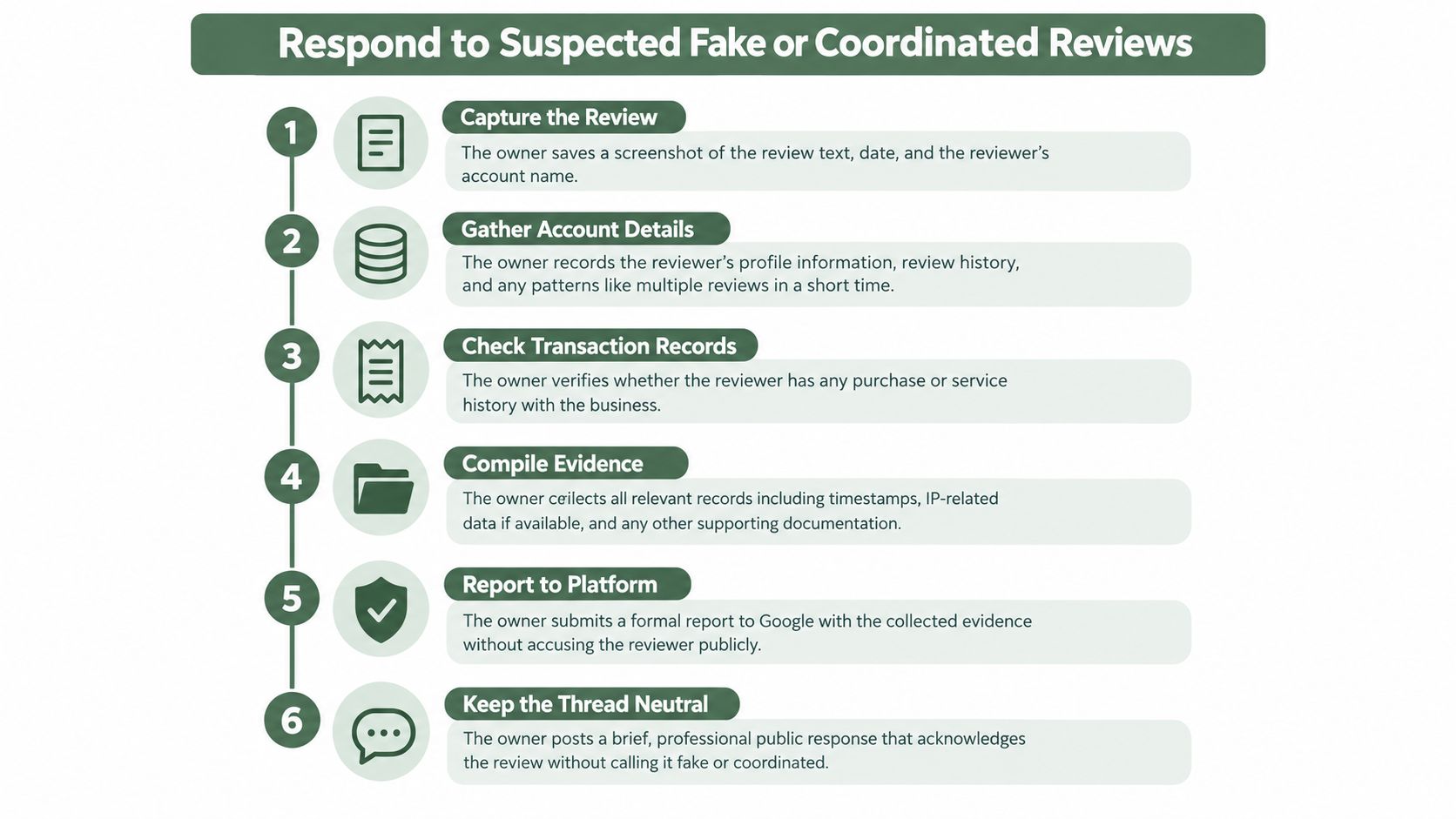
Start by preserving what you can verify. Save the review text, date, account name, and relevant transaction or service records. Note any pattern that concerns you and keep supporting documentation together. For a multi-location business, assign one person to maintain the evidence log so different teams don't make conflicting claims.
Report through the profile and keep the thread neutral
Use the Google Business Profile associated with the listing. Open the review-management area, select the review, and submit a report with the most relevant policy reason. Keep a record of what you reported and the evidence you used. Any review can be reported, but only policy-violating reviews are eligible for removal. Google's instructions support reporting policy violations, not requesting removal just because a review is harsh or disputed.
If you respond publicly while the report is being considered, avoid accusations. You might say, “We take feedback seriously but can't match this review to a visit from the details available. Please contact [official contact] so we can look into it.” Use that wording only if it accurately describes your records. Don't announce a suspected campaign or invite others to confront the reviewer.
Google prohibits discouraging negative reviews and selectively soliciting positive ones. Its guidance also says suspected fake-review activity can lead to restrictions, including temporarily preventing new reviews or unpublishing existing reviews, and verified profile owners may have an appeal opportunity. Google's fake-engagement policy makes clear why review requests must remain open and fair to customers, not limited to people you expect to be happy.
A review request process can offer customers a public Google review option and a private feedback option side by side, with the customer choosing. That's different from steering unhappy customers away from Google. RecensioAI provides those two options on its review page, alongside tools for managing review responses and suspected fake reviews. For more on evaluating questionable posts, see how to spot and report fake Google reviews.
Measure Whether the Response Process Is Working
A response process is working when your team handles complaints consistently and fixes recurring problems, not when you treat every reply as a ranking tactic. Google documents review count and review score as local-ranking inputs. A reply itself isn't a confirmed ranking factor, so keep customer-service measurements separate from search-performance claims.
Use a simple log that a location manager can review during a regular operating check-in. Track whether new negative reviews received a response, the median time to first response, whether the reply gave a private contact route, and whether the case was resolved. Group complaints by theme and check whether the same problem returns after a correction.
A hotel might track repeated complaints about front-desk communication. A restaurant could look for a pattern of delayed orders. A contractor can record missed appointments and assign someone to review scheduling practices. If the same issue keeps appearing, assign a corrective action and check the results during the next operating cycle. For a fuller view of reputation measurement, use this guide to online reputation KPIs that matter.
This week, open your Google Business Profile, find the newest unanswered negative review, classify the issue, and post a fact-based reply through an official business channel. Then assign someone to follow up privately and record whether the complaint was resolved.
---
RecensioAI B.V. offers review-management tools for local businesses, including review requests, response support, and a workflow for documenting suspected fake reviews. If you want to organize your response process across one or more locations, visit RecensioAI B.V..
Frequently asked questions
You might also like
Handpicked articles for you
Hotel Review Management: Automate Post-Stay Requests with Apaleo, Mews and Your PMS
A practical guide to turning hotel checkouts into timely review requests, with Apaleo live, Mews early access and flexible PMS alternatives.
Why the Business Around the Corner Beats You on Google: What 21,373 Profiles Reveal
We compared 21,373 Google Business Profiles with their three strongest nearby competitors. The gap is smaller than most owners think, but it has two sides: rating and volume.
Treatwell Review Management for Salons: One Reputation View Alongside Google
Bring your public Treatwell rating and recent reviews into RecensioAI, then combine salon signals with Google for faster, better decisions.