How to Respond to Negative Google Reviews the Right Way
Learn how to respond to negative Google reviews with proven templates, timing rules, and escalation steps that protect your local reputation.
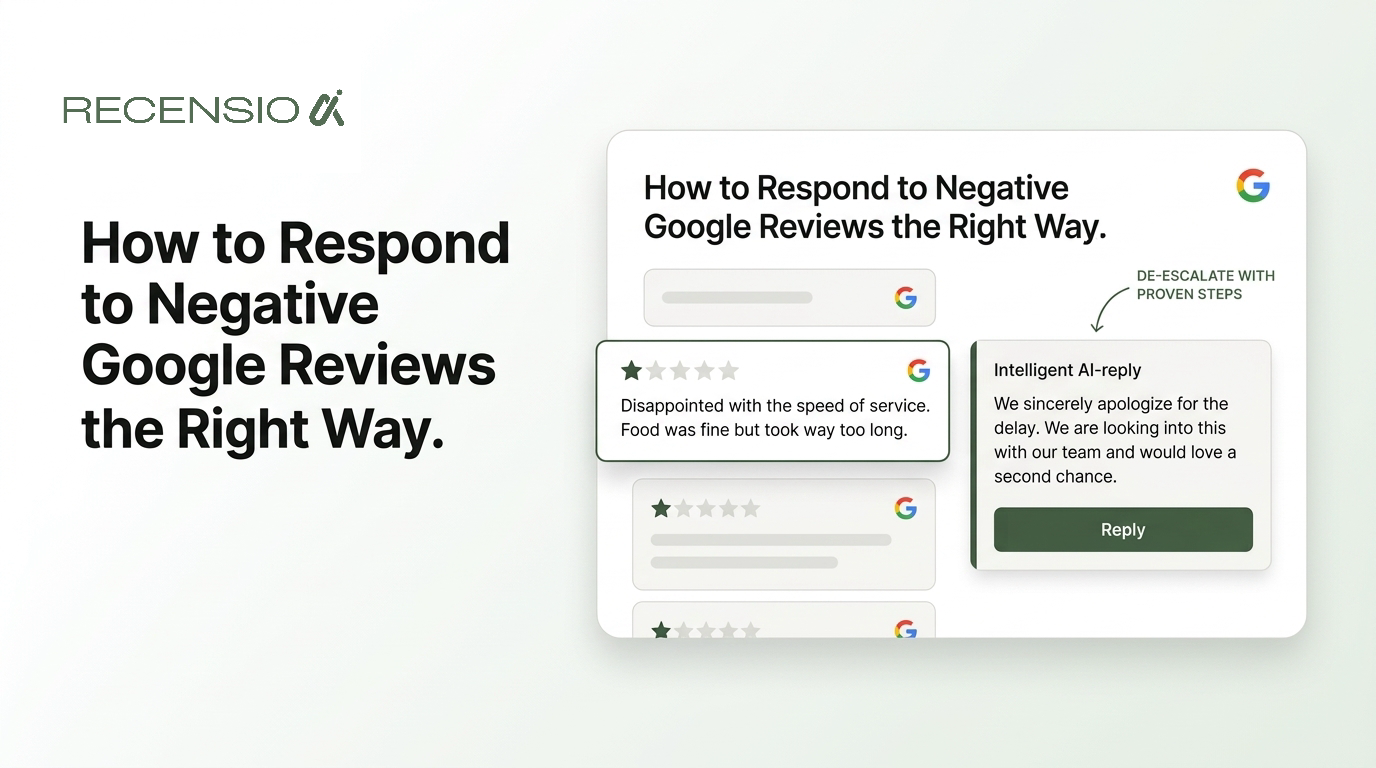
Table of Contents
- 1Introduction
- 2The 1-Star That Just Hit Your Phone
- 3What Negative Reviews Actually Cost Local Businesses
- 4Read the pattern as a pipeline problem
- 5Calm process beats panic
- 6Before You Reply, Run This 60-Second Pre-Flight
- 7Sort the review before drafting
- 8The Five-Part Reply That Actually Works
- 9Adapt the structure to the business
- 10When to Reply, When to Report, When to Do Both
- 11The order matters
- 12Escalation Triggers and Sensitive Cases
- 13Use a clear handoff matrix
- 14Turn Replies Into a 30-Day Quality System
- 15Assign every recurring theme
Introduction
You're standing behind the counter when your phone lights up. A restaurant guest says the meal arrived cold. A salon client says the stylist ignored the appointment request. A clinic patient says billing was unclear. A hotel guest says the room wasn't ready. The rating is one star, and the review is now sitting where future customers will see it.
Don't treat that post like a private complaint. It's a public record of how your business handles problems. Your reply has two audiences: the reviewer, who wants recognition and a route to resolution, and the next customer deciding whether to call, book, visit, or keep scrolling.
The right response isn't a defensive explanation or a discount offer. It's a repeatable operating process. You need to classify the review, verify what happened, decide whether to reply or report it, publish a concise answer, and assign the underlying issue to someone who can fix it.
The 1-Star That Just Hit Your Phone
The first mistake happens before anyone types. An owner sees the review, recognizes the day, and starts writing from memory. The customer is blamed for arriving late. The reservation is challenged. The employee's version is posted publicly. A reply intended to defend the business becomes a second complaint for everyone to read.
Pause. The review may be unfair, incomplete, or completely accurate. You don't know which one until you check.
A negative Google review remains visible to people who have no connection to the original incident. Someone searching for a hotel near me may never contact the reviewer, but they'll read whether the hotel acknowledged the problem. A parent comparing clinics may focus less on the original billing dispute than on whether the clinic exposed private details in its reply.
Write for the next customer as carefully as you write for the person who complained.
That changes your wording. You don't need to win an argument. You need to show that a real operator noticed the issue, understands the impact, and has a responsible next step.
A restaurant response might address a cold entrée without explaining the entire kitchen workflow. A contractor might acknowledge a missed arrival window without publishing the customer's address. A salon manager might apologize for a scheduling failure without identifying the stylist or discussing another client.
The process in front of you is practical. First, separate service recovery from policy enforcement. Then use a five-part reply structure. Finally, track recurring themes so the same complaint doesn't keep appearing under different names and locations.
What Negative Reviews Actually Cost Local Businesses
Negative reviews affect the customer funnel before a prospect ever speaks with your team. A diner may choose another restaurant. A hotel shopper may book elsewhere. A patient may call a different clinic. A homeowner may skip your estimate form because the review pattern suggests poor follow-through.
BrightLocal's 2025 research found that 49% of consumers avoid a business after reading negative reviews. The avoidance pattern rises from 28% after one negative review to 71% after six or more. The figures are reported in BrightLocal's 2025 consumer research summary.
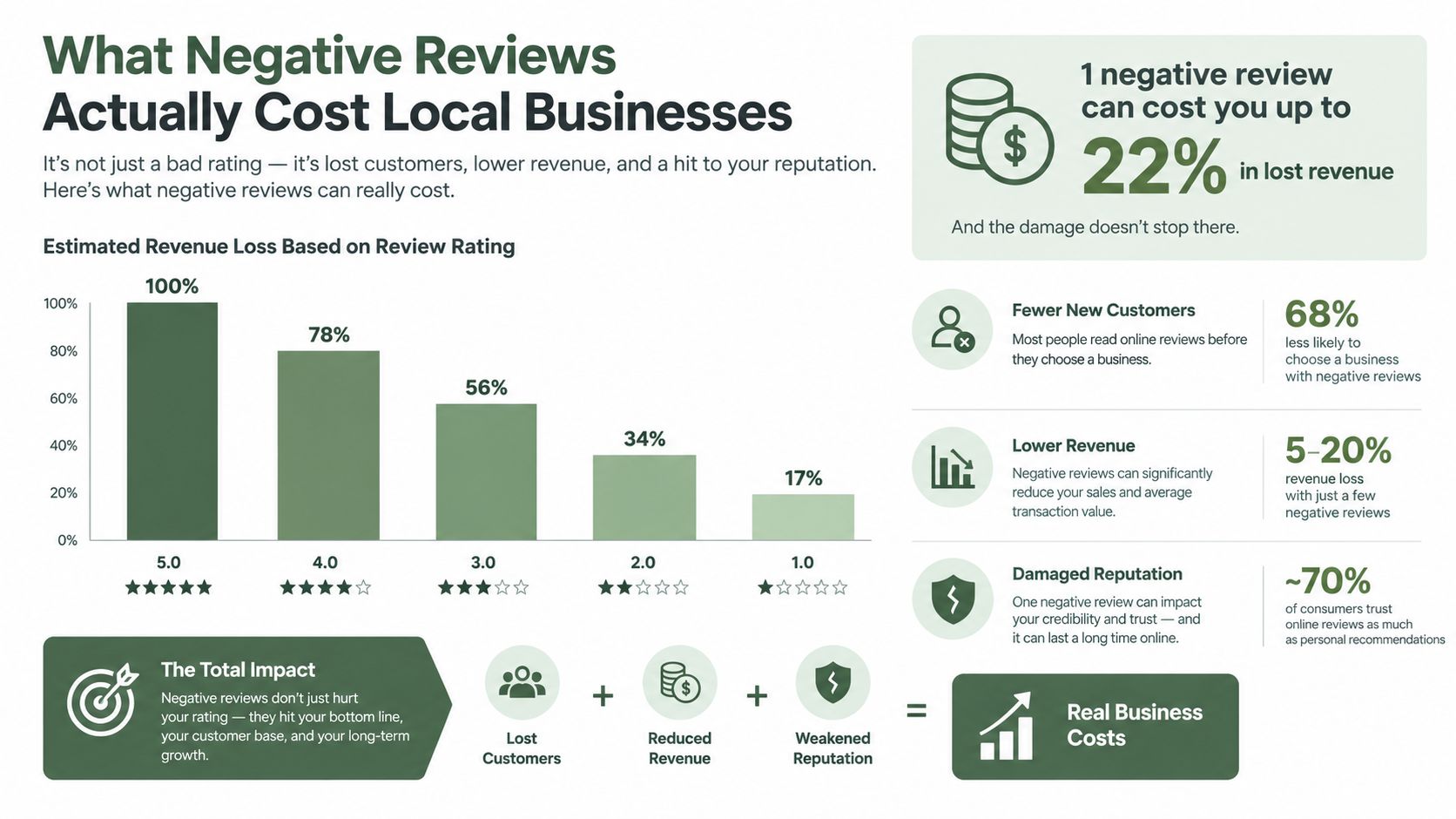
The point isn't that one bad review destroys a business. It usually doesn't. The point is that an unresolved pattern changes the prospect's risk calculation.
Read the pattern as a pipeline problem
One review about a long wait may cause a prospect to hesitate. Several reviews describing the same wait suggest the business hasn't addressed it. For a salon, repeated comments about appointment delays can reduce bookings. For a clinic, recurring billing complaints can move calls to a competitor. For a contractor, several reports of missed callbacks can stop quote requests before they arrive.
That's why you should treat response work as reputation recovery, not as a defensive chore. A public reply won't erase the rating, and it won't guarantee that the reviewer returns. It can give future customers evidence that your business investigates complaints and takes action.
The first operational question is simple: is this an isolated incident or a repeated failure? Look across locations and review dates. Tag themes such as food temperature, cleanliness, appointment delays, staff conduct, billing, or delivery reliability.
Calm process beats panic
Panic creates inconsistent replies. One manager offers a refund. Another argues. A third says nothing. Customers then see a business with no shared standard.
Use a fixed workflow instead:
A professional reply can't compensate for a broken process. It can, however, prevent silence from becoming the only public evidence of how you manage dissatisfied customers.
- One review: verify the facts and respond specifically.
- Several similar reviews: assign the theme to an operational owner.
- A serious allegation: stop routine handling and escalate.
- A policy violation: preserve evidence and report it separately.
Before You Reply, Run This 60-Second Pre-Flight
Google requires you to verify your Google Business Profile before you can reply to reviews. Google also advises moving sensitive details to phone or email instead of handling them publicly, as explained in its Business Profile review-reply guidance.
Start with the account, not the emotion. Open the review, capture a screenshot, note the date and location, and pull the relevant transaction, booking, appointment, or service record. If you can't match the reviewer to a record, that doesn't prove the review is fake. It only means the public information isn't enough to verify the incident.
Sort the review before drafting
Use four practical categories:
Each category has a different owner. Frontline staff can handle routine dissatisfaction. A manager should review billing, safety, discrimination, privacy, and recurring operational complaints. Policy or legal review may be necessary for threats, extortion, personal data, or potentially defamatory claims.
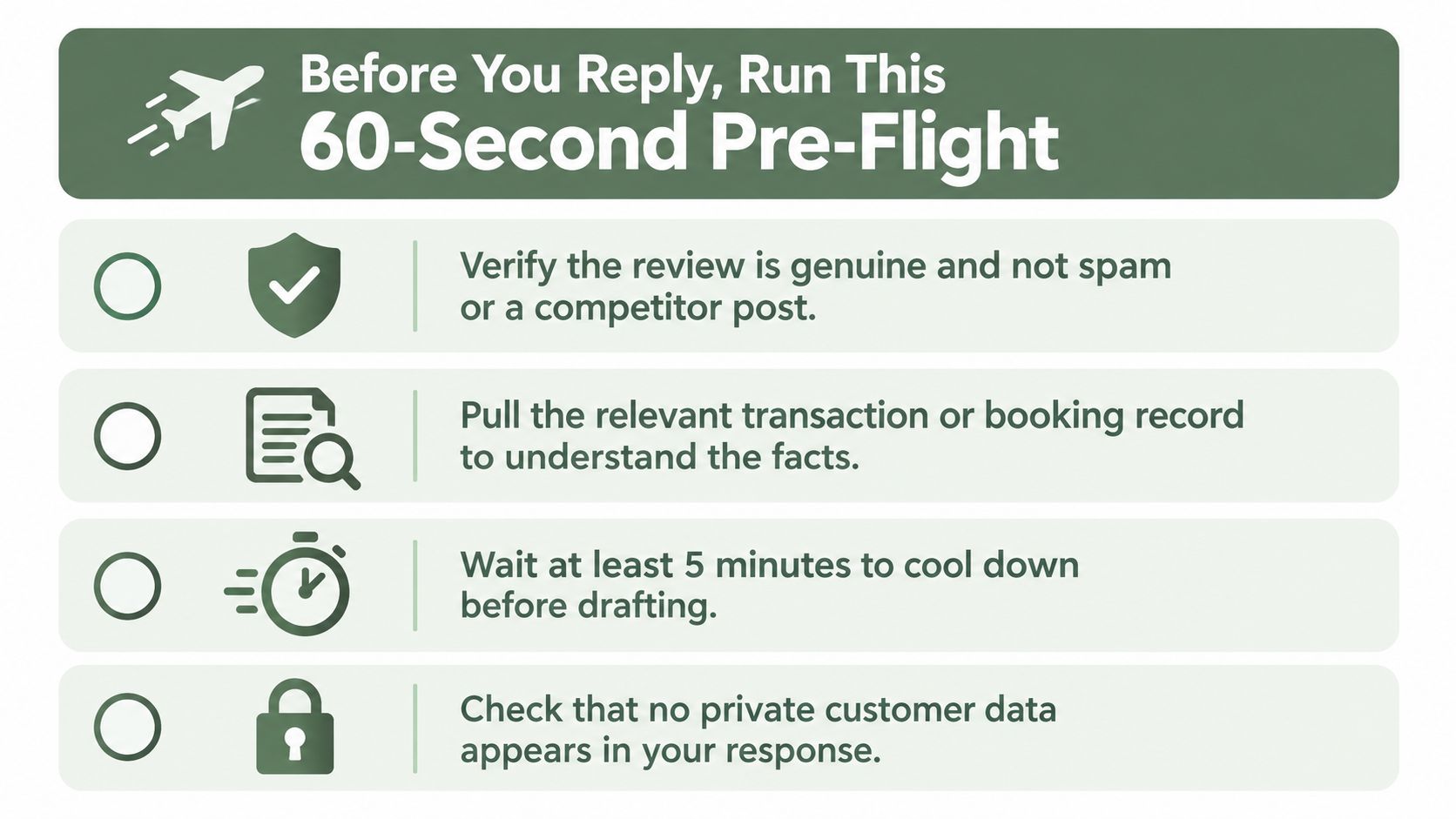
Before you write, check four things:
Don't publish a reply that says “we'll make this right” if nobody has been assigned to do it. For a practical list of common handling errors, review 5 mistakes businesses make when handling negative reviews.
- Factual service failure: You can see what went wrong, such as a delayed appointment or incorrect charge.
- Allegation requiring investigation: The review mentions discrimination, injury, harassment, unsafe conditions, or another claim that needs management review.
- Policy dispute: The customer objects to a cancellation, deposit, return, payment, or service policy.
- Suspected abuse: The content may be spam, fabricated, irrelevant, hateful, or connected to a competitor, but you don't yet have enough proof to accuse anyone.
- Verification: Is your Business Profile verified, and can you access the reply function?
- Records: What does the relevant order, booking, appointment, or job record show?
- Privacy: Have you removed names, phone numbers, medical details, payment information, and booking specifics?
- Ownership: Who will handle the private follow-up, and can that person access the case?
The Five-Part Reply That Actually Works
A strong reply is short, specific, and useful to someone who has never visited your business. Google recommends investigating the experience, checking your records, showing empathy, apologizing when appropriate, personalizing the response, and offering a phone or email route for complicated matters in its guidance for replying to reviews.
Use five parts:
| Part | Purpose | Example line |
|---|---|---|
| Acknowledgment | Show that you read the actual complaint | “You mentioned waiting past your appointment time.” |
| Apology | Recognize the customer's experience without making an unsupported admission | “We're sorry the visit fell short.” |
| Corrective action | Give future readers evidence of responsible handling | “The manager is reviewing that day's schedule with the front desk.” |
| Offline route | Protect privacy and create a real path to resolution | “Please email our clinic manager at the address below.” |
| Neutral closing | End without pressure or promotion | “Thank you for bringing this to our attention.” |
Acknowledgment
Apology
Corrective action
Offline route
Neutral closing
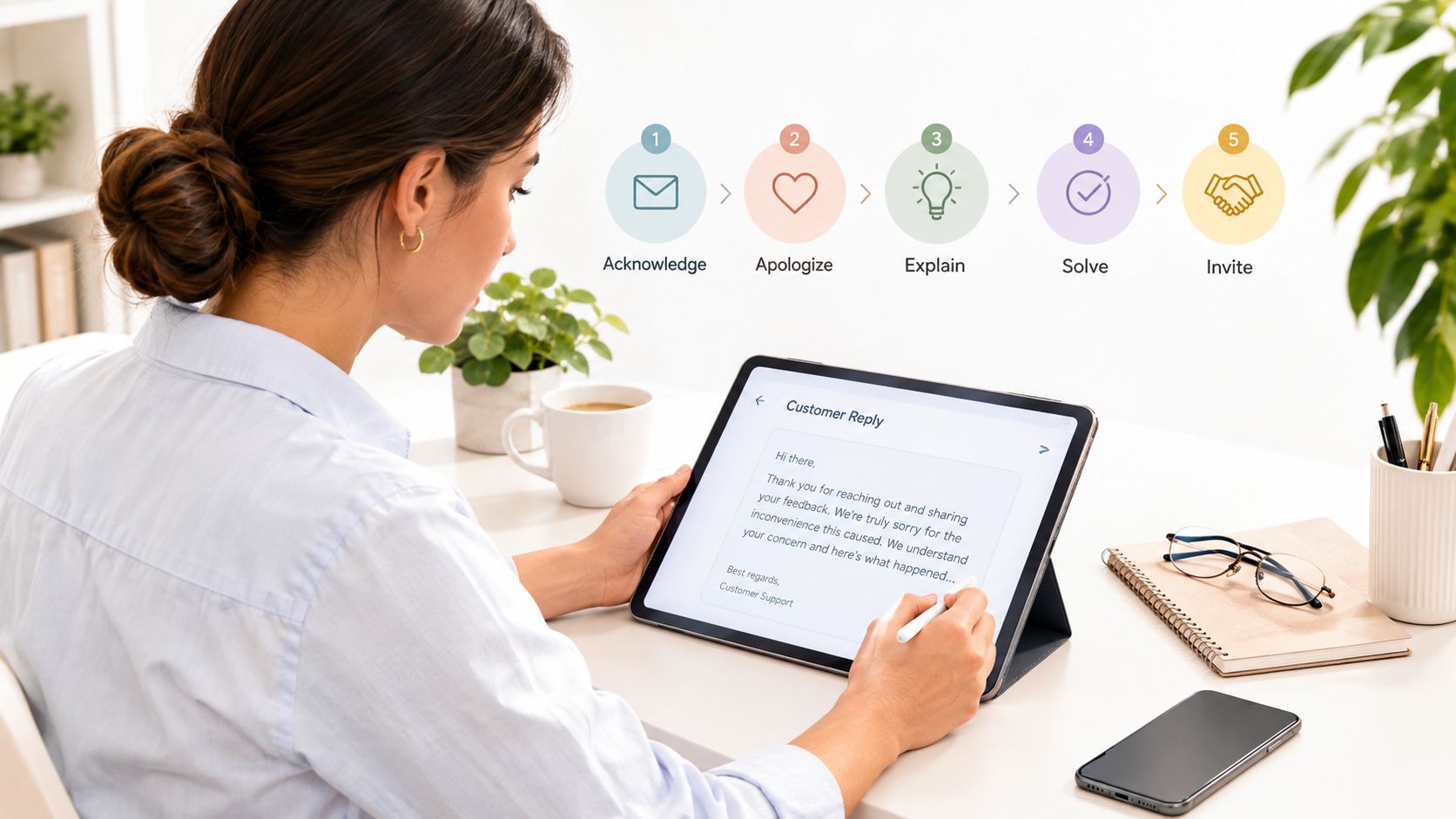
- Acknowledge one identifiable issue. Mention the cold meal, missed appointment, delayed room, or unclear invoice.
- Apologize for the experience. Don't litigate the customer's account in public.
- State one verifiable corrective step. Say what you've checked, changed, or assigned.
- Offer a named offline contact. Give a monitored phone number or email and identify the manager or team.
- Close neutrally. Don't demand a rating change or add a sales pitch.
Adapt the structure to the business
Restaurant
Weak: “We're sorry you feel that way. We have great food and service.”
Better: “Hi Jordan, we're sorry your entrée arrived cold and that the issue wasn't corrected during your visit. Our manager is reviewing the service notes with the kitchen and dining team. Please contact Maria, our floor manager, at [verified phone or email] so we can discuss the visit privately. Thank you for flagging it.”
Salon
Weak: “We're sorry. Please call us for a discount.”
Better: “Hi Taylor, we're sorry your appointment started late and didn't match what you booked. We're reviewing the schedule and front-desk handoff for that day. Please contact our studio manager at [verified contact] so we can review the appointment privately. Thank you for the feedback.”
Clinic
Weak: “That's not what happened. Call billing.”
Better: “Hi Morgan, we're sorry the billing explanation left you frustrated. Our practice manager will review the account record and the information provided at the visit. Please contact the practice directly at [verified contact], and don't post any personal or medical details here. We appreciate you raising the concern.”
Hotel
Weak: “You should have told us at the desk.”
Better: “Hi Casey, we're sorry your room wasn't ready when you arrived. The front-office manager is reviewing the arrival and housekeeping handoff for that date. Please contact us at [verified contact] so we can discuss the reservation privately. Thank you for letting us know.”
Contractor
Weak: “We were delayed because of circumstances outside our control.”
Better: “Hi Alex, we're sorry we missed the agreed arrival window and didn't update you clearly. The service manager is reviewing the scheduling record and callback process. Please contact us at [verified contact] with the job details privately so we can follow up.”
Don't add discounts, product plugs, SEO phrases, or claims such as “we're the best.” Independent research with 442 randomized participants found that promotional material in seller responses made businesses appear self-interested and reduced relationship quality and repurchase intention, as reported in the published study on promotional review responses.
BrightLocal's 2025 research found that 63% of consumers expect a business to respond within two to three days through one week, according to its local consumer review survey. Use that as a practical response window, but check the facts before publishing. Fast and wrong is still wrong.
When to Reply, When to Report, When to Do Both
Not every hostile review belongs in customer service. A genuine complaint should receive a professional public reply. A review that violates Google's content rules should be reported through the policy channel. Sometimes you should do both.
Google allows businesses to report reviews involving spam, fake content, hate speech, or conflicts of interest, while ordinary negative opinions from real customers aren't removal grounds, as stated in Google's Maps user-contributed content policy.
| Situation | Public response | Policy action |
|---|---|---|
| Genuine complaint with verifiable service issue | Reply with acknowledgment and corrective action | None |
| Genuine complaint you can't yet verify | Reply neutrally and invite private contact | None unless separate policy violation exists |
| Spam or irrelevant promotion | Keep the response factual or skip it | Report |
| Suspected fake or competitor review | Don't accuse the poster | Preserve evidence and report if a specific violation exists |
| Hate speech, threats, or personal data | Escalate internally before responding | Report and follow the safety or privacy process |
Genuine complaint with verifiable service issue
Genuine complaint you can't yet verify
Spam or irrelevant promotion
Suspected fake or competitor review
Hate speech, threats, or personal data
The order matters
For ordinary dissatisfaction, reply first after checking the facts. For suspected policy violations, document the review, transaction records, screenshots, and relevant evidence before reporting. If the content is also creating a serious safety or privacy concern, escalate internally immediately.
Don't publish “This is fake” because the name doesn't match your booking system. A public accusation can make you look evasive, especially if the review turns out to describe a real visit under another name. Neutral language protects your credibility while the platform reviews the report.
Google's policy enforcement can also affect your profile if your business engages in prohibited review activity. Don't offer money, discounts, free goods, or services in exchange for posting, changing, or removing a review. Don't pressure customers to revise a rating.
A Business Profile team handling many locations may need a dedicated owner. If you're building that function, a customer service representative can help manage the queue, records, and escalation handoffs. The person should follow your policy. They shouldn't improvise public accusations.
If Google doesn't remove an eligible review after a report, Google provides a one-time appeal option for up to 10 eligible reviews at once, according to its review-removal support guidance. Use that process for identifiable policy violations, not for every review that damages your rating. For timing decisions, use the operational approach described in how fast you should reply to a Google review.
Escalation Triggers and Sensitive Cases
A complaint about a slow manicure or lukewarm side dish belongs with frontline staff. An injury, medical record, discrimination allegation, or billing history belongs with management. Treat every public reply as a future-customer artifact, not a private customer-service exchange.
Keep booking details, payment records, medical information, internal notes, phone numbers, and staff investigation details out of the reply. Google's guidance also says businesses should not solicit or expose private or confidential information in review-related content. Acknowledge the concern without confirming disputed facts, then provide a safe contact route, as described in Google's business-profile guidance for sensitive content.
Use a clear handoff matrix
Use the matrix to separate reputation repair from policy enforcement. A reply can show care without exposing the case. GatherUp's cited survey found that 66% of consumers reported greater trust when a response offered to make things right, 64% when it included an owner apology, and 38% when it explained preventive changes. State which process you are reviewing, not what happened to a named customer.
For a clinic or healthcare group, use staffing support for private intake and administrative routing, and keep public replies under management control. A best place to hire medical virtual assistants resource can support that administrative function without putting public disclosure in the wrong hands.
Stop improvising when a review mentions injury, discrimination, harassment, medical information, payment records, personal data, threats, or illegal conduct. Assign the case, preserve relevant records, and publish only approved language. For suspected fake content, handle the customer-facing response separately from the reporting process by following this guide to spotting and reporting fake Google reviews.
- Frontline can respond: General service complaints and routine feedback. The employee can acknowledge the issue, apologize for the experience, and route private follow-up.
- Supervisor review required: Billing disputes, medical claims, possible data exposure, repeated service failures, or staff-conduct allegations. A manager checks the record and approves the wording.
- Immediate management handoff: Safety threats, discrimination, violence, illegal activity, harassment, or credible injury claims. Management chooses the required legal, safety, privacy, or platform-policy support.
Turn Replies Into a 30-Day Quality System
A reply is finished when it's published. The problem isn't finished until someone checks whether the underlying issue recurs.
Create a rolling review log for each location. Track response coverage, median response time, subsequent rating from the same reviewer, rating change over the next 30 to 90 days, and recurrence of the complained-about theme. These measures tell you whether the team is responding, whether customers are following up, and whether operations are improving.
Don't measure star ratings alone. A restaurant may have a stable rating while wait-time complaints increase. A salon may receive positive comments overall while appointment delays keep appearing. A hotel may answer every review while housekeeping misses the same room-readiness issue.
Assign every recurring theme
Use a simple ownership table:
| Theme | Operational owner | Deadline | Evidence of completion |
|---|---|---|---|
| Food temperature | Kitchen manager | Assigned internally | Service check record |
| Appointment delays | Studio manager | Assigned internally | Schedule and handoff review |
| Cleanliness | Housekeeping or facilities lead | Assigned internally | Inspection record |
| Billing confusion | Practice or finance manager | Assigned internally | Updated explanation or workflow |
| Staff conduct | General manager | Assigned internally | Documented review and training action |
Food temperature
Appointment delays
Cleanliness
Billing confusion
Staff conduct
Google identifies relevance, distance, and prominence as the main local-search factors. It says review count and positive ratings can help local ranking, while describing replies as a way to show customers that the business values feedback, according to Google's local ranking guidance. Don't tell your staff that replying guarantees a higher position in the local pack or map results. Write replies for trust and clarity.
This matters for “near me” searches because reputation is part of the customer's decision process even when the reply itself isn't a confirmed ranking factor. A complete, active profile with genuine customer feedback gives prospects more context. Your operating system should protect that context without filtering customers or suppressing negative feedback.
Start this week by exporting or recording every negative review across your locations. Tag each one as service failure, allegation, policy dispute, or suspected abuse. Assign one owner to every recurring theme, then review the list at the end of the month. If you want software to organize review requests, draft replies, group themes, and manage suspected fake-review workflows, RecensioAI B.V. offers those functions for local and multi-location businesses.
---
RecensioAI B.V. helps local businesses collect authentic review requests, draft and manage Google review responses, group recurring feedback themes, and monitor Google Business Profile activity. Visit RecensioAI B.V. to see whether its workflow fits your locations and review process.
Frequently asked questions
You might also like
Handpicked articles for you
Hotel Review Management: Automate Post-Stay Requests with Apaleo, Mews and Your PMS
A practical guide to turning hotel checkouts into timely review requests, with Apaleo live, Mews early access and flexible PMS alternatives.
Why the Business Around the Corner Beats You on Google: What 21,373 Profiles Reveal
We compared 21,373 Google Business Profiles with their three strongest nearby competitors. The gap is smaller than most owners think, but it has two sides: rating and volume.
Treatwell Review Management for Salons: One Reputation View Alongside Google
Bring your public Treatwell rating and recent reviews into RecensioAI, then combine salon signals with Google for faster, better decisions.