Google Reviews Restaurants Near Me: A Practical Guide
Learn how Google reviews restaurants near me searches find, with practical steps to generate, reply to, and manage reviews that boost your restaurant's
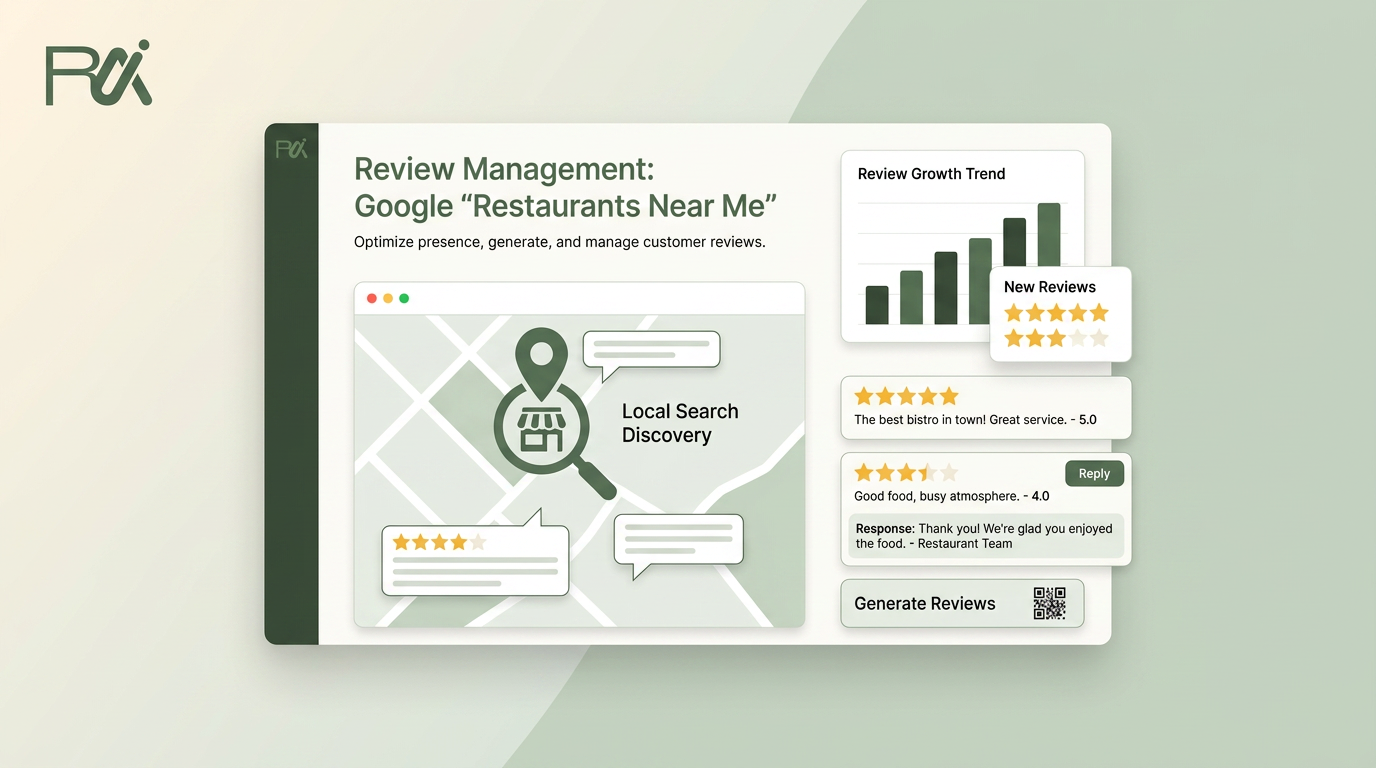
Table of Contents
- 1Introduction
- 2How Google Picks the Three Restaurants on the Map
- 3What Google Reviews Actually Move in Local Search
- 4Review Signals and Their Documented Impact
- 5Building a Review Request Flow That Runs Itself
- 6Start at the right moment
- 7Choose channels your team can actually run
- 8Give staff one sentence to use
- 9Replying to Reviews the Way Diners Expect
- 10Handle complaints without arguing
- 11Why Filtering Negative Reviews Backfires
- 12Your Weekly Restaurant Review Checklist
- 13Daily tasks
- 14Weekly tasks
- 15Monthly tasks
Introduction
A diner is sitting in a parked car, hungry and in a hurry. They type “restaurants near me” into Google Maps, scan the first three listings, check the latest reviews, and choose one. Your restaurant may be close, serve exactly what they want, and still lose the click because your profile looks quiet or your recent feedback doesn't build confidence.
That's the core problem with Google reviews for restaurants near me searches. Owners treat reviews like a final score. Diners treat them like a live signal. They want to know what's happening now, whether the food and service match their needs, and whether the owner pays attention.
How Google Picks the Three Restaurants on the Map
Google has documented three main factors for local results: relevance, distance, and prominence. These factors decide which businesses appear in the local pack and map results when someone searches for a nearby restaurant, salon, clinic, hotel, contractor, or other local service. Google's local guidance describes these factors in its Business Profile ranking guidance.
Relevance means your listing matches what the person searched for. A seafood restaurant with a complete menu, accurate category, clear description, and current services has a better match for “seafood restaurants near me” than a listing with a vague description. The same principle applies to a salon showing its hair services, a clinic listing its specialties, or a contractor explaining the work it performs.
Distance is simpler. Google considers how far the searcher is from the address connected to your listing. You can't move your building, and you can't make a restaurant appear closer to someone who is across town. You can make sure your address and map pin are accurate so Google understands where the business operates.
Prominence reflects how established and well-known the business appears. Reviews, ratings, links from other websites, and broader brand awareness contribute to this picture. Google specifically says that the number of reviews and positive ratings can help local ranking, but reviews are only one part of prominence, not a replacement for relevance or proximity.

Practical rule: Keep your profile accurate, then keep genuine review activity moving. A one-time review campaign won't stay useful if the listing goes quiet afterward.
The restaurant that wins a map result today may not hold the same position later. Searchers move, competitors collect feedback, menus change, and profiles become more or less complete. Review work should therefore run as an operating process, like checking hours or restocking takeout supplies. You're feeding a signal that needs regular attention, not chasing a finish line.
What Google Reviews Actually Move in Local Search
Google publicly connects reviews to prominence, especially review quantity and positive ratings. Google's local guidance also says local results depend on relevance, distance, and prominence. That means a strong review profile can help, but it can't overcome a wrong category, an incomplete profile, or a location that is far from the searcher.
Other review details matter to diners even when Google hasn't confirmed them as direct ranking factors. Recent review activity can make a restaurant look open, active, and dependable. Review language can also help a person decide whether the business fits their needs. A diner may search for a patio, gluten-free dishes, quiet seating, or fast takeout, then scan review text for those details.
A practitioner summary of local search evidence places review quantity, recency, and steady new-review velocity near the top of local-pack factors. It also warns that a smaller, fresher review set can overtake an older portfolio when a business stops generating new feedback. Treat that evidence as an operational reason to maintain cadence, not as a promise of a specific ranking outcome. The local merchant guide from Wispra offers additional practical guidance for keeping a local profile complete.
Review Signals and Their Documented Impact
| Signal | Confirmed by Google | Effect on Local Pack |
|---|---|---|
| Review count | Yes | Contributes to prominence |
| Positive ratings | Yes | Can help local ranking as part of prominence |
| Review recency | Not stated by Google as a standalone factor in the cited guidance | Strong trust signal for diners and an important operating metric |
| Review wording | Not confirmed as a standalone ranking factor | Helps diners judge menu fit, service, and current conditions |
| Owner replies | Not confirmed as a direct ranking factor | Shows engagement and gives future diners more context |
Review count
Positive ratings
Review recency
Review wording
Owner replies
The platform gap also changes how you interpret ratings. Academic research comparing the same restaurants found that Google Maps ratings were, on average, 0.7 stars higher than Yelp ratings. Google Maps ratings were higher for 93% of restaurants in that study, with an average gap of 1.1 stars for chain restaurants and 0.6 stars for independent restaurants. Those figures come from the restaurant rating comparison study, and they don't mean you should ignore other platforms. They do show why Google deserves close attention when your customers search on Maps.
Check your Google Business Profile dashboard for new reviews, rating movement, and unanswered comments. Don't judge the account only by its lifetime average. A high score with no recent activity can look less convincing than a slightly lower score with detailed, current feedback.
Building a Review Request Flow That Runs Itself
You can put a basic request flow in place this week. It doesn't need an agency, a complicated campaign, or a staff meeting that lasts all afternoon. It needs a clear moment, a direct path, and consistent execution.
Start at the right moment
Ask shortly after the customer has finished the transaction. For a restaurant, that might be shortly after the check is paid or the order is bagged. For a salon, it could be after the appointment. A hotel can ask after checkout, while a contractor can ask after the agreed work is complete.
Use a simple message:
Thanks for visiting, [Name]. If you have a moment, please share your honest experience on Google: [direct review link].
Don't promise a discount, free item, gift card, or anything else of value in exchange for a review. Incentives can violate Google's review policies and weaken the credibility of the feedback.
Choose channels your team can actually run
Pick two channels that fit your operation.
A QR code works well for counter service and fast casual restaurants. SMS can suit reservations, salons, clinics, and hotels. Delivery businesses may get better results from a receipt message followed by email. Test the channels separately so you know which one customers notice.

- Receipt QR code: Put a scannable code beside the total or at the bottom of the receipt.
- SMS follow-up: Send a short message after the visit if you have permission to contact the customer.
- Email button: Use one clear Google review button instead of burying the request in a long newsletter.
- Shareable link: Give managers and staff one direct review URL they can use consistently.
Give staff one sentence to use
Your host, cashier, server, and delivery driver shouldn't improvise different requests. Train them to say, “If you enjoyed your visit, we'd appreciate your honest feedback on Google.” Every customer should receive the same public review option. Don't ask employees to pressure guests or suggest a particular rating.
Track new reviews per week against covers served, completed appointments, room nights, or finished jobs. A practical planning range is around one to three percent of satisfied guests leaving a review, based on the operating benchmark specified for this process. That range isn't a guarantee. If you fall below one percent, check whether the link works, whether the request arrives too late, and whether staff mentions it.
The guide to automating review requests can help you think through timing and channel setup. Automation should remove the memory problem. It shouldn't replace honest service or customer choice.
Replying to Reviews the Way Diners Expect
Future diners read your replies. They're looking for signs of accountability, not polished corporate language. Reply within 24 hours when possible, and handle negative reviews faster when the issue needs immediate attention. Google says replies are publicly posted as the business after policy review. Review processing usually takes up to 10 minutes, although some replies can take up to 30 days, according to Google's published guidance summarized by Max Growth Agency.
A useful reply has three parts:
For a positive brunch review, avoid this:
Thanks for your review. We hope to see you again.
Write this instead:
Thanks, Maria. We're glad you enjoyed the ricotta pancakes and the patio table. We'll pass your kind words to the brunch team, and we hope you'll join us again next weekend.
The second reply sounds like someone who remembers the operation. It also gives the next diner a real detail.
- Use the reviewer's name.
- Mention a specific dish, service, or problem.
- State what happens next.
Handle complaints without arguing
For a complaint about a long wait, don't explain every staffing problem in public. Acknowledge the problem, name the fix, and move the conversation offline.
Hi James. I'm sorry you waited 40 minutes for your table. We're reviewing our reservation pacing and host-stand process so we can prevent a repeat. Please contact me at manager@example.com so I can learn what happened during your visit.
Don't offer a public discount in exchange for changing or removing a review. Keep the reply focused on service recovery, not reputation repair. For more examples, see these practical replies to negative Google reviews.
| Situation | Reply That Helps | Reply That Hurts |
|---|---|---|
| Positive dish feedback | Thanks for mentioning the grilled salmon. The kitchen prepares it with the seasonal vegetables listed on our current menu. | Thanks for the five stars. |
| Long wait | You're right to call out the delay. We're reviewing table pacing and would welcome an offline conversation. | You should understand how busy we were. |
| Wrong order | I'm sorry the takeout order was incorrect. We're checking the packing process with the closing team. | That wasn't our fault. |
| Vague praise | Thanks for visiting. We're glad the service made your evening comfortable. | Thanks, thanks, thanks. |
Positive dish feedback
Long wait
Wrong order
Vague praise
If you operate across AI-generated recommendations and review platforms, Algomizer's discussion of managing AI reviews in search provides useful context. The core rule remains simple. Write like a manager who has read the review.
Why Filtering Negative Reviews Backfires
Some businesses try to protect their rating by showing happy customers a public Google option while sending unhappy customers to a private form. That practice is review gating, and Google's 2024 review policy explicitly bans it. The policy problem isn't solved by calling the private form a survey or by hiding the routing inside an automated message.
You also create a trust problem. A profile filled only with selected praise doesn't give future diners a reliable picture of the business. Genuine criticism can reveal issues with wait times, order accuracy, accessibility, cleanliness, or staff communication. Those details give you a chance to fix the operation instead of guessing why guests don't return.

Use a compliant two-option flow instead:
The customer chooses. You don't block, filter, intercept, or hold back anyone's public review. RecensioAI's documented workflow presents the public Google option and private feedback option side by side, rather than routing people based on sentiment.
A private complaint form can help you respond quickly, but it isn't a substitute for an open review request. Keep the language neutral. Don't say “leave feedback privately if your visit wasn't perfect.” Say, “Share your honest experience on Google or send feedback directly to our team.”
Use the private channel to investigate and improve. Use Google to maintain a genuine public record. That's safer for the listing and more useful for the next person searching nearby.
- Public option: Every customer sees a neutral invitation to leave an honest Google review.
- Private option: Every customer can also send feedback directly to your team.
Your Weekly Restaurant Review Checklist
The process works when someone owns it. You don't need to stare at a dashboard all day. A manager can handle the basics with a short daily check, a weekly review, and a monthly profile audit.
Daily tasks
Open your Google Business Profile notifications and look for new reviews, questions, and suggested changes. Reply to new reviews within 24 hours, then flag anything requiring a phone call, refund discussion, staff review, or private follow-up.
Keep a small log. Record the location, issue, responsible manager, and next action. This prevents the same complaint from being answered repeatedly without anyone changing the underlying process.
Weekly tasks
Count new reviews and note the average rating. Then read the newest comments for recurring themes. Look for specific operational patterns, such as delayed lunch orders, confusing reservation instructions, poor lighting, missing menu information, or a dish that regularly arrives cold.
Turn one repeated issue into one operational action.
Send the week's approved review requests through your receipt, SMS, email, or QR process. Don't leave the process waiting for one busy server to remember it.
- Service pattern: Review the shift handoff with the front-of-house team.
- Food pattern: Check the preparation and holding process with the kitchen.
- Information pattern: Update the menu, services, attributes, or profile description.
- Request pattern: Adjust the timing or channel used for review requests.
Monthly tasks
Audit the full Google Business Profile. Check categories, hours, holiday hours, address details, menu links, services, attributes, photos, and business description. A complete profile supports relevance, while accurate location information supports distance and active review work contributes to the broader prominence picture.
Compare current review velocity with your own previous operating period. Use your records, not a competitor's assumptions. Reviewers also notice whether photos and hours look current, especially when deciding between nearby businesses.
For tools that combine QR-based requests with restaurant customer engagement, BonusQR for restaurants is one option to evaluate alongside a simple receipt and SMS process. Choose the setup your staff will use every week.
The wider review environment is changing. BrightLocal's 2026 survey reports that 74% of consumers prioritize reviews from the last three months, 44% focus on the last month, 89% expect owner responses, 19% expect a same-day reply, and 50% are put off by generic, templated responses. The same survey reports that Google's share of review-source use fell from 83% in 2025 to 71% in 2026, while generative AI and video platforms gained ground. Those findings appear in BrightLocal's local consumer review survey.
Start this week. Verify your map pin and hours today, create one direct review link, train staff on one honest request, and schedule a daily reply check. If you want a system to handle requests, responses, profile audits, and multi-location reporting, RecensioAI B.V. offers those workflows for local businesses. Visit RecensioAI B.V. to review the available tools and decide whether they fit your operation.
You might also like
Handpicked articles for you
Hotel Review Management: Automate Post-Stay Requests with Apaleo, Mews and Your PMS
A practical guide to turning hotel checkouts into timely review requests, with Apaleo live, Mews early access and flexible PMS alternatives.
Why the Business Around the Corner Beats You on Google: What 21,373 Profiles Reveal
We compared 21,373 Google Business Profiles with their three strongest nearby competitors. The gap is smaller than most owners think, but it has two sides: rating and volume.
Treatwell Review Management for Salons: One Reputation View Alongside Google
Bring your public Treatwell rating and recent reviews into RecensioAI, then combine salon signals with Google for faster, better decisions.