Google Reviews Maps: The Local Owner Guide to Visibility
Learn how Google Reviews Maps can boost your local visibility and trust in 2026 with actionable tips for business owners.
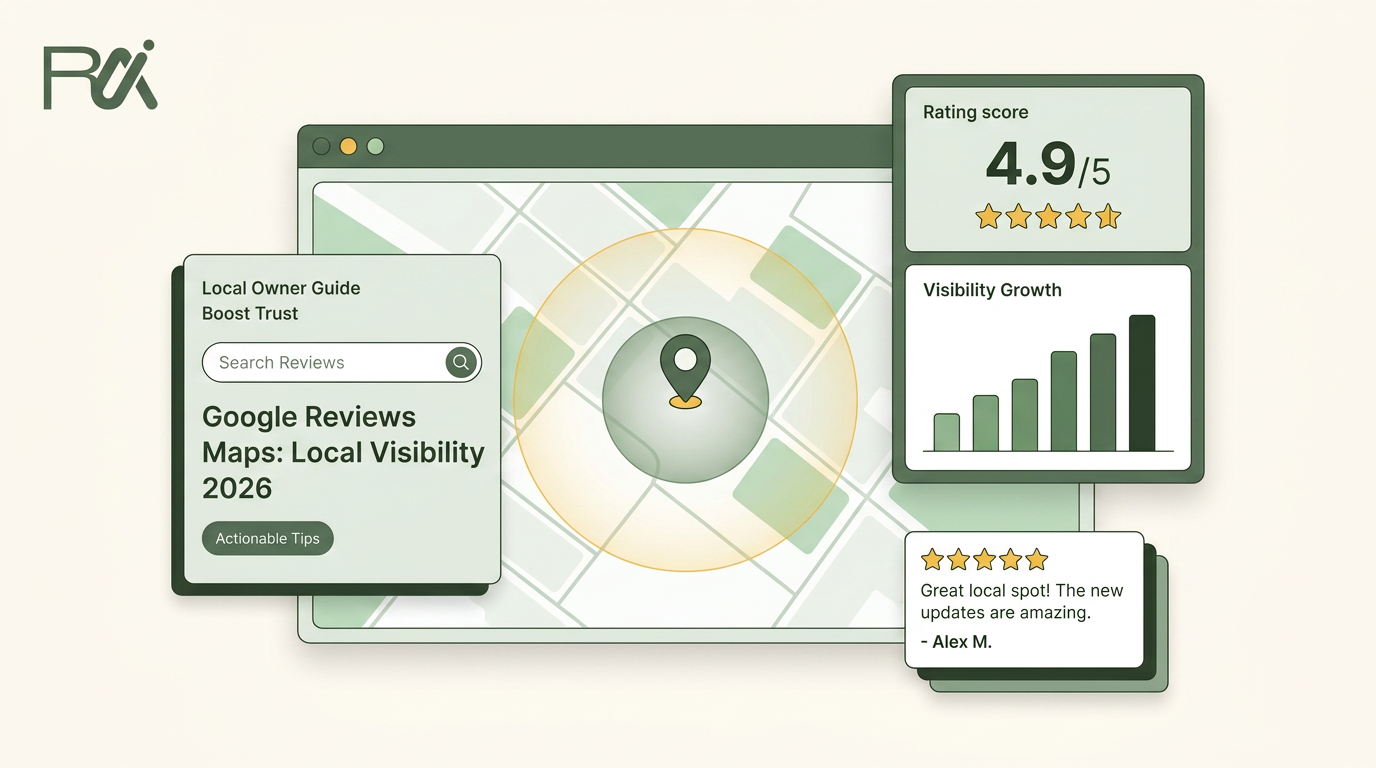
Table of Contents
- 1Introduction
- 2The Three-Pack Moment and Why It Matters
- 3What Google Reviews on Maps Actually Are
- 4Separate the signals before you manage them
- 5How Google Decides Which Three Businesses Show Up
- 6Relevance
- 7Distance
- 8Prominence
- 9Managing Reviews From a Single Google Business Profile
- 10A workable daily check
- 11Running Reviews Across Multiple Locations
- 12Track each pin independently
- 13Set rules staff can follow
- 14Risky Review Tactics and the New Enforcement Reality
- 15Replace the shortcut, not the goal
- 16A Weekly Routine for Reviews, Replies, and Posts
- 17Monday morning
- 18Wednesday reply block
- 19Friday complaint triage
- 20Weekend profile activity
- 21Your Next Step and Quick Answers for Owners
- 22Does replying to reviews improve ranking?
- 23How long does a new review take to appear?
- 24What should I do with a policy-violating review?
- 25Can one location outrank a chain with fewer reviews?
Introduction
At 6:15 p.m., a tired parent searches “pizza near me” in Google Maps. Three businesses appear. One is closer, one has a stronger rating, and one has reviews that mention fast service and family seating. The parent taps one listing, checks the hours, reads a recent review, and selects Directions.
If your restaurant, salon, clinic, hotel, or contracting business isn't among those first three map results, the customer may never compare you with the businesses that did appear. Google reviews are part of that decision, but they operate inside a larger path that begins with the three-pack and ends with a call, website visit, or tap on Directions.
The Three-Pack Moment and Why It Matters
The local three-pack is the small group of businesses Google places above the broader map results for a local search. A homeowner searching for an emergency plumber, a traveler looking for a hotel, or a diner looking for pizza may make a decision from that first view without opening the full local finder.

The three listings usually give the searcher enough information to compare name, category, distance, rating, review count, hours, and actions. The customer isn't evaluating your entire marketing strategy. They're asking a quick question: “Can this business solve my problem, and does it look trustworthy enough to choose now?”
That makes the three-pack a finite competitive surface. Your Google Business Profile, service details, photos, hours, and review activity all affect what the customer sees after the listing appears. Reviews don't replace relevance or proximity, but they can supply the visible proof that separates similar businesses.
For a restaurant, the difference may be a recent review describing the food and wait time. For a clinic, it may be several patients describing the appointment experience. For a contractor, it may be a steady record of customers discussing the actual service performed. Owners who want more practical ideas for converting local attention into visits can also review attract customers with MODERN LYFE, particularly when the map listing is only one part of the customer journey.
Practical rule: Treat the map listing as a decision screen, not a static directory entry.
The work starts with the searches that matter to your business. List the services, neighborhoods, and “near me” phrases customers use. Then check which businesses appear, what information they show, and whether your own listing gives a customer a clear reason to tap. For a deeper competitive process, see this complete strategy for outranking a competitor on Google Maps.
What Google Reviews on Maps Actually Are
A Google review on Maps is customer feedback attached to a Google Business Profile. It can include a one-to-five-star score, written comments, photos, and other details connected to the customer's real experience with the business.
These reviews can appear across several Google surfaces. A customer may see them in the map pin, the business profile in Maps, the local panel on Google Search, or the review and photo tabs. The same business can therefore look slightly different depending on where the customer encounters it.
Separate the signals before you manage them
A Google review isn't the same as an in-app rating from a delivery or booking platform. Those ratings may come from another service and don't represent the review content attached to your Google Business Profile.
The review snippet is also different. It's the bold or highlighted text Google selects from review content and displays near the listing. You don't write that snippet directly, and Google may select text from an older review. Your job is to create accurate customer experiences and maintain an honest, active profile, not to force a particular excerpt.
Google ties reviews to the business location or service-area profile and requires the reviewer to have had an actual experience. Reviews from competitors, employees, or friends of the owner aren't appropriate because they don't represent an ordinary customer transaction.
| Surface | Source | Owner Can Edit? | Where It Appears |
|---|---|---|---|
| Google review | Customer's Google account | No, the customer controls the review | Maps listing, Search business profile, review tab |
| Owner response | Business owner or profile manager | Yes, the owner can edit the response | Beneath the relevant review |
| Third-party rating | Delivery, booking, or review platform | Usually no, platform rules apply | Connected app or external platform |
| Review snippet | Google-selected review text | No, Google selects it algorithmically | Map results and business profile surfaces |
Google review
Owner response
Third-party rating
Review snippet
This distinction matters during a busy shift. If a customer mentions a problem on a delivery platform, you may need to address it there. If the complaint appears on Google Maps, your response belongs in the Google Business Profile. Keep the channel clear so your team knows where to act.
How Google Decides Which Three Businesses Show Up
Google says local results are primarily based on relevance, distance, and prominence. Its own guidance also states that review count and positive ratings can help local ranking, while broader explanations of the local model place reviews within prominence. Google's local ranking guidance is the clearest starting point for owners.
Relevance
Relevance asks whether your profile matches what the customer searched for. Your primary category, additional categories, services, business description, attributes, and the information on your website all help define that match.
A salon that lists hair coloring, cuts, and styling gives Google more context than a profile with only “salon.” A contractor should describe the actual work offered instead of using a broad label that could fit almost any service business.
Review wording can also help Google understand the services customers associate with your business. That doesn't make review keywords a separate ranking score, and you shouldn't script customer language. Ask for honest feedback about the experience, then let customers describe it naturally.
Distance
Distance is the physical relationship between the searcher and the business. Google may use the searcher's device location or a stated location in the query.
You can't move your building closer to a customer. A strong review profile won't erase the disadvantage of being far away when the search is highly location-sensitive. This is why a single-location clinic or contractor should focus on the service areas it can realistically serve instead of trying to appear everywhere.
Prominence
Prominence reflects how well-known and authoritative a business appears. Google explicitly includes review signals among the factors that can contribute to this broader concept, alongside links and general web visibility.
Review count and rating are therefore documented local ranking factors, but reviews aren't a standalone switch. They work within the whole profile and don't guarantee placement. The same principle applies to review text. It may provide context for relevance, but Google hasn't confirmed a separate score for placing keywords in reviews.

Responding to reviews is useful for trust and customer communication. It isn't a confirmed ranking factor. Once your listing appears in the local pack, customers also judge the visible photos, hours, review excerpts, recent feedback, and tone of owner responses. Those elements can influence whether someone calls or taps Directions, even when they aren't documented ranking inputs.
For a plain-language breakdown of the profile elements that matter, use this guide to Google Business Profile ranking factors.
Managing Reviews From a Single Google Business Profile
Start by confirming that you control the correct Google Business Profile. If the listing is unclaimed or tied to a former employee's account, resolve ownership before you build a review routine. A profile you can't access can't be monitored, updated, or used to respond promptly.
Open the profile dashboard and select the reviews area. Turn on available email alerts so new feedback doesn't sit unnoticed. On a phone, use the Google Search or Maps interface connected to the managing account, open the business profile, select reviews, and choose the response option beneath the customer's review.

Read the score and the written detail separately. A four-star review may contain a useful operational issue, while a five-star review may confirm that the customer enjoyed the visit. Your response should address what the customer wrote, not paste the same sentence beneath every review.
A workable daily check
Use a short routine that fits the business:
Flagging is reserved for policy violations, not simple disagreement or criticism. Google's official process is to open the Business Profile, select Read reviews, choose Report beside the review, select the reason, and submit it. If a repeated attack comes from changing accounts, keep screenshots and a timeline before contacting Business Profile Support through the documented process.
The practical distinction is important. Accurate categories and services help Google understand the business. Current hours and contact information prevent a customer from arriving at the wrong time. Owner responses support trust. None of those tasks should be described as guaranteed ranking improvements.
A short demonstration can help new managers find the review controls inside the profile:
- Read new reviews: Check whether the customer names a service, staff interaction, delay, billing issue, or facility problem.
- Reply with context: Thank positive reviewers without stuffing service terms into the response. For complaints, acknowledge the concern and invite the customer to continue privately.
- Check Q&A: The Questions and Answers area sits near other profile information. Correct inaccurate answers and add clear information about parking, appointments, accessibility, or service limitations.
- Review profile details: Confirm hours, holiday schedules, services, categories, photos, and contact information.
Running Reviews Across Multiple Locations
A chain with several restaurants, clinics, salons, or hotels shouldn't manage reviews from one blended brand average. Each location has its own Google Business Profile, map position, customers, staff, and operating conditions.
Central reporting helps leadership spot patterns. Local ownership keeps responses accurate. A downtown hotel may receive complaints about parking, while a suburban location may receive questions about breakfast hours. A central team can identify the trend, but the local manager usually knows the right answer.
Track each pin independently
Build a dashboard with a row for every location. Review the following separately:
Google's local model evaluates businesses in relation to the searcher and competing listings. A strong flagship location doesn't transfer its prominence to a weaker branch automatically. Each pin must earn trust in the market where it operates.
- Review activity: Is each location receiving a steady flow of genuine feedback, or has one profile gone quiet?
- Rating and review count: Compare locations without hiding weaker branches inside a brand-wide average.
- Unanswered complaints: Give local managers a clear list of reviews that need a factual response or service recovery.
- Profile health: Check hours, categories, services, photos, and location-specific attributes.
Set rules staff can follow
A multi-location review program needs a written policy. Staff can ask customers to share honest feedback after a real interaction. They shouldn't pressure customers to give a particular rating, offer rewards for positive reviews, or ask for specific wording.
The April 2026 policy update described in industry coverage added explicit restrictions on directing staff to reach a certain number of reviews or request content such as an employee's name. Review requests should therefore focus on the customer's experience, not quotas, names, ratings, or scripted praise. Review the current policy before rolling out a franchise-wide campaign, especially when supervisors measure frontline performance.
Google also assesses reviews before publication and can respond to suspicious activity at the profile level. A sudden pattern at one location can create operational problems before managers see the reviews publicly. Keep request records, use consistent compliant wording, and investigate unusual spikes instead of trying to create them.
Software can handle alerts, routing of tasks, draft preparation, and location-level reporting. A real manager still needs to approve sensitive responses, verify local facts, and decide how to fix a recurring service issue.
Risky Review Tactics and the New Enforcement Reality
Many review problems begin with advice that sounds efficient. “Get every happy customer to post five stars.” “Have employees ask for reviews by name.” “Send unhappy customers to a private form first.” Those shortcuts can put the profile at risk because Google is looking at how reviews are generated, not only at the final star count.
Google says it automatically assesses reviews before publication and has upgraded scam detection. If suspicious activity appears, Google may remove fake content, pause new reviews on a profile, alert the owner, and display a notification explaining the temporary restriction. That changes the operating question from “How do we get more reviews?” to “How do we request honest feedback without creating a suspicious pattern?”
Replace the shortcut, not the goal
| Risky practice | Why it creates concern | Compliant alternative |
|---|---|---|
| Buying reviews | The reviewer may not have had a real experience, and the content can be removed | Ask real customers for honest feedback without promising a rating |
| Review gating | Sending only satisfied customers to Google while diverting unhappy customers elsewhere manipulates who gets public visibility | Show every customer a public Google option and a private feedback option, then let the customer choose |
| Two-step interception | Requiring an internal complaint form before showing the Google option delays or blocks the customer's choice | Present both options clearly without making private feedback a condition |
| Staff quotas | Pressure to hit a review number can produce unnatural solicitation and policy violations | Train staff to mention feedback naturally without quotas or rating targets |
| Name requests | Asking customers to mention an employee can create patterned content and violates the newer solicitation restrictions described in the April 2026 policy coverage | Ask about the overall experience and let the customer decide what to include |
| Review blasts | A sudden, identical wave of requests can look disconnected from real visits | Send a timely request after a genuine customer interaction, using the channel the customer agreed to receive |
Buying reviews
Review gating
Two-step interception
Staff quotas
Name requests
Review blasts
A public Google review option and a private feedback option can coexist only when the customer chooses between them. You can't use the private path to hide negative sentiment or prevent an unhappy customer from posting publicly. That practice is review gating, and Google's policies prohibit manipulated review activity.
Owners who are considering paid reviews should read this explanation of why buying Google reviews can damage a business. The operational alternative is less dramatic but more durable: ask real customers, avoid pressure, document unusual activity, and respond to the feedback that arrives.
Compliance check: If your process would make a customer work harder to reach Google after a negative experience, change the process.
Don't promise that a compliant process will produce a particular ranking or volume. The objective is honest customer feedback, a trustworthy profile, and a routine that doesn't trigger avoidable enforcement.
A Weekly Routine for Reviews, Replies, and Posts
You don't need a complicated campaign. You need assigned ownership and a repeatable calendar. The following routine works for a single location and can be adapted for each branch in a larger group.
Monday morning
Spend the first review block checking new feedback and alerts. Open the Business Profile, review recent posts, look for profile-change notifications, and identify anything urgent, such as an allegation involving safety, billing, discrimination, or a serious service failure.
Reply to straightforward comments during this block. Save complex complaints for the owner or manager who can verify the facts.
Wednesday reply block
Set aside a focused period for positive reviews. Thank the customer, mention the experience they described, and avoid forcing keywords into the response. A restaurant might acknowledge the meal and service. A clinic might thank a patient for sharing their appointment experience without exposing private health details.
Review drafts before publication. A tool can help monitor, organize, and prepare responses, but a manager should personally approve anything involving a complaint, refund, employee conduct, or sensitive customer information.
Friday complaint triage
Respond to negative reviews with three parts: acknowledge the concern, state what you can verify without arguing, and offer a direct way to continue the conversation. Don't disclose personal information or accuse the customer of lying in public.
A private follow-up can support service recovery, but it mustn't replace the customer's public Google option. If the review appears to violate policy, report it through Google's process and preserve evidence. Don't report a review because it hurts the rating.
Weekend profile activity
Publish a Google Business Profile post tied to a real operating moment. Examples include a seasonal menu item, appointment availability, a holiday-hours reminder, or a photo of a service area. A post should help a customer decide whether to visit, call, or request directions. It isn't a substitute for accurate profile information.
Finish with a short audit. Check unanswered reviews, open complaints, requested fixes, new photos, hours, and the next review-request touchpoint. A review-management tool such as RecensioAI can organize monitoring, draft responses, flag suspected policy violations, and provide per-location reporting. You still own the judgment behind a complaint and the decision to contact a customer privately.
Your Next Step and Quick Answers for Owners
Finish one setup task this week instead of trying to rebuild the entire profile. Claim and verify your Google Business Profile, turn on review alerts, confirm your hours and services, and write three response templates before the next difficult review arrives.
Keep the templates flexible. One can thank a customer, one can acknowledge a complaint, and one can explain how to contact the business directly. If you also want to improve the visual side of your listing, resources on cinematic video creation tips can help you think more carefully about authentic footage for posts and profile content.
Does replying to reviews improve ranking?
Google documents review count and positive ratings as local ranking signals within prominence. It hasn't confirmed owner replies as a ranking factor. Respond anyway because clear, respectful replies help customers judge how you handle feedback.
How long does a new review take to appear?
There isn't a guaranteed publication time. Google assesses reviews before publication, and suspicious activity can lead to removal or a temporary pause on new reviews. A missing review isn't automatically proof that the customer did something wrong.
What should I do with a policy-violating review?
Report it through the Business Profile review workflow and select the reason that matches the violation. Keep screenshots and a timeline if the activity appears coordinated or repeats across accounts. Don't report an honest complaint only because it is negative.
Can one location outrank a chain with fewer reviews?
Yes, placement depends on relevance, distance, and prominence, not review count alone. A nearby, well-matched location can appear ahead of a larger brand when the search context favors it, but no business can guarantee a three-pack position.
---
RecensioAI B.V. offers review requests, monitoring, response drafting, profile audits, post generation, and per-location reporting for local businesses. If you want a structured way to manage Google Maps feedback without filtering customer choices, visit RecensioAI B.V. and review how the platform fits your weekly process.
You might also like
Handpicked articles for you
Hotel Review Management: Automate Post-Stay Requests with Apaleo, Mews and Your PMS
A practical guide to turning hotel checkouts into timely review requests, with Apaleo live, Mews early access and flexible PMS alternatives.
Why the Business Around the Corner Beats You on Google: What 21,373 Profiles Reveal
We compared 21,373 Google Business Profiles with their three strongest nearby competitors. The gap is smaller than most owners think, but it has two sides: rating and volume.
Treatwell Review Management for Salons: One Reputation View Alongside Google
Bring your public Treatwell rating and recent reviews into RecensioAI, then combine salon signals with Google for faster, better decisions.