8 Google My Business Posts Examples for Local Businesses
See 8 google my business posts examples by industry, with copy, image ideas, CTAs, timing, and practical tips for your Google Business Profile.
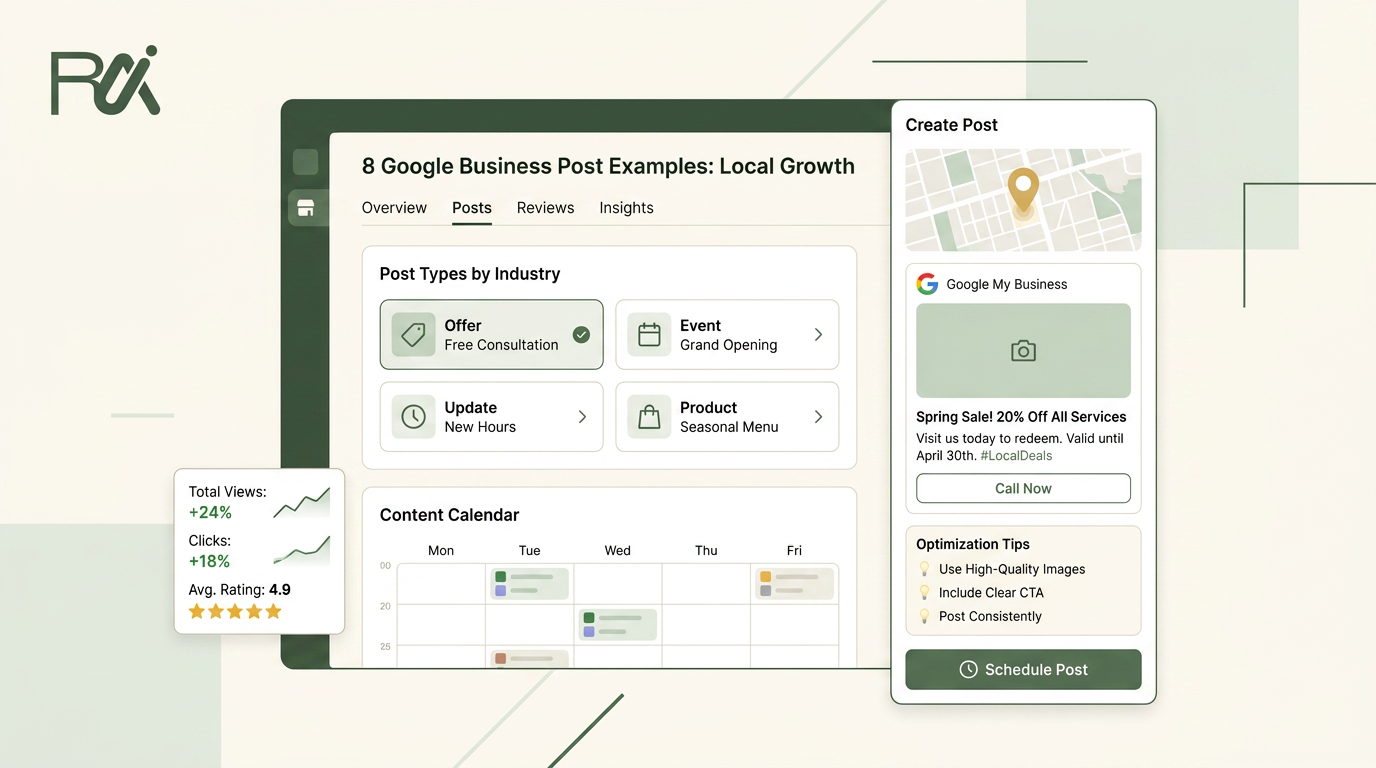
Table of Contents
- 1Introduction
- 21. Weekly Special or Limited-Time Offer
- 3Make the offer easy to verify
- 42. New Product, Service, or Menu Item Launch
- 5Lead with the customer benefit
- 63. Team Member Highlight or Staff Achievement
- 7Keep credentials specific
- 84. Before and After Project or Transformation
- 9Make the comparison fair
- 105. Educational or How-To Content
- 11Choose one question and one action
- 126. Community Involvement or Local Event Participation
- 13Name the event and the organization
- 147. Customer Question Response or FAQ Post
- 15Use real questions, not guesses
- 168. Photo Gallery or Portfolio Showcase
- 17Show the place as customers will find it
- 188 GMB Post Types Comparison
- 19Turn These Examples Into This Week's Posting Plan
Introduction
You know your Google Business Profile should look current, but the blank post box makes that harder than it sounds. What should you promote, which photo should you use, and should the button say Call, Book, Order, or Learn more?
The examples below give you eight practical formats for restaurants, salons, clinics, hotels, contractors, and other local businesses. Each one includes sample copy, an image choice, a suitable CTA, timing advice, trade-offs, and a method you can repeat this week.
Google Business Profile posts appear directly on your business listing in Google Search and Google Maps. They can support trust, engagement, and profile completeness by showing useful, current information to people comparing local businesses or searching for a service near them. They shouldn't be presented as confirmed ranking factors. Google documents posts and profile performance separately, and its guidance doesn't promise that posting frequency itself improves local ranking. For broader ideas on keeping your content useful, see these social media content refresh tips.
1. Weekly Special or Limited-Time Offer
A time-bound offer gives local searchers a specific reason to act. It can feature a restaurant meal, salon package, clinic availability, hotel promotion, or contractor service. Set a real start and end point. “Great deals all month” gives customers no clear deadline.
Restaurant example:
Tuesday Pasta Night: Buy one entrée, get 50% off a second. Valid Tuesday from 5 p.m. to 8 p.m. Dine-in only. Reserve your table online.
A salon could write, “New client special: First cut and color for $85. Schedule this week.” A medical clinic might post, “Flu shots available walk-in this Saturday from 9 a.m. to 2 p.m. No appointment needed.” Each example states the offer, timing, and next action without forcing customers to ask for missing details.
Choose a strong food, service, or product photo. A real image shows what customers will receive and usually gives staff more useful material than a generic discount graphic.

Make the offer easy to verify
Publish 5 to 7 days before the offer starts so customers can plan. Include exact dates, times, eligibility rules, location, and booking requirements. Choose Order, Book, Call, or Learn more according to the action your team can handle promptly.
Google Business Profile posts can contain 150 to 1,500 characters, a photo or video, and CTA buttons such as Call, Book, Order, Learn more, Sign up, or Buy, according to this guide to Google Business Profile post ideas. Keep one promotion per update. Combining several offers makes the details harder to verify.
The main risk is operational. If staff cannot explain the terms or the advertised item sells out, the post creates frustration instead of trust. Check the post when the promotion ends, remove outdated details, and use a Google Post Generator to prepare the next accurate offer.
2. New Product, Service, or Menu Item Launch
A launch post answers a question many local searchers have before they call: Do you offer this? State what changed, explain who it helps, and tell people how to request it.
A coffee shop could write:
Now serving cold brew on tap. Try it with any of our pastries. Order at the counter or call ahead for a larger pickup order.
A physical therapy clinic might announce dry needling and tell patients to ask their therapist whether it's appropriate for their treatment plan. A plumbing contractor could explain that the company now offers thermal-imaging leak detection to help pinpoint problems during an inspection.

Lead with the customer benefit
“New service available” is accurate but weak. “Find hidden leaks without opening multiple walls” gives a customer a clearer reason to ask about the service. Keep the benefit factual. Don't promise a result you can't support or guarantee.
Use a genuine product photo for food, retail, and hospitality. For a contractor or clinic, show the equipment, treatment setting, or staff member delivering the service. Select Order, Book, Call, or Learn more according to the next step.
Publish within a week of launch while the addition is still new to regular customers. Confirm that the service is available at the specific location shown on the profile. Multi-location businesses should avoid claiming that every branch offers the new service unless that has been checked.
The strength of this format is clarity. Someone searching Google Maps can see that your business has a relevant option before visiting your website. The trade-off is that launch posts become stale quickly. If the menu changes, equipment is replaced, or the service pauses, revise the post immediately.
3. Team Member Highlight or Staff Achievement
Customers often want to know who they'll meet. A team post can make a dental practice, salon, restaurant, cleaning service, or clinic feel more familiar before the first visit.
Use a real portrait and introduce one person at a time. For example:
Meet Dr. Sarah Chen, our new orthodontist. She trained at Boston Children's Hospital and has eight years of experience. Call our office to ask about orthodontic consultations.
A restaurant could introduce James, its head chef, and mention his advanced French pastry training alongside a new dessert. A cleaning company could celebrate Maria's ten years with the team and connect her work to careful attention to customer homes.
Keep credentials specific
Include only credentials, training, or experience that the business can verify. Ask the staff member for permission before using their name and image. For healthcare businesses, take extra care with professional titles, licenses, and statements about care.
The benefit should remain customer-centered. “Dr. Chen is available for consultations on Tuesday” helps more than a long biography. “Maria works with recurring residential customers” gives context without inventing testimonials or performance claims.
Choose Book for an appointment-based business, Call when customers need to discuss fit, or Learn more when a profile page contains the full biography. A portrait taken in the actual workplace usually feels more useful than a heavily designed stock-style graphic.
Rotate people over time if your team is large. Don't spotlight only owners or senior staff if customers regularly interact with receptionists, stylists, technicians, servers, or care coordinators. The risk is inconsistency. If someone leaves, update the post so the profile doesn't introduce a person who no longer works there.
4. Before and After Project or Transformation
A before-and-after post helps customers judge whether your work matches their needs. It works well for contractors, salons, landscaping services, cosmetic services, and some dental practices.
A bathroom contractor could show the original room beside the completed renovation, then write:
Small bathroom renovation completed. We replaced the tile, vanity, fixtures, and lighting while keeping the existing footprint. Call to schedule an on-site estimate.
A hair salon might show a color correction with the customer's permission. A landscaping company could show an overgrown yard transformed into an organized outdoor space. A dental office can share a whitening or cosmetic result only when the patient has given clear consent.

Make the comparison fair
Take the “before” photo when the customer arrives, not from memory or a description. Match the angle, framing, and lighting as closely as possible. Explain what changed in plain language, and don't imply that one example represents every customer's outcome.
Use Call, Book, or Learn more. A contractor may need to qualify a project by phone, while a salon can send a customer directly to online booking.
Written permission matters. If the customer prefers anonymity, crop or blur the face while keeping the work visible. For dental, medical, and cosmetic examples, follow your privacy requirements and use only images that the patient has authorized.
The strength is visible proof. The risk is misleading presentation. Heavy editing, mismatched angles, or an unclear description can make the post look staged. Keep the copy short, identify the service, and state the next step. If the project is seasonal or location-specific, name the neighborhood or branch only when it is accurate.
5. Educational or How-To Content
Your staff already answers customer questions every day. Turn one answer into a short Google Business Profile post that gives the reader something useful to do.
A plumber could write:
Three signs your water heater may need replacement: visible rust, strange noises, or water pooling underneath. Call for an inspection before the problem gets worse.
A spa might explain how to extend the life of a pedicure. A veterinary clinic could explain signs of heat stress in dogs, then advise owners to bring the animal inside, offer water, and call if symptoms continue.
Choose one question and one action
Don't turn the post into a full article. Answer one common question in language a customer can understand. Avoid technical terms unless your customers already use them. A photo, simple graphic, or short video can make the advice easier to scan.
A low-pressure CTA usually works best. Use Learn more for a detailed service page, Call when the situation needs professional assessment, or Book when the next step is routine.
This format builds helpfulness and trust. It isn't a confirmed ranking tactic, and it shouldn't promise better placement in map results. Its value is that a person comparing nearby providers can see how your business explains a problem before deciding whether to contact you.
Keep a shared document of questions staff hear at the front desk, on calls, and during appointments. Review it each week and choose one question that can be answered safely and accurately. You can also use this Google Business Profile optimization checklist when checking the rest of your listing.
This video format can work for a quick demonstration or explanation:
Google's photo and video guidance allows videos up to 30 seconds and up to 75 MB, so keep the recording focused and easy to watch on a phone. Google's Business Profile media guidelines explain the practical upload limits.
6. Community Involvement or Local Event Participation
A community post should show real participation, not turn a donation into a sales pitch. Restaurants, clinics, auto shops, hotels, and contractors can use this format to document a local event while making the business more familiar to nearby customers.
A restaurant could write:
We sponsored the local Little League this season. You can see our name on the scoreboard at Central Park field. Thanks to the players, families, and volunteers for a great season.
A medical practice might share a photo from a health fair where its team provided blood pressure checks and wellness resources. An auto repair shop could describe donating vehicle maintenance to a youth trade school program.
Name the event and the organization
Use a genuine photo showing your team, storefront, booth, uniforms, or the event itself. Name the organization clearly. Post during the event or soon afterward, while the details are still fresh.
The CTA should serve the reader. Learn more can point to the event or nonprofit. Call may be appropriate if the event involves reservations or services. Sometimes no aggressive CTA is needed, especially when the post is primarily about community participation.
The strength is local familiarity. A person comparing businesses near them may recognize the organization, park, school, or neighborhood. The risk is self-congratulation. Keep the focus on the cause and the people involved, not on inflated claims about your generosity.
Don't describe community involvement as a confirmed local ranking factor. It can support goodwill and recognition, but map visibility still depends on the broader information and behavior Google uses for local results. Keep event details accurate, and avoid posting a generic “Happy Monday” message that gives customers no useful context.
7. Customer Question Response or FAQ Post
A strong FAQ post removes a practical obstacle. It answers the question that stops someone from booking, calling, or visiting.
A salon could write:
Do we take walk-ins? Yes. The average wait is 15 minutes on weekends and 5 to 10 minutes on weekdays. Book online to reserve a specific time.
A medical clinic might list accepted insurance providers, including Medicare, Medicaid, Blue Cross, Aetna, and UnitedHealth, then ask people to call if their provider isn't listed. A contractor could name the ZIP codes it serves and explain that travel fees may apply outside the usual area.
Use real questions, not guesses
Ask front-desk staff what customers repeatedly ask. Review call notes, booking messages, and conversations with technicians. Format the post as a question followed by a direct answer so mobile readers can find the detail quickly.
Use Call when policies require discussion, Book when the answer removes uncertainty, or Learn more when a page contains full service-area or insurance information. Be precise about hours, coverage, wait times, appointment rules, and service areas.
This format is useful because it reflects actual customer intent. It also carries a high accuracy burden. A changed insurance contract, staffing shortage, holiday schedule, or service-area policy can make the post wrong.
Review date: Put a reminder on your calendar when the policy may change, and check the post before staff sends customers to it.
Google's content policy says posts should accurately represent the location or product and be based on a real experience. That matters especially for operational claims. Don't exaggerate availability, invent wait times, or imply that every branch follows the same policy. Keep each answer tied to the specific profile where it appears. Read Google's prohibited and restricted content guidance before publishing claims about products, services, or customer experiences.
8. Photo Gallery or Portfolio Showcase
A gallery gives a potential customer a preview of the experience. It can show a restaurant's dining room, a hotel's guest areas, a dental clinic's treatment rooms, or a fitness studio's class setup.
A restaurant might pair photos of the dining area, bar, private event room, and signature dishes with this copy:
Planning a dinner or private event? See our dining room, bar, and event space. Call to discuss availability and group menus.
A hotel can show a guest room, lobby, gym, pool, and restaurant. A dental practice can show the waiting room, treatment setup, and sterilization area. A fitness studio can show equipment and different class layouts.

Show the place as customers will find it
Use natural light when possible, add proper lighting where needed, and clean the background before taking photos. Include both wide shots and detail shots. A hotel guest wants to see the room layout, while a restaurant customer may care about seating, food presentation, and private dining.
Choose one CTA. Book suits hotels, salons, and fitness studios. Call works for private events, clinics, and services that need questions answered. Learn more can lead to a portfolio or service page.
Refresh photos after renovations, seasonal changes, or major menu updates. Don't show a staged space that looks different during business hours. Vary the subjects across posts so your profile doesn't repeat the same room or dish.
Use this Google Business Profile photo guide when deciding what to add beyond a single gallery post. The gallery's strength is confidence before the visit. Its risk is overpromising through old or heavily edited images. Show the condition, service, and setting customers can expect.
8 GMB Post Types Comparison
| Post Type | Implementation Complexity 🔄 | Resource Requirements ⚡ | Expected Outcomes 📊 & Quality ⭐ | Ideal Use Cases 💡 | Key Advantages ⭐ |
|---|---|---|---|---|---|
| Weekly Special or Limited‑Time Offer | Low 🔄, template + dates | Low ⚡, short copy, simple image | 📊 Short-term traffic & conversions; ⭐⭐⭐ | Restaurants, salons, clinics to boost slow periods | Creates urgency; measurable; drives immediate visits |
| New Product / Service / Menu Launch | Medium 🔄, launch messaging + assets | Medium ⚡, photo/video and readiness | 📊 Drives trials, differentiates; ⭐⭐⭐ | Businesses adding notable offerings or upgrades | Announces growth; attracts competitor shoppers |
| Team Member Highlight / Staff Achievement | Low–Medium 🔄, consent + portrait | Low ⚡, portrait photo, brief copy | 📊 Builds trust & rapport; ⭐⭐ | Service businesses with repeat customer interactions | Humanizes brand; improves credibility & morale |
| Before & After Transformation | Medium–High 🔄, consistent framing & consent | Medium–High ⚡, quality photos, editing | 📊 Strong social engagement & proof; ⭐⭐⭐ | Contractors, salons, landscapers, cosmetic services | Demonstrates results; builds confidence in workmanship |
| Educational / How‑To Content | Medium 🔄, accurate, helpful scripting | Low ⚡, short text/photo/video, staff expertise | 📊 Positions as expert; long‑term trust; ⭐⭐⭐ | Businesses answering common pre‑purchase questions | Attracts research-stage customers; shareable helpful content |
| Community Involvement / Local Events | Medium 🔄, genuine participation + timing | Medium ⚡, event photos, coordination | 📊 Local goodwill & visibility; ⭐⭐ | Local businesses seeking community ties | Builds local reputation; employee engagement and shares |
| Customer Question Response / FAQ | Low 🔄, Q&A formatting | Low ⚡, content upkeep when policies change | 📊 Reduces calls, captures search queries; ⭐⭐⭐ | Any business with recurring customer questions | Removes barriers to contact/purchase; evergreen content |
| Photo Gallery / Portfolio Showcase | Medium 🔄, curation & updates | High ⚡, quality photography, refresh schedule | 📊 Increases conversions & reduces hesitation; ⭐⭐⭐ | Hotels, restaurants, clinics, studios where environment matters | Provides virtual preview; proves amenities and standards |
Weekly Special or Limited‑Time Offer
New Product / Service / Menu Launch
Team Member Highlight / Staff Achievement
Before & After Transformation
Educational / How‑To Content
Community Involvement / Local Events
Customer Question Response / FAQ
Photo Gallery / Portfolio Showcase
Turn These Examples Into This Week's Posting Plan
You don't need to invent a new idea every time you open your Google Business Profile. Start with the next real operating need. A restaurant with a new seasonal dish should use a launch post. A salon with open appointments should use a specific offer or FAQ. A contractor who just completed strong work should use a before-and-after post. A hotel preparing for a busy period should refresh its gallery.
Use this five-step process:
Google describes Business Profile posts as short updates that can support business updates, offers, events, and product-style promotions directly on Search and Maps. The format is brief enough to repeat, but it still needs operational discipline. A post that advertises an expired deal or unavailable service damages confidence.
Posts typically leave the main display after seven days, although they may remain visible in profile update areas, according to this overview of Google Business Profile post timing and formats. That short lifecycle makes recurring specials, weekly menu changes, events, and fresh announcements practical. It also means a business that posts occasionally shouldn't fill the listing with evergreen copy that never changes.
Rotate the eight formats instead of repeating discounts. Use offers for immediate action, launches for new demand, people for familiarity, projects for proof, education for useful answers, community posts for local connection, FAQs for friction, and galleries for visual confidence. Keep your profile details, hours, services, photos, and posts accurate across every location.
Don't promise that posting activity will improve ranking. Google doesn't identify posting frequency as a confirmed direct ranking factor. Treat posts as on-profile conversion assets that help people decide whether to call, visit, book, order, or request directions from a business they found through a nearby search.
If managing posts alongside review requests, profile updates, and multiple locations keeps getting pushed aside, RecensioAI can help organize Google Business Posts and broader profile activity. The platform also supports workflows for review requests, review responses, profile audits, and multi-location management. Whatever system you use, draft the post that best matches your customers' immediate need, verify every detail, and schedule it this week. For a broader planning routine, use this guide on how to plan social media content.
---
RecensioAI B.V. offers tools for Google Business Profile audits, post generation, review requests, review responses, and multi-location profile workflows. Visit RecensioAI B.V. to see how you can keep local business activity organized without relying on staff to remember every update.
- Match the format to the event: Choose an offer, launch, team update, project, lesson, community activity, FAQ, or gallery based on what customers need to know now.
- Write one customer benefit: Explain what the reader gets, understands, or can do after reading the post.
- Choose a genuine image: Use the actual dish, team member, project, location, product, or event. Don't use an unrelated stock photo.
- Add one suitable CTA: Select Call, Book, Order, Learn more, Sign up, or Buy only when that button matches the next action.
- Set a review date: Check time-sensitive posts when the offer, schedule, service, policy, or event changes.
You might also like
Handpicked articles for you
Hotel Review Management: Automate Post-Stay Requests with Apaleo, Mews and Your PMS
A practical guide to turning hotel checkouts into timely review requests, with Apaleo live, Mews early access and flexible PMS alternatives.
Why the Business Around the Corner Beats You on Google: What 21,373 Profiles Reveal
We compared 21,373 Google Business Profiles with their three strongest nearby competitors. The gap is smaller than most owners think, but it has two sides: rating and volume.
Treatwell Review Management for Salons: One Reputation View Alongside Google
Bring your public Treatwell rating and recent reviews into RecensioAI, then combine salon signals with Google for faster, better decisions.