10 Best Google Business Profile Reviews Management Tools
Find the best Google Business Profile reviews management tool for your business. Compare 10 top options for SMBs and multi-location brands to automate reviews.
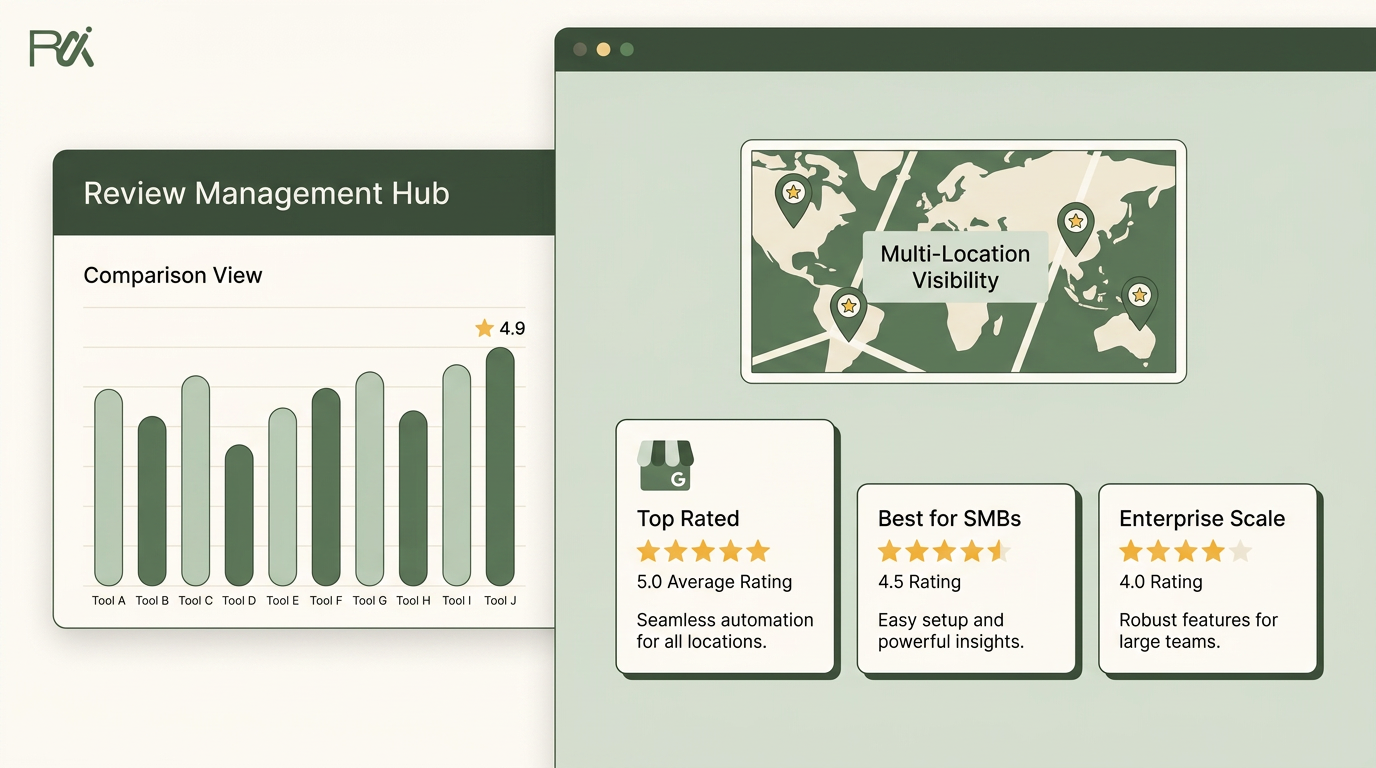
Table of Contents
- 1Introduction
- 21. RecensioAI B.V.
- 31. RecensioAI B.V.
- 4Why it fits multi-location operators
- 52. Birdeye
- 6Best when your team needs one workspace
- 73. Podium
- 8Good for businesses that live on texting
- 94. NiceJob
- 10Simple setup, less overhead
- 115. GatherUp
- 12Useful for agencies and multi-location teams
- 136. ReviewTrackers (by InMoment)
- 14Strong on alerts and routing
- 157. SOCi
- 16Built for governance first
- 178. Uberall
- 18Good for store managers on the move
- 199. Yext
- 20Best when the location layer is complex
- 2110. Reputation (formerly Reputation.com)
- 22A fit for enterprise CX teams
- 23Top 10 Google Business Profile Review Management Tools, Comparison
- 24Your Next Step Choosing the Right Tool
Introduction
You're busy, and the reviews still pile up. A customer leaves a Google review after lunch, another one comes in after closing, and your phone lights up again when somebody asks if you're open on Sunday. If you run a restaurant, salon, clinic, hotel, or contractor business, you already know the problem. Reviews aren't rare. They're daily work, and they affect how you show up in near me searches and Google Maps. Google says local ranking rests on relevance, distance, and prominence, and reviews contribute to prominence, while Business Profile data is managed per profile, not in one neat cross-location dashboard Google Business Profile help.
A google business profile reviews management tool helps you keep that work under control. The right one lets you collect reviews, reply faster, watch trends, and keep your profile active without living inside Google all day. If you manage one location, you need speed and simplicity. If you manage many, you need control, reporting, and less chaos. Start with the list below, then choose the tool that fits your actual operation, not the one with the loudest pitch. For a quick overview of the category, you can also compare these Google review handling tools.
1. RecensioAI B.V.
If your business wins or loses on Google Maps visibility, RecensioAI belongs near the top of your shortlist. It is built for operators who depend on near me searches, including restaurants, hotels, salons, clinics, retail, and multi-location brands. It keeps review collection, replies, profile work, and location reporting in one place, so you are not stitching together separate tools to manage one job.
If you run one location, use a tool that keeps the work simple and fast. If you run multiple locations, pick software that gives you control across sites without turning every store into a separate headache. That split matters. Single-location SMBs need speed. Multi-location brands need visibility, oversight, and consistent execution.
Practical rule: if your team keeps missing review requests because staff are busy, use automation. If your team keeps missing replies because no one owns the inbox, use a dashboard that assigns the work to the platform.
RecensioAI stands out because it treats reviews as part of the full customer flow, not as a separate task. It connects SMS, WhatsApp, email, and QR review requests to a choice between a public Google review and private feedback. Use that structure carefully, and avoid review gating. It also detects the customer's device language, which helps when one location serves people in more than one language. The platform says it supports 15 customer languages and 12 dashboard languages, which helps when your front desk, store managers, or guests do not all work in one language.
A tool like this matters most when you manage several locations and need the same process everywhere. If you want help comparing fit before you buy, start with this guide on how to compare review management software. If your needs are broader and you want hands-on support, look at these review management services.
1. RecensioAI B.V.

If your business depends on Google Maps visibility, this is the strongest fit on the list. RecensioAI is built for businesses that live or die by near me searches, which means restaurants, hotels, salons, clinics, retail, and multi-location brands. It handles review collection, replies, profile work, and location reporting in one place, so you're not juggling five tools to do one job.
Practical rule: if your team keeps missing review requests because staff are too busy, use automation. If your team keeps missing replies because no one owns the inbox, use a dashboard that assigns the work to the platform.
RecensioAI stands out because it doesn't treat reviews as a standalone task. It connects SMS, WhatsApp, email, and QR review requests to a choice between a public Google review and private feedback. That matters because it keeps the public profile active without crossing into review gating, which you should avoid. It also detects the customer's device language, which helps when one location serves people in more than one language. The platform says it supports 15 customer languages and 12 dashboard languages, which is useful if your front desk, store managers, or guests don't all work in one language.
Why it fits multi-location operators
Google's own workflow fragments data by profile, so a brand with several locations needs a real operating system, not a pile of tabs Google Business Profile help. RecensioAI's value is that it turns those scattered location-level numbers into one dashboard. The site also presents the platform as a single place for Google Business Profile audits, Google Posts, competitor tracking, social auto-posting, and review response work, which is exactly the kind of repeatable process a busy owner can't do manually every day. The company's materials position it as Google-compliant, with a private feedback option shown side by side with the public review path.
It also fits operators who want the profile itself kept current. If your hours, categories, attributes, or photos drift, you lose trust before you lose ranking opportunity. RecensioAI bundles profile audits, content publishing, and review handling so your staff doesn't have to remember every small task.
RecensioAI is the one to pick if you want one system for collection, replies, profile upkeep, and multi-location reporting.
Pros
Cons
Website: RecensioAI B.V.
- Automates review collection across SMS, email, WhatsApp, and QR so your staff doesn't have to remember each request.
- Keeps public and private feedback separate, which helps you stay compliant and avoid risky review gating.
- Supports multilingual review pages and dashboards, which is useful for hotels, clinics, and restaurants serving mixed-language customers.
- Bundles audits, Google Posts, social posting, Wi-Fi lead capture, and competitor tracking in one dashboard.
- Offers a free trial and transparent entry pricing, which makes it easier to test without a long sales process.
- Monthly pricing may be more than you need if you only want a basic review link.
- Automation still needs setup and oversight, especially if you want replies to match your brand voice.
- You'll get the most value when your systems are connected, such as POS or booking workflows.
2. Birdeye
Birdeye is the stronger pick when you need reviews, listings, and customer communication in one place. It is built for SMBs and large franchises, so it handles scale better than a basic review app. If you run a dental group, auto shop network, hotel chain, or retail brand, that difference matters. You need a tool that keeps multi-location work organized without forcing every update through manual steps.
The main reason to look at Birdeye is centralized review control. You can collect Google reviews, monitor them in one dashboard, and use AI-assisted replies when the inbox starts to fill up. The platform also includes listings sync across major directories, which helps keep profile data consistent when hours, services, or location details change. That consistency matters because a broken profile hurts the first impression, and you do not get many chances to recover from that.
Best when your team needs one workspace
Birdeye fits teams that want operational coverage, not just review replies. The managed services option helps if your internal team does not have the bandwidth to keep up. If you are running multiple locations and no one owns review follow-up, that support can keep responses from slipping and listings from going stale. If you want a clearer way to judge tools like this, use this review management software comparison guide before you choose a vendor.
If you manage a single café or salon with light review volume, Birdeye can feel like too much platform. That is the tradeoff. You get more capability, but you also take on more setup and a sales-led buying process. For a multi-location operator, that extra depth usually makes sense. For a local shop with one storefront, a lighter google business profile reviews management tool may be the better fit. If you need a simpler way to handle replies and profile updates, manage Google reviews with a dedicated workflow and keep the process tight.
Website: Birdeye
3. Podium
Podium is built for businesses that get reviews through customer conversations, not just after-the-fact follow-up. If you run home services, healthcare, retail, or automotive, you probably already know how often customers respond faster by text than by email. Podium leans into that reality. It gives you review request workflows by SMS and email, plus a unified inbox for customer communication.
The practical benefit is speed. Your staff can send a Google review request right after a visit or completed job, then monitor replies in the same place they handle messages and webchat. That's useful when your front desk, service writers, or office team are already using text to book, confirm, or follow up. The AI Reputation Specialist also helps draft responses, which reduces the lag between a review landing and your team replying.
Good for businesses that live on texting
Podium makes the most sense when reviews are part of your sales process. A contractor who closes a job, a clinic that finishes an appointment, or a car dealership that delivers a vehicle can use Podium to keep the follow-up tight. It's less about marketing theory and more about getting the ask out while the customer still remembers the service.
If you're comparing platform depth, this guide to review management services helps frame the category. Podium isn't the lightest option, and it's not the cheapest one to run if you only need basic review links. But if your team already depends on texting, it's easy to adopt because the workflow feels familiar.
Website: Podium
4. NiceJob
NiceJob is a better fit for small teams that want more reviews without a complicated setup. It focuses on reputation marketing, which means automated Google review requests, monitoring, and response help, plus a few practical extras like social proof widgets and referral features. If you run a salon, local service business, or small hospitality operation, that simplicity matters. You don't need a giant platform if your main problem is that nobody sends the review request consistently.
The appeal is straightforward. NiceJob helps you keep review flow moving and makes it easier to show recent feedback on your site. That matters for trust, especially when a customer is comparing you against two nearby competitors in map results. Strong reviews don't replace good service, but they do make the first click easier to win.
Simple setup, less overhead
NiceJob is worth a look if you want transparent pricing and a lighter learning curve. Smaller teams usually don't need heavy governance, complex user permissions, or enterprise reporting. They need a tool that works quickly and doesn't require a long implementation project.
It also makes sense if you're not trying to centralize a dozen locations. A single-location owner can use NiceJob to automate the repetitive parts of review collection and keep social proof visible without adding a lot of admin work. If you ever outgrow it, that's a good sign. It means the business got busy enough to need a bigger system.
Website: NiceJob
5. GatherUp
GatherUp is for operators who want review requests and customer feedback in one system. It handles email, SMS, links, and QR codes, so you can ask for feedback in the channel that fits the visit. For restaurants, clinics, and service businesses, that's practical. Customers aren't all going to respond to the same prompt the same way.
The platform also gives you AI-crafted reply suggestions, topic tagging, and benchmarking across locations. That makes it stronger than a basic review collector. It helps you see patterns, not just isolated comments. If your reviews keep mentioning the same wait-time issue or front desk friction, you need a tool that helps you spot that early.
Useful for agencies and multi-location teams
GatherUp has the kind of structure agencies and franchises can use. Role controls and white-label options matter when multiple people are touching the same locations. It also includes an optional Listings Hub, so you can sync directory data without adding a separate system for every task.
The platform's style is more toolbox than all-in-one suite. That can be good or bad. If you like clean specialization, it works. If you want one polished interface with every function baked in, it may feel less unified than newer platforms.
Website: GatherUp
6. ReviewTrackers (by InMoment)
ReviewTrackers is built for monitoring and response at scale. If your locations get reviews from multiple sites and you need a clean way to route them to the right people, this is a serious contender. It aggregates Google reviews and many other sources into a single inbox, then adds alerts and templates so nothing gets missed. That's useful when managers are busy and review follow-up gets pushed to the side.
The main reason to use it is control. You can see which locations are getting more attention, which reviews need a response, and where escalation is necessary. For multi-location teams, that can keep one store manager from drowning while another ignores the inbox. It also gives you mobile access, which helps when the person who needs to respond isn't sitting at a desk.
Strong on alerts and routing
ReviewTrackers is most valuable when response discipline matters. If you run hotels, clinics, or fast-moving retail operations, you need a system that surfaces new reviews quickly. Delays make you look inattentive. Fast responses make you look present.
If you're researching the broader software category, this review management software guide for 2026 gives a useful framework. ReviewTrackers won't be the lightest or flashiest option, and smaller businesses may want more AI drafting features. But if you care about alerting, consolidation, and keeping the team honest, it's a solid pick.
Website: ReviewTrackers
7. SOCi
SOCi is for franchises and large multi-location brands that need governance. If your corporate team wants to control messaging while local managers still need to participate, SOCi is built around that problem. It combines review monitoring, AI-assisted response, local social publishing, Google Posts, and permissioned workflows. That's a lot, but that's the point. Big location networks need structure.
The strongest use case is brand control. When dozens or hundreds of locations can touch the same profile ecosystem, you need approvals, role management, and clear boundaries. SOCi gives you that. Its reputation module and AI layer help reduce the manual load, but the larger value is that the system can keep the brand voice consistent across many locations.
Built for governance first
This is not the tool you buy for a single shop. It's the tool you buy when different teams, regions, or field operators are all involved. If your franchisees need to publish, respond, and escalate without stepping outside corporate rules, SOCi fits.
The tradeoff is complexity. Implementation takes real coordination, and the platform is overkill for a one-location owner. But if you're managing a brand that needs approval flows and repeatable local marketing, SOCi belongs near the top of the list.
Website: SOCi
8. Uberall
Uberall combines listings management and review handling in one place. That makes it appealing if your business has many locations and you care about directory consistency as much as review response. The platform syncs across a large directory footprint and gives store-level teams mobile access, which is handy when local managers need to answer reviews on the go.
The reason to consider Uberall is operational steadiness. Multi-location brands need the same address, hours, and profile details everywhere. If one location changes hours and another doesn't, customers get frustrated fast. Uberall helps reduce that drift while still giving you a place to manage reviews and responses.
Good for store managers on the move
The mobile angle matters more than many owners realize. A store manager doesn't always have time to open a desktop dashboard. If they can handle a review from a phone, you're more likely to get a timely response. That kind of responsiveness helps the profile look active and cared for.
Uberall is more platform than point solution, so smaller businesses may find it broader than they need. But if you're running a distributed brand and want directory sync plus review handling in one operating layer, it's a sensible option.
Website: Uberall
9. Yext
Yext is an enterprise local presence platform. If you need listings, pages, and reviews tied together with strict control, it belongs on your shortlist. It's especially useful for regulated industries or brands with many locations and many people touching the data. You get enterprise permissions, templates, approvals, and auditability, which matters when one wrong edit can spread across a large footprint.
The biggest benefit is consistency. Yext helps manage location data and review responses in a controlled system rather than a series of one-off edits. That's the right model when brand teams, regional teams, and local operators all need different levels of access. If your business relies on a clean local presence across dozens or hundreds of locations, that structure saves time and prevents mistakes.
Best when the location layer is complex
Yext is not the tool to buy if you only need Google review replies. It's for businesses that want a bigger operational layer around local visibility. That includes pages, listings, governance, and review workflows in the same stack.
You'll need to go through a quote-based sales process, and that's part of the enterprise tradeoff. For a single-location owner, it's too much. For a large brand, it's exactly the kind of control you pay for.
Website: Yext
10. Reputation (formerly Reputation.com)
Reputation is a full customer experience and reputation platform, not just a review inbox. It's built for large brands that need review monitoring, AI-assisted responses, surveys, sentiment work, and managed services in one place. If your internal team is stretched thin, the option to outsource review replies and listings work can matter as much as the software itself.
The practical strength here is breadth. You're not just collecting Google reviews. You're connecting them to broader customer feedback and operational insight. That helps if you want one system for reputation, surveys, and location governance instead of separate tools for each job.
A fit for enterprise CX teams
This is another platform that makes more sense when you have multiple layers of ownership. Brand teams, operations teams, and location managers can all work inside the same framework. That's useful when review handling is tied to customer experience reporting at a higher level.
For a local owner, it's probably too much. For a brand with a serious reputation program, it's a credible enterprise option. If you need support, reporting, and a broader CX stack around Google reviews, it belongs on the list.
Website: Reputation
Top 10 Google Business Profile Review Management Tools, Comparison
| Tool | Core features | UX / Quality | Value & Pricing | 👥 Target audience | ✨ Unique selling points |
|---|---|---|---|---|---|
| RecensioAI B.V. 🏆 | Automates review collection (SMS/WhatsApp/Email/QR), AI replies, GBP audits & posts, multi‑location dashboard | ★★★★★ | 💰 $49+/mo starter, 14‑day trial, transparent | 👥 Restaurants, hotels, salons, clinics, retail, multi‑location brands | ✨ Multilingual review pages, private feedback channel, Google‑compliant automation, POS integrations |
| Birdeye | Review collection & monitoring, listings, AI reply drafts, managed services | ★★★★☆ | 💰 Sales‑led; can be costly with add‑ons | 👥 SMBs → enterprise & franchises | ✨ Strong listings sync + optional managed services |
| Podium | SMS/email review invites, unified inbox, webchat, payments, AI reply suggestions | ★★★★☆ | 💰 Sales‑led; best value with messaging stack | 👥 Retail, home services, healthcare, auto | ✨ Fast review velocity via SMS; unified customer comms |
| NiceJob | Automated review/referral campaigns, widgets, AI reply help, optional managed sites | ★★★★ | 💰 Lower‑entry, transparent pricing | 👥 Small SMBs, single locations | ✨ Easy setup, social proof widgets, referral features |
| GatherUp | Multi‑channel requests, AI reply suggestions, topic tagging, multi‑location benchmarking | ★★★★ | 💰 Public pricing, generous message credits | 👥 Agencies, franchises, SMBs | ✨ GBP‑safe automations, role controls, white‑label options |
| ReviewTrackers | Aggregated review inbox, alerts & routing, templates, multi‑location reporting | ★★★★ | 💰 Limited public pricing; tiered | 👥 Mid‑market operations, multi‑location teams | ✨ Strong alerting/routing and inbox consolidation |
| SOCi | Centralized reviews, AI responses, sentiment/escalation, governance & approvals | ★★★★★ | 💰 Quote‑based enterprise pricing | 👥 Franchises, large enterprises | ✨ Enterprise governance, approval workflows, scaled reporting |
| Uberall | Review management + listings sync (125+ dirs), mobile app, GBP tools | ★★★★ | 💰 Quote‑based; per‑location complexity | 👥 Retail chains, multi‑location brands | ✨ Listings + reviews in one platform; mobile manager workflows |
| Yext | Reviews + listings + Pages, templates, approvals, enterprise permissions | ★★★★★ | 💰 Packaged/quote pricing (enterprise) | 👥 Regulated orgs, enterprises with distributed locations | ✨ Deep listings/pages integration with review governance |
| Reputation | Review collection/AI replies, surveys, CX analytics, managed services | ★★★★★ | 💰 Sales‑led (enterprise focus) | 👥 Large brands, CX teams, enterprises | ✨ Full CX + reputation suite; managed services for scale |
RecensioAI B.V. 🏆
Birdeye
Podium
NiceJob
GatherUp
ReviewTrackers
SOCi
Uberall
Yext
Reputation
Your Next Step Choosing the Right Tool
Choose based on your business size, not on feature overload. If you run one location or just a few, pick a tool that helps you request reviews, answer them fast, and keep your profile active without adding admin work. NiceJob and GatherUp make sense when you want something simpler and more affordable. Podium fits better if texting is already part of how your business sells and serves customers.
If you care most about Google Maps visibility and want one platform to handle review collection, replies, posting, and profile work, RecensioAI is the strongest match on this list. It's built for businesses that depend on near me searches and need a single operating system for the profile, the reviews, and the follow-up. That is the right move when your current process is scattered across text messages, spreadsheets, and whoever happened to be on shift that day.
If you run many locations, make the decision around governance. SOCi, Yext, Uberall, Reputation, and Birdeye are better fits when you need approvals, reporting, and control across a brand network. If you're an agency or consultant, look hard at ReviewTrackers, GatherUp, and Birdeye for workflow and consolidation. Don't buy the biggest system you can find. Buy the one your team will use next week.
Start with one trial. Connect one or two locations. Watch how long it takes to send review requests, reply to new reviews, and pull a report without copying data by hand. If that still feels like a chore, the tool is wrong. If it gives you time back, keep it and move the rest of your locations over.
For a more direct comparison with broader local search workflow tools, see AI Tools for Local SEO's review software.
---
RecensioAI B.V. gives you one place to handle Google review requests, AI replies, profile audits, Google Posts, and multi-location reporting. If your business depends on Google Business Profile performance and steady review flow, that's the kind of setup that saves time and keeps the work moving. Visit RecensioAI B.V. and see how it fits your locations.
You might also like
Handpicked articles for you
Hotel Review Management: Automate Post-Stay Requests with Apaleo, Mews and Your PMS
A practical guide to turning hotel checkouts into timely review requests, with Apaleo live, Mews early access and flexible PMS alternatives.
Why the Business Around the Corner Beats You on Google: What 21,373 Profiles Reveal
We compared 21,373 Google Business Profiles with their three strongest nearby competitors. The gap is smaller than most owners think, but it has two sides: rating and volume.
Treatwell Review Management for Salons: One Reputation View Alongside Google
Bring your public Treatwell rating and recent reviews into RecensioAI, then combine salon signals with Google for faster, better decisions.