How to Detect Fake Reviews on Google Business Profile
Learn how to detect fake reviews on your Google Business Profile with practical signals, documentation steps, and reporting workflows built
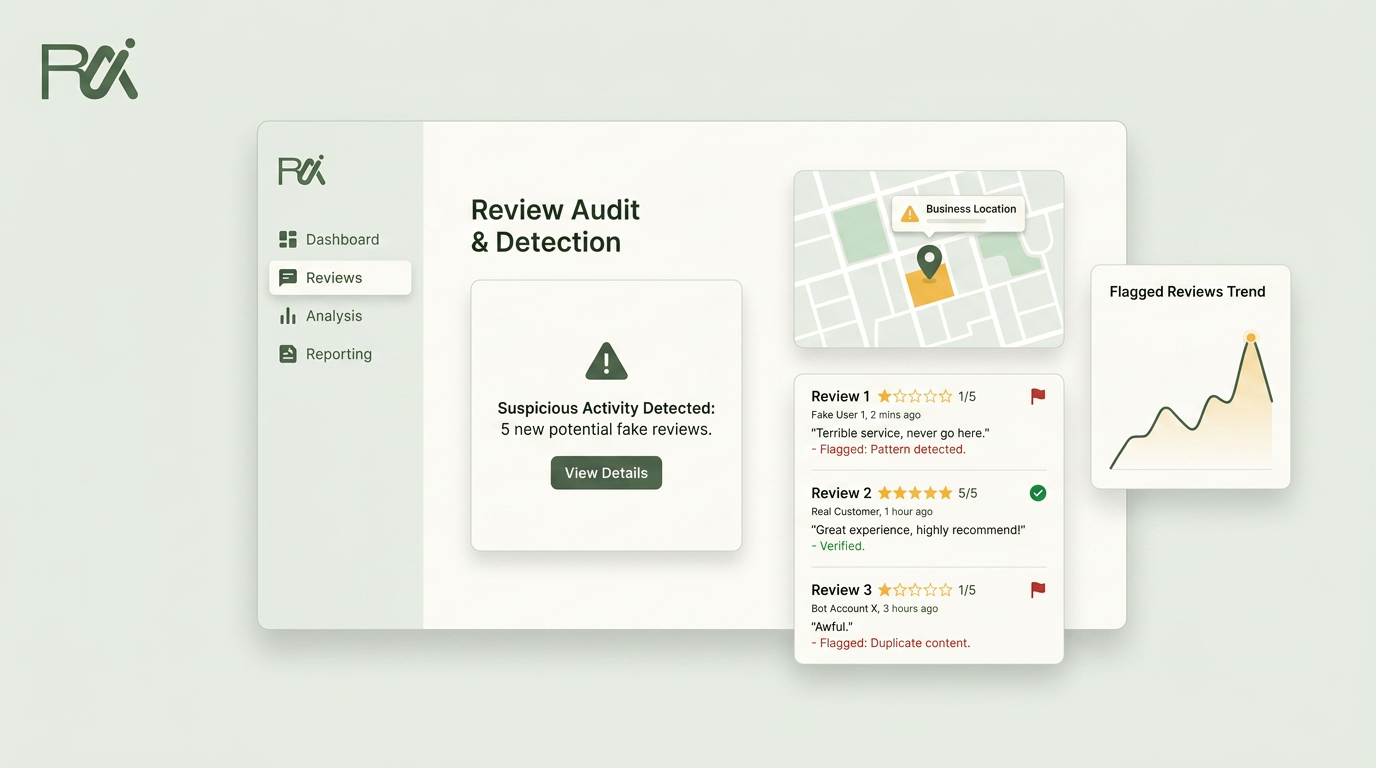
Table of Contents
- 1Introduction
- 2Why Fake Reviews Matter for Your Local Business
- 3Treat review checks like an operating task
- 4Signals That a Review Might Be Fake
- 5Look for timing and profile patterns
- 6Compare the claim with your records
- 7Why Obvious Text Cues Are Not Enough
- 8AI fakes can look ordinary
- 9How to Document Suspected Fake Reviews
- 10Build one record for each review
- 11Use a repeatable file name
- 12Reporting Fake Reviews Through Google Business Profile
- 13Follow the official click path
- 14Explain the evidence clearly
- 15Keeping Your Profile Healthy After Removal
- 16Keep the routine simple
Introduction
You open your Google Business Profile before the lunch rush and find a cluster of one-star reviews from names you don't recognize. A salon owner sees several glowing reviews on a nearby competitor that mention services the salon doesn't even offer. A contractor gets a complaint about a job at an address that never appeared in the schedule.
The first reaction is usually anger. The useful reaction is slower. Before you report anything, you need to determine whether the review is suspicious, document what you can prove, and match the report to a Google policy violation. That's how you protect your profile without asking Google to remove legitimate criticism.
Why Fake Reviews Matter for Your Local Business
A fake review can create work even when it never came from a real customer. You may spend time searching appointment records, asking staff what happened, and writing a response to someone who was never at your restaurant, clinic, hotel, or job site. Meanwhile, a potential customer sees the review while deciding where to call.
That matters because Google says local results are mainly based on relevance, distance, and prominence. Prominence includes signals such as the number of reviews a business has and its review scores, and Google says more reviews and positive ratings can help local ranking. You can read Google's explanation of how local ranking works.
For a restaurant, the result may be a customer choosing another listing after seeing an unexplained one-star cluster. For a salon, it may be someone questioning whether the business is reliable. A clinic can face confusion about a practitioner or treatment. A hotel may have reviews describing a room type it doesn't offer. These problems affect the trust people place in map results, where many “near me” searches end.
Treat review checks like an operating task
Don't wait for a crisis. Add a short review check to the person already responsible for the Google Business Profile. That person should scan new reviews, compare unusual claims with business records, and flag patterns for the owner or manager.
A useful review process also protects you from the opposite mistake. A negative review isn't fake just because you dislike it, remember the situation differently, or can't identify the customer from the name shown. Genuine customers may use nicknames, visit a different location, or describe an experience your staff didn't record correctly.
Practical rule: Suspicion is a reason to investigate, not proof that Google should remove a review.
Fake reviews are part of a broader trust problem. The UK government evidence base discussed in why online reviews are more important than ever estimated that fake reviews represented about 11% to 15% of reviews across popular UK e-commerce platforms, while a separate academic review found that many studies estimate roughly 20% to 30% of reviews may be fake. Those figures concern wider online marketplaces, not a prediction about your profile, but they show why a regular workflow is justified.
Signals That a Review Might Be Fake
A suspicious review usually becomes clearer when you examine its timing, account, and business details together. The FTC advises businesses and consumers to watch for a burst of reviews over a short period and to check how recent the activity is. Use the FTC's consumer guidance on suspected fake reviews while reviewing unusual activity.

Look for timing and profile patterns
A sudden group of reviews deserves a closer check. Five reviews appearing close together may follow a busy event, a promotion, or a delayed batch of customer feedback. Concern increases when the accounts are new, use generic names, show no visible history, and repeat similar wording.
Review the profile where Google makes that information visible. A missing photo proves nothing, and neither does a generic username. An account with one review, a history of reviewing unrelated businesses in distant cities, or several posts within a compressed period provides useful context for your records.
The pattern should fit the type of business. A restaurant might see accounts reviewing businesses across unrelated locations without mentioning a dish, server, or visit detail. A contractor might receive several reviews praising “excellent service” without naming a project, neighborhood, material, or type of work. A clinic could receive comments about a treatment it does not provide. A salon might find repeated references to a service absent from its menu.
Compare the claim with your records
Check the review against your service list, appointment system, invoices, and location details. Watch for:
Keep the psychology behind customer reviews in mind as you assess tone and detail. Genuine customers may write briefly, use familiar phrases, or remember a service differently. Style alone is weak evidence, so document the specific mismatch instead of treating an impression as proof.
No single signal establishes fraud. A new profile may belong to someone who rarely posts, and a short review may come from a real customer in a hurry. Build the case from connected observations, then save screenshots, dates, profile details, and the relevant business record before reporting it.
Teams that moderate user profiles or visual content can consult this guide for journalists and moderators for context on suspicious online identities. It does not replace Google's policy review, but it can help staff record profile-level observations consistently.
Ask, “What specific fact makes this review inconsistent with our business, customer records, or surrounding activity?” That question produces a reportable record instead of a guess.
- Vague language: “Great place, highly recommend” could describe almost any business.
- Wrong services: A review mentions laser hair removal, but the salon offers only cuts and color.
- Wrong setting: A hotel review describes a pool or room category that is unavailable.
- Copy-like phrasing: Several reviews use the same unusual wording or sentence structure.
- No visit detail: The reviewer gives a broad opinion without connecting it to an actual experience.
Why Obvious Text Cues Are Not Enough
Generic praise, repeated phrases, and awkward grammar can flag a review for closer checking. They cannot prove that the review was generated or posted fraudulently. Genuine customers may write short comments, rely on familiar templates, or produce polished wording. A human reader can mistake writing style for evidence, so staff should record concrete inconsistencies rather than impressions.
Human detection has clear limits. A 2025 study found that 151 consumers classified 906 reviews with only 53.2% accuracy, with particularly weak results for negative AI-generated fake reviews, as summarized in this review of recent fake-review detection research. Your instinct can identify a review worth investigating, but it should not decide whether to report it.
AI fakes can look ordinary
A fabricated review may describe a plausible appointment, a realistic delay, or a common service complaint. A generated negative review can sound more natural than a genuine customer's rushed comment. Telling staff to report anything polished, generic, or emotionally extreme will create false positives and waste time on legitimate feedback.
Photos need the same caution. An image can add visual credibility, yet it may be reused, unrelated, or artificially generated. Teams assessing image evidence can consult this resource on detecting AI-generated photos. An image check alone still cannot establish that the reviewer visited your business. For a practical view of why this evidence matters, see why photo reviews are becoming more important for visual credibility.
Research also examines text and images together. One multimodal study used 21,142 user-uploaded images across food delivery, hospitality, and e-commerce and reported an F1-score of 0.934, as described in this research on multimodal fake-review detection. That result does not give an owner a ready-made test for a Google review. It does show why wording alone misses part of modern review abuse.
Use text as an initial clue, then check timing, profile activity, business records, location details, repeated behavior, and policy fit. Document the connected facts that support a report. The objective is not to identify the author's technology. It is to show why the review may violate Google's rules.
How to Document Suspected Fake Reviews
A report works better when it gives Google a clear, review-specific reason to investigate. Don't start by writing an angry response. Preserve the evidence first, because the profile, wording, or surrounding review pattern may change.

Build one record for each review
Use a simple document or spreadsheet. A single-location restaurant can keep one tab for the business. A franchise should add the location name, store code, and manager responsible for checking records.
Record these details:
Don't include customer information that isn't necessary. Your internal records help you investigate, but a report should focus on relevant facts. If you collect information through forms or spreadsheets, a resource on how to validate Google Forms data can help you keep entries consistent, especially across multiple locations.
Documentation standard: Write as if another manager must understand the case without calling you. “Fake competitor review” is an opinion. “Reviewer describes a service we don't offer, posted alongside four new accounts in the same period” is evidence.
- Capture the review: Take a screenshot showing the text, star rating, date, reviewer name, and any attached image. Copy the review URL if your workflow allows it.
- Capture the profile: Screenshot the reviewer profile and note visible review history, profile name, and other activity relevant to your concern.
- Check internal records: Search bookings, point-of-sale records, appointment software, delivery logs, work orders, and staff notes. Don't assume a name mismatch proves the person wasn't a customer.
- Match the facts: Write down the exact inconsistency. For example, “Review says roof replacement, but this location only provides gutter repair,” or “Review names a service not offered at this clinic.”
- Map the timing: List other suspicious reviews near the same date. Note whether they appeared in a short burst or share unusual wording.
- Identify the policy concern: Use plain language such as “spam and fake content” or a possible conflict of interest. Explain the evidence, not your conclusion alone.
- Save the file: Keep the screenshots and notes together. Add the date you reported the review and any response from Google.
Use a repeatable file name
For example:
`Location name, review date, reviewer name, suspected policy issue`
For a franchise, add the location identifier. Keep a separate status field for not reviewed, under review, reported, Google decision, and escalated. The exact time required will depend on the review and your records, so don't promise that every case can be documented in a fixed number of minutes. A consistent file matters more than speed.
Reporting Fake Reviews Through Google Business Profile
Google's reporting path is straightforward, but the reason you select matters. Google says you can report a review only when it violates its content policies. A review you merely dislike or disagree with isn't eligible for removal, according to Google's review reporting guidance.
Follow the official click path
Open the correct Google Business Profile, then:
Don't report a review as fake merely because it gives one star. If a real customer complains about a long wait, a missed appointment, a billing dispute, or poor workmanship, respond professionally and handle the operational issue separately. Removal is for policy violations, not reputation cleanup.
- Open the review list: Choose Read reviews.
- Select the review: Find the suspected review and choose Report next to it.
- Choose the reason: Select the category that best matches the conduct, such as Spam and fake content.
- Submit the report: Provide the requested details and send it.
Explain the evidence clearly
A strong report connects the review to observable facts. State the location, date, reviewer, specific claim, and evidence that makes the review inconsistent. If several reviews form a pattern, describe the shared timing or repeated wording, but keep the report focused on the review you're submitting.
Google may leave a review online while it evaluates the report. Don't promise customers or staff that removal will happen, and don't publish accusations about the reviewer. If the first report doesn't lead to removal, review the policy category, add relevant context, and use Google's available support or escalation process. Repeating the same unsupported accusation usually doesn't strengthen the case.
A public response can still protect trust while the report is pending. Keep it short, avoid personal information, and invite the reviewer to contact the business through a private channel. Don't claim that Google is investigating, and don't reveal internal records in a public reply.
Keeping Your Profile Healthy After Removal
Removing a policy-violating review doesn't repair every weakness in your Google Business Profile. You still need accurate hours, categories, services, attributes, photos, and location details. A customer deciding between nearby restaurants, salons, clinics, hotels, or contractors needs a profile that answers basic questions before calling.
Genuine review activity also needs a regular process. Send review requests after real customer interactions, such as a completed meal, appointment, stay, consultation, or project milestone. Ask every customer the same way and give them a public Google review option. Don't pressure customers to leave only positive feedback or steer unhappy customers away from Google.
Google's local ranking guidance identifies review count and review score as part of prominence. It doesn't confirm that replying to reviews, adding review text, or posting activity directly improves ranking. Those actions still matter for trust, engagement, and profile completeness, especially when a prospective customer is comparing businesses on map results.
Keep the routine simple
Assign ownership. One person checks new reviews, another can investigate records when the review raises a serious concern, and a manager decides whether to report. Multi-location operators should use the same evidence fields at every location so a regional team can spot unusual activity without reading every case from scratch.
A platform such as RecensioAI can automate review requests and provide a structured workflow for documenting suspected fake reviews. It should support your process, not replace judgment. The customer must still choose whether to leave a public Google review or private feedback, and your team must still report only reviews that appear to violate policy.
Audit your current reviews this week. Check the newest activity, review profiles, service details, and timing patterns. Document the strongest suspected cases, submit reports through your Google Business Profile, and keep the records with your normal reputation workflow.
---
RecensioAI B.V. helps local businesses automate review requests and organize suspected fake-review documentation without filtering customer feedback. Visit RecensioAI B.V. to see how it can fit your Google Business Profile workflow.
You might also like
Handpicked articles for you
Hotel Review Management: Automate Post-Stay Requests with Apaleo, Mews and Your PMS
A practical guide to turning hotel checkouts into timely review requests, with Apaleo live, Mews early access and flexible PMS alternatives.
Why the Business Around the Corner Beats You on Google: What 21,373 Profiles Reveal
We compared 21,373 Google Business Profiles with their three strongest nearby competitors. The gap is smaller than most owners think, but it has two sides: rating and volume.
Treatwell Review Management for Salons: One Reputation View Alongside Google
Bring your public Treatwell rating and recent reviews into RecensioAI, then combine salon signals with Google for faster, better decisions.