
Automotive Customer Experience: A Practical Guide for 2026
Learn what drives automotive customer experience in 2026, from dealership touchpoints and EV service gaps to digital metrics and retention strategies.
Table of Contents
- 1Introduction
- 2The Moment a Customer Decides if You Are Worth Returning To
- 3The test happens after the handshake
- 4What Automotive Customer Experience Actually Covers
- 5Think in layers, not slogans
- 6The Modern Automotive Customer Journey Stage by Stage
- 7Each stage creates its own friction
- 8Walk the journey yourself
- 9The CX Metrics That Actually Matter and Who Owns Each One
- 10Sales and service need different scoreboards
- 11Weekly ownership beats quarterly reporting
- 12Digital Touchpoints and AI Where They Help and Where They Do Not
- 13Use AI for speed, not for accountability
- 14Keep the human on money and diagnosis
- 15The EV Service Gap That Now Decides Loyalty
- 16Customers ask practical questions, not technical ones
- 17Make first-time fix the headline
- 18Retention This Week and Local Visibility Without Shortcuts
- 19Do these three things now
- 20Where to Start on Monday Morning
Introduction
You know the moment. A customer is sitting in the service drive with a dashboard warning, a phone full of unanswered texts, and a simple question, how long is this going to take. If your advisor can answer that clearly, explain what was done, and set the next expectation without making the customer chase you, you're building loyalty. If not, the sale you worked so hard to win starts leaking out of the back door.
Automotive customer experience is not just what happens in the showroom. It's the whole chain, research, purchase, delivery, app setup, maintenance, repair, recall work, and the follow-up that decides whether the customer comes back or starts shopping somewhere else. That's the standard I'd use if I were running your store, your service lane, or your multi-location operation. For a useful reminder that trust comes from the promise you keep after the sale, I'd also look at Blade Auto Keys satisfaction guarantee as an example of how customers judge whether a business stands behind its work.
If you care about local visibility too, keep one eye on the basics that drive map results. Your Google review response timing matters for trust and engagement, even when it's not the same thing as ranking.
The Moment a Customer Decides if You Are Worth Returning To
A customer does not decide whether to come back when they sign the papers. They decide it when something goes wrong, and your team either handles it cleanly or adds another layer of friction. A software fault, a recall, a loaner delay, or a vague repair estimate can turn a decent sale into a bad relationship fast.
The test happens after the handshake
Stop treating the handover as the finish line. The first loyalty test is the first time the customer needs help and has to see whether your team knows the vehicle, knows the process, and can speak plainly.
Strong operators do not chase one polished moment. They make every stage easier to trust. When an advisor explains what was fixed, what it cost, and what comes next without hiding behind jargon, the customer feels looked after. That feeling earns the next visit.
Practical rule: the customer should never have to call twice for the same answer.
That applies whether you run a dealership, a salon, a clinic, or a hotel desk. The business that reduces effort wins repeat business. The business that makes customers work for clarity trains them to look elsewhere.
Service culture still comes down to plain answers and clean execution. If your team needs a benchmark for how to make a public promise and keep it credible, look at the Blade Auto Keys satisfaction guarantee as a simple example of what customers expect after the sale. If your staff also handles online feedback, your Google review response timing matters too, because slow replies signal drift and indifference.
What Automotive Customer Experience Actually Covers
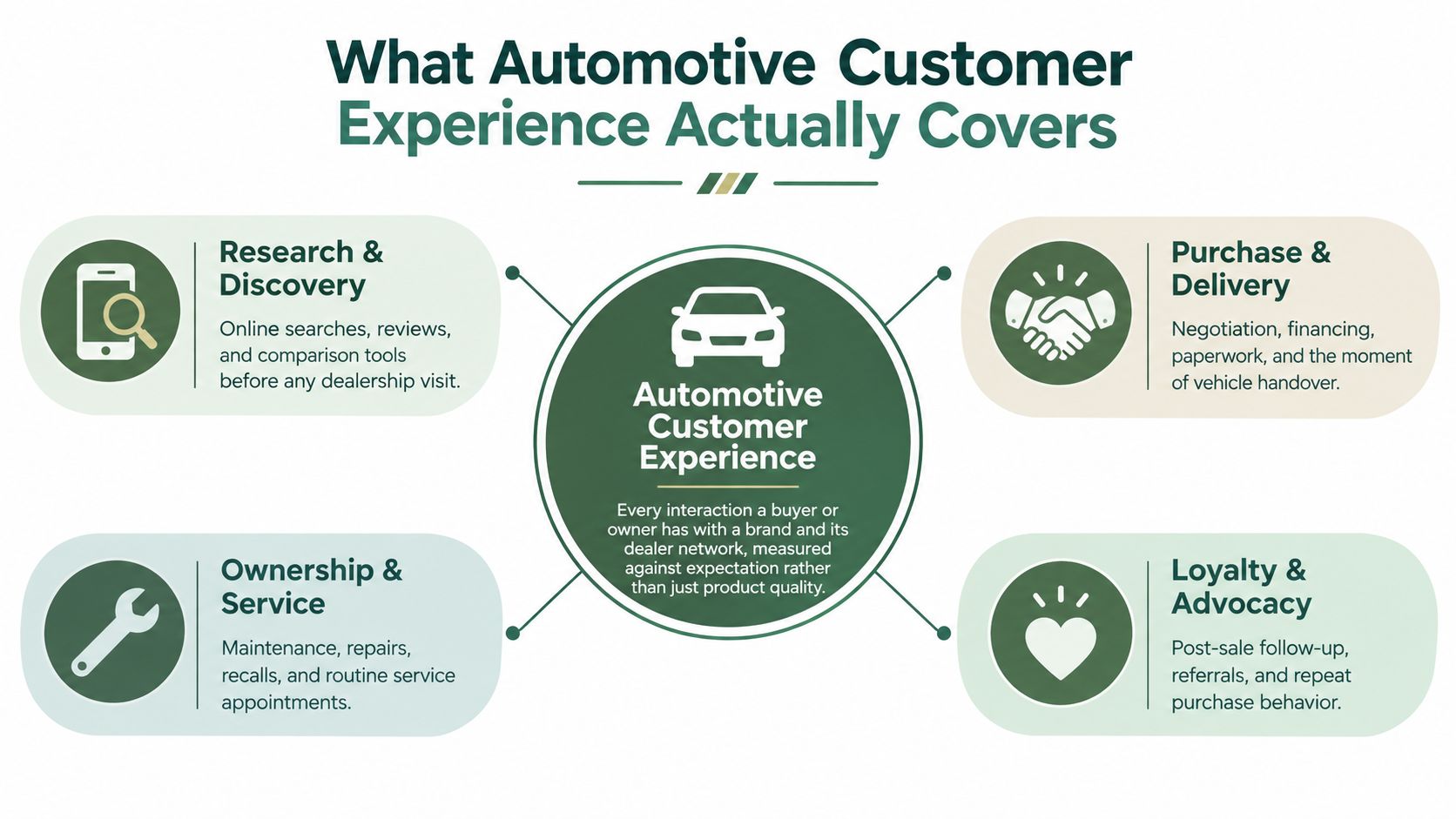
Automotive customer experience is the sum of every interaction the buyer or owner has with your brand and your dealer network. It's not just product quality, and it's not just the sale. In the 2025 U.S. Sales Satisfaction Index Study, J.D. Power evaluated 32,616 customers who purchased or leased a new vehicle between March and May 2025, and the framework covered delivery, dealer personnel, negotiation, paperwork, dealership facilities, and the dealership website. The overall purchase-experience score was 802 out of 1,000, a one-point increase from the prior year, which tells you this is measurable, not vague sentiment (J.D. Power SSI Study).
Think in layers, not slogans
The mistake I see is simple. Stores report one customer score and call it done. That tells you almost nothing. A customer can like the salesperson, hate the paperwork, tolerate the facilities, and still never come back.
Use a journey view instead. Sales has one set of friction points, after-sales has another, and in-vehicle or app experience has its own problems. Ipsos measures automotive CX across dealer sales, dealer after-sales, and in-vehicle user experience, and it does so with more than 125,000 interviews across seven European markets (Ipsos automotive CX measurement). That structure is the right mindset for any operator who wants a real dashboard instead of a vanity score.
The same logic applies after the sale. Service experience depends on honesty, repair quality, timeliness, and first-time fix performance. A clean waiting area won't save you if the customer gets weak updates and has to return for the same problem. If the work isn't right, the experience isn't right.
Use this as your operating definition, every stage has a process owner, a metric, and a customer expectation attached to it. That's the difference between managing a business and hoping customers stay patient.
For reputation work tied to those stages, the same discipline applies in automotive reputation management, where each touchpoint should be visible and accountable.
The Modern Automotive Customer Journey Stage by Stage
The old model treated the dealership as the whole experience. That doesn't work anymore. Customers start on a phone, compare options across multiple sites, and bring a long memory into the showroom. If your journey still behaves like a single visit instead of a connected process, you're losing people before you ever meet them.
Each stage creates its own friction
Online discovery is overloaded. Buyers jump between OEM pages, dealer sites, third-party reviews, and forums, and they're trying to make sense of options that aren't presented consistently. That's where confusion starts, not later in finance.
Lead follow-up is where a lot of shops fail. If the first answer is slow or incomplete, the buyer moves on. Test drive and negotiation then add pressure because the customer still doesn't have a clear picture of total cost, trade-in assumptions, or what is included.
Delivery matters more than many teams admit. It's the first moment the customer decides whether your store feels organized or chaotic. If your team rushes through onboarding, the connected app goes unused, and the customer forgets half the features before leaving the lot.
Operator rule: the handoff should answer three things, what they bought, how to use it, and where to go next if something doesn't work.
Ownership support is where loyalty is won or lost over time. The app, service lane, recall communication, and repair status updates all shape whether the customer feels respected. Renewal is the last stage, but it's really the summary of everything that came before it.
Use local SEO for auto repair as a reminder that customers often compare service choices before they ever call. The businesses that look clear, current, and responsive get the click.

Walk the journey yourself
Don't map this from a conference room. Sit down and walk your own process as if you were the customer. Count how many times the customer has to repeat information, how many handoffs happen, and where your team asks for patience instead of giving clarity.
That exercise usually reveals two or three leaks right away. One store I'd bet against is the one that can't answer who owns the customer at each stage. If no one owns the stage, the customer owns the frustration.
The CX Metrics That Actually Matter and Who Owns Each One
Most stores measure what's easy to print, not what changes behavior. That's why teams end up with bloated reports and weak execution. The right metrics are stage-specific, and each one needs one accountable owner who can move it.
Sales and service need different scoreboards
For sales, I'd track web-lead response speed, appointment set rate, closing rate by lead source, digital retailing completion, and the dealership satisfaction signals reflected in the J.D. Power SSI work. Those numbers tell you whether the front end is reducing effort or creating drop-off.
For service, the meaningful metrics are appointment availability, advisor communication quality, first-time fix, days to repair, and how well recall work is handled when it's bundled with other maintenance. The J.D. Power 2025 Customer Service Index Study makes the service point impossible to ignore. It analyzed 55,210 verified owners and lessees of one- to three-year-old vehicles, and it found satisfaction among mass-market battery-electric and plug-in hybrid owners was 51 points lower than mass-market internal-combustion owners, with a 57-point gap in premium segments (J.D. Power CSI Study).
For ownership and retention, you need app engagement, connected-car opt-in, retention by time period, and repurchase intent. Those are the signals that tell you whether the relationship still has life in it.
| Journey Stage | Key Metric | Typical Owner |
|---|---|---|
| Sales | Web lead response speed | Internet sales manager |
| Sales | Appointment set rate | BDC or sales manager |
| Sales | Digital retailing completion | Sales operations leader |
| Service | Appointment availability | Service manager |
| Service | First-time fix | Fixed ops manager |
| Service | Days to repair | Service advisor / dispatcher |
| Ownership | App engagement | OEM or digital experience lead |
| Ownership | Retention by tenure | General manager |
Sales
Sales
Sales
Service
Service
Service
Ownership
Ownership
Stop dumping all of this into one monthly CX number. Segment by journey stage, then give each metric to the person who can change it. If you want a useful pattern from another industry, a lot of teams use track Instagram engagement metrics the same way, by tying one number to one owner instead of hiding behind a dashboard nobody reads.
Weekly ownership beats quarterly reporting
Pick the two weakest stages and put one weekly number on the wall for each. Review them every week. If the number goes the wrong way, fix the process, not the report.
One clean metric with an owner beats ten metrics with no decision attached.
That's how you move from reporting customer experience to managing it.
Digital Touchpoints and AI Where They Help and Where They Do Not
Digital tools matter now because customers expect them to work. In the 2024 American Customer Satisfaction Index automobile study, mobile app quality scored 83 out of 100, alongside dependability at 83 and exterior appearance at 83, while the overall U.S. industry satisfaction score was 80/100 (ACSI automobile study). That tells you app quality isn't a side note anymore. It's part of the product in the customer's mind.
Use AI for speed, not for accountability
AI is useful when it removes routine work. Use it for lead prioritization, scheduling, follow-up reminders, recall notifications, and draft replies to common questions. That's where it earns its keep.
It falls apart when it tries to replace judgment. Pricing explanation, financing terms, trade-in assumptions, repair diagnosis, and post-repair communication still need a human who can answer follow-up questions and own the outcome. Customers don't want a chatbot pretending to understand a payment they can't afford.
Buyer behavior supports that line. Cox Automotive's study of 2,300 recent vehicle buyers found that 62% considered leasing or owning a car too costly, 25% of new-vehicle buyers used AI during shopping, and 59% reported high satisfaction with AI-powered assistance. Among mostly digital buyers who used AI assistants, 84% were highly satisfied, yet only 7% completed the entire purchase online, compared with 53% who completed all steps at the dealership (Cox Automotive car buyer journey).
That's the split. AI can help customers move faster, but it doesn't solve affordability, trust, or commitment on its own.
If you want a practical implementation model for how teams use automation without handing over the whole conversation, how teams use AI marketing is useful as a reference point. The right tools cut busywork. They don't replace the person who has to explain the deal.
Keep the human on money and diagnosis
That rule is simple. If the interaction involves cost, uncertainty, or a promise the customer will remember later, put a person on it. If it's routine, repetitive, and low-risk, automate it.
That's also where bad digital design hurts. A broken app, a clumsy login, or a vague status update erodes confidence faster than most organizations realize. The customer doesn't separate "digital issue" from "brand issue." They just remember that it was annoying.
The EV Service Gap That Now Decides Loyalty
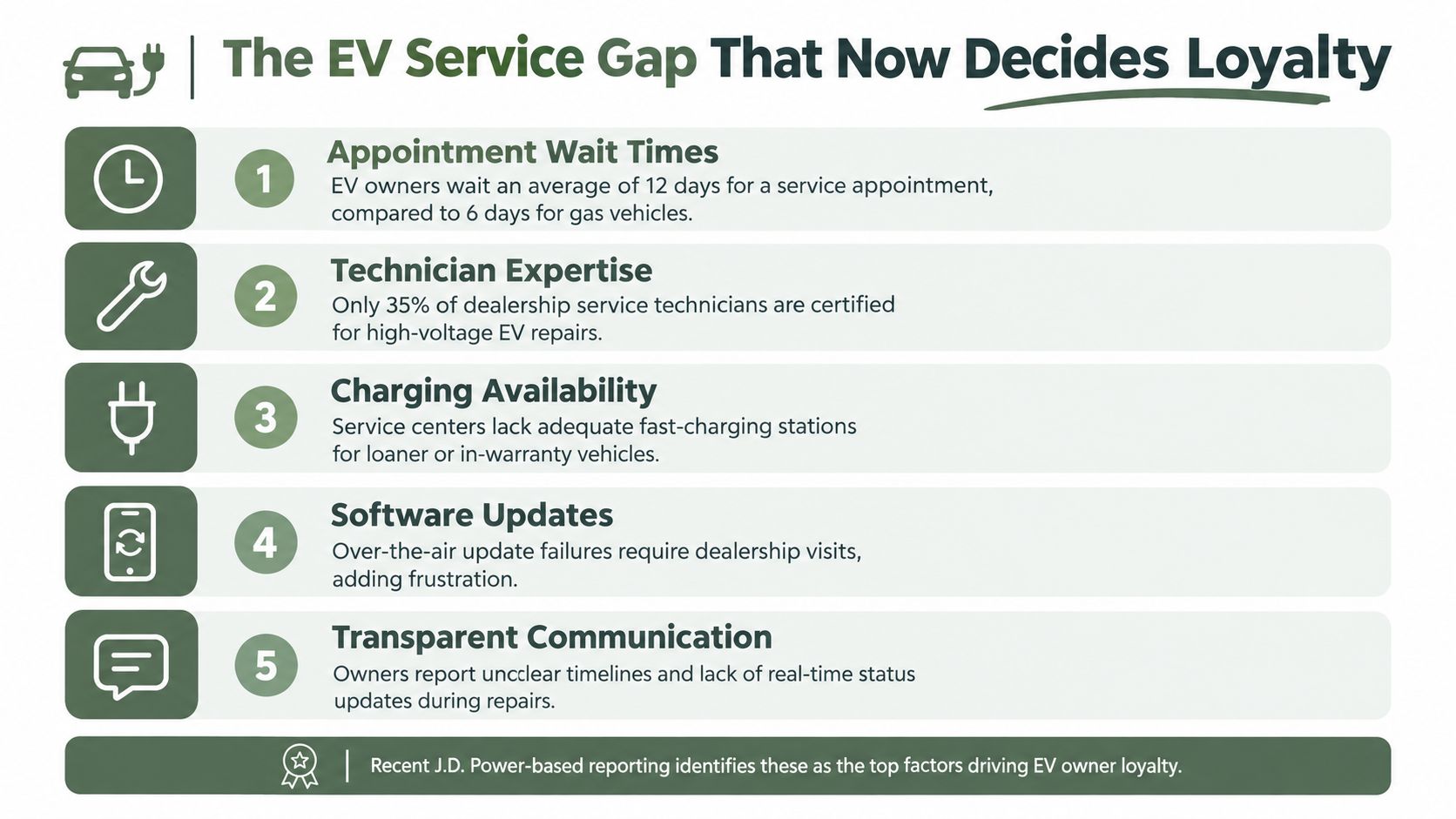
If you sell EVs or service them, the showroom is no longer the main loyalty battleground. The service drive is. J.D. Power-based reporting says the biggest frustrations are waiting for appointments, waiting for repairs, and waiting to get back on the road, and it also reports that about 12% of repairs were not fixed correctly the first time (Ward's Auto report on dealer pain points).
Customers ask practical questions, not technical ones
They want to know four things. How long will this take. Can your store handle this battery or software issue. What happens if a part isn't available. Can they get a credible status update without calling three times.
That's the level you need to operate on. The more electric and software-heavy the vehicle becomes, the more your team has to explain unfamiliar work in plain language. If your advisors can't do that, the customer reads it as uncertainty.
Train technicians before the vehicles pile up. Publish realistic timeframes. Give advisors a status-update cadence they can stick to. If a repair needs specialist help or a part that isn't on hand, say so early instead of letting silence become the customer's story.
The service lane is where trust is created or destroyed after the sale. EV customers are especially sensitive to competence because they know the vehicle is different, even if they don't know the mechanics. If your operation can't answer the basic questions well, the customer won't see you as modern. They'll see you as behind.
Make first-time fix the headline
After-hours attention is where service operations earn lasting trust. First-time fix should sit at the top of the after-sales dashboard. If a customer comes back because the first repair wasn't right, your process failed, even if the paperwork looked clean.
Use the service drive to prove competence, not to hide it. The store that communicates clearly, repairs correctly, and closes the loop reliably will keep more EV owners than the one with the slickest sales pitch.
Retention This Week and Local Visibility Without Shortcuts
A customer has just left the service lane, and your team still has a chance to win the next visit. Retention and local visibility are built in the same week, not after a platform project lands.
Do these three things now
That last point matters because buyers still search “dealership near me” and “service center near me” before they search your brand. A stale profile sends that attention to the next shop.
Keep review requests running after every sale and every service visit. Offer every customer a public Google review option and a private feedback option side by side, and never route unhappy customers away from the public path. Do not filter, gate, or pressure customers into leaving only positive reviews. Google's Maps policy requires real customer experience, not selective solicitation, and it prohibits paid or incentivized reviews and pressure tactics (Google review contribution policy).
If the profile is incomplete and the review flow is inconsistent, you are asking local search to do work your operations should already be doing.
If you want to automate the review request flow, RecensioAI B.V. fits this kind of work. Use a tool that sends requests after every visit and supports both public and private feedback options, while your team still fixes the service lane and follows through on the responses.
- Write the cost story: Put the total cost of ownership for your top three vehicles into plain language on the website and in the showroom. If customers cannot see what ownership really costs, they hesitate.
- Tighten status updates: Set a rule that every service customer gets a status update by SMS or app within an agreed window. No one should have to call just to find out what is happening.
- Clean up your Google Business Profile: Make sure your categories, hours, attributes, services, and photos are complete and current. Google says local search results depend mainly on relevance, distance, and prominence, and that review count and review score can improve local ranking (Google local ranking factors).
Where to Start on Monday Morning
Pick the weakest stage in your journey and put one owner on it. Then put one weekly number on the wall and review it with the team every Monday. On Tuesday, walk the journey from first search to post-service follow-up and write down every place the customer repeats information. On Wednesday, audit your Google Business Profile and turn on review requests tied to real sales and service moments. On Thursday, sit with an advisor and count how many status updates go out without a customer asking.
---
RecensioAI B.V. helps businesses manage the customer journey after the sale by keeping review requests consistent, organizing feedback, and making Google Business Profile work more reliably for local visibility. If you want one system that supports reputation, response, and profile upkeep without turning review management into another manual chore, visit RecensioAI B.V. and see how it fits your operation.
Frequently asked questions
You might also like
Handpicked articles for you
Hotel Review Management: Automate Post-Stay Requests with Apaleo, Mews and Your PMS
A practical guide to turning hotel checkouts into timely review requests, with Apaleo live, Mews early access and flexible PMS alternatives.
Why the Business Around the Corner Beats You on Google: What 21,373 Profiles Reveal
We compared 21,373 Google Business Profiles with their three strongest nearby competitors. The gap is smaller than most owners think, but it has two sides: rating and volume.
Treatwell Review Management for Salons: One Reputation View Alongside Google
Bring your public Treatwell rating and recent reviews into RecensioAI, then combine salon signals with Google for faster, better decisions.