
Yelp vs Google Reviews: Best Platform for Local SEO
Yelp vs Google reviews compared. Discover which platform drives more "near me" customers and learn the right strategy for your local business.
Table of Contents
- 1Introduction
- 2The Two Places Customers Check Your Reputation
- 3Reach and Audience Differences Between Platforms
- 4Google creates broad discovery
- 5Yelp has depth and category strength
- 6How Each Platform Affects Local Search Visibility
- 7What Yelp can and can't do for Google Maps
- 8Getting Reviews on Google and Yelp
- 9Build a compliant Google process
- 10Treat Yelp as an organic channel
- 11Fake Review Handling and Trust Signals
- 12Start with evidence
- 13Business Features and Integration Options
- 14Match tools to the work
- 15Recommended Strategy for Local Businesses
Introduction
Google Reviews holds roughly 73% of online reviews, compared with about 6% for Yelp, so Google matters more for local visibility and reaching new customers. Yelp still matters for established brands and categories such as dining, hospitality, and some services, but most businesses should focus primarily on Google.
You see the difference when you check your own listings. A restaurant may have a steady stream of short Google ratings, while Yelp has fewer reviews with longer comments about the menu, service, and atmosphere. A plumber may barely get mentioned on Yelp but appear in Google Maps every time someone searches for help nearby.
That's the practical answer to Yelp vs Google Reviews. They don't play the same role, and treating them as equal wastes time. Google is usually your discovery platform. Yelp is a secondary reputation source that can influence customers who already use it, especially in selected industries and locations.
The Two Places Customers Check Your Reputation
A salon owner opens both profiles on a Monday morning. Google shows the listing customers see in Maps, complete with the star rating, review count, hours, photos, and directions. Yelp shows a smaller audience, but several reviews contain useful detail about stylists, appointments, and the customer experience.
Those profiles look different because customers use them differently. Google reviews sit inside the search journey. Someone types “hair salon near me,” compares map results, and can call or request directions without leaving Google. Yelp is more often a destination. A customer may open Yelp specifically to compare restaurants, hotels, contractors, or local services.
That doesn't make Yelp irrelevant. It makes the platform's value more dependent on business type, location, and customer habits. A neighborhood restaurant in a city with active Yelp users may receive serious consideration from a customer who checks Yelp before booking. A regional clinic or home contractor may get far more discovery from Google Maps.
Practical rule: Build the platform customers encounter before they know your name. For most local businesses, that means Google first.
Google's position in the customer journey is why a complete profile and a steady flow of genuine feedback matter. Reviews can shape whether a searcher taps your listing, calls your business, or chooses another company in the local pack. Yelp helps when a customer cross-checks your reputation or already trusts the platform.
You can't assume that a strong Google profile covers every decision point. A diner may compare your menu on Yelp. A hotel guest may read detailed comments there before booking. A contractor may be judged by a Yelp profile that appears when the customer researches your business name.
Use this guide to why online reviews matter to frame reviews as part of the customer experience, not just as a score. Then decide where your limited time belongs based on how customers find and evaluate your business.
Reach and Audience Differences Between Platforms
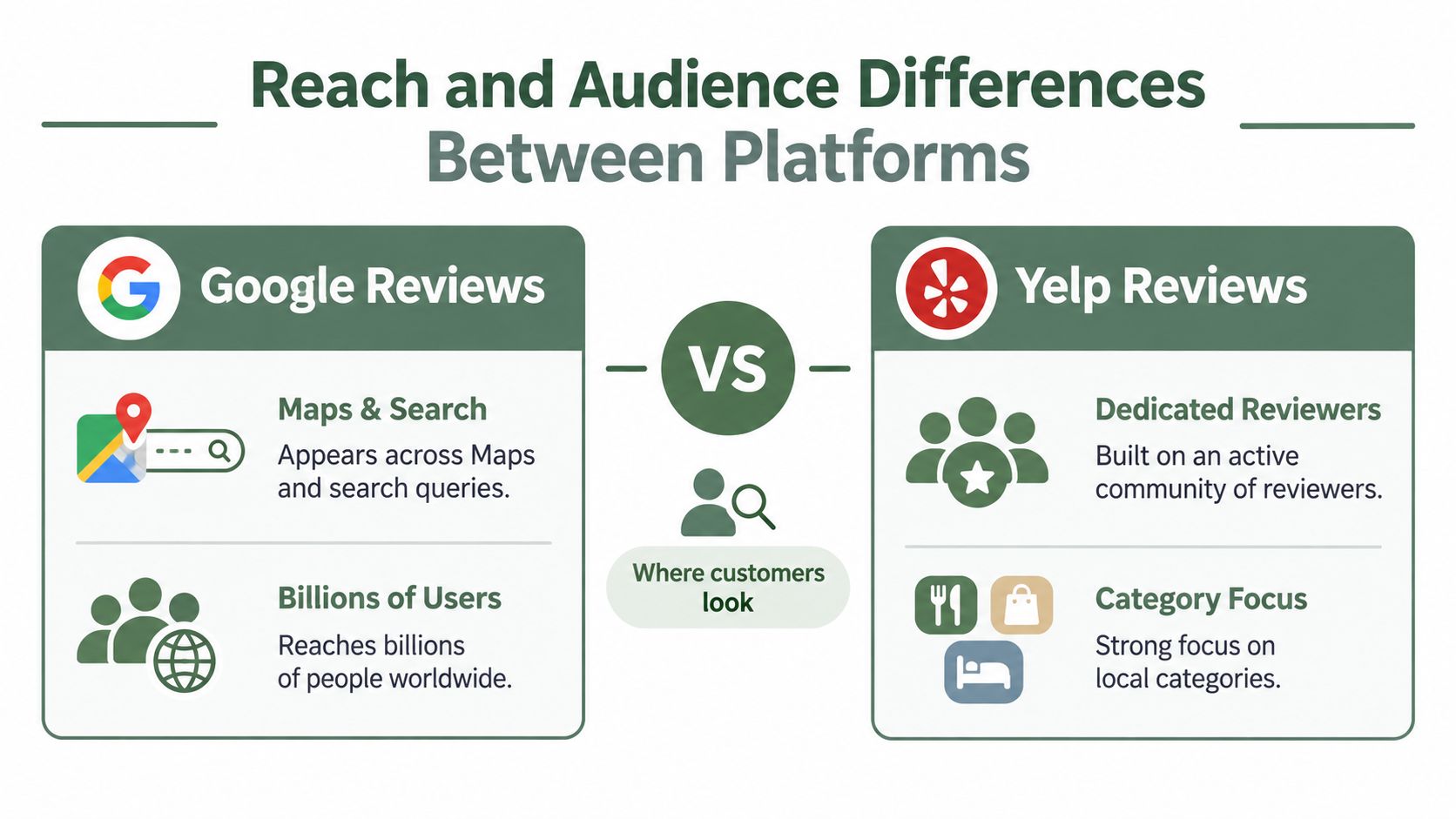
Google wins on distribution. Industry summaries cited by ReviewTrackers' online reviews survey place Google at roughly 73% of online reviews, while Yelp is typically around 6%. The same source reports that 88% of all reviews are concentrated across Google, Yelp, Facebook, and TripAdvisor.
That concentration matters because Google reviews appear where local discovery already happens. Customers see them in Google Search and Google Maps, often while searching for a category rather than a specific business. Yelp reviews usually require a customer to enter Yelp or reach a Yelp page during a broader reputation check.
Google creates broad discovery
Google's lower participation barrier helps explain its scale. A Google account is enough to leave a review, and the customer doesn't need to provide proof of an actual customer relationship, as described by Reviewfinder's comparison of review platforms. That makes review collection easier and faster, although it also means businesses need a clear process for reporting suspicious content.
Google is the natural first priority for businesses that depend on “near me” searches:
- Restaurants: Customers find you while searching for food, cuisine, or opening hours.
- Salons and clinics: Searchers compare proximity, ratings, and appointment details.
- Contractors: Homeowners often start with a service and location query.
- Hotels: Travelers use Maps and Search to compare options quickly.
- Multi-location brands: Each location needs a visible, accurate profile in its own market.
Yelp has depth and category strength
Yelp's absolute review base remains substantial. Independent compilations cited in the ReviewTrackers material report about 330 million cumulative Yelp reviews by the end of 2025, compared with 265 million in 2022, plus roughly 22 million new reviews in 2025 and about 132.9 million monthly visitors. Those figures show why Yelp can remain commercially useful even with a smaller overall share.
Yelp is particularly relevant in food, hospitality, nightlife, and selected services markets. Its users often spend more time reading written experiences. That can help a restaurant explain service quality or help a hotel address details that a short Google comment doesn't cover.
A useful way to divide the platforms is simple:
| Customer stage | Google Reviews | Yelp Reviews |
|---|---|---|
| Initial discovery | Usually strongest | More limited |
| Map visibility | Directly integrated | Not the primary channel |
| Quick comparison | Strong | Moderate |
| Detailed research | Variable | Often stronger |
| Best first investment | Most businesses | Selected categories and markets |
Initial discovery
Map visibility
Quick comparison
Detailed research
Best first investment
A Google profile brings more people to the decision. A Yelp profile can help some of those people feel confident enough to act.
The video below gives another visual comparison of how the platforms fit into local reputation management.
How Each Platform Affects Local Search Visibility
Google has publicly stated that local results mainly depend on relevance, distance, and prominence. Its guidance says prominence can be influenced by how well known a business is, including how many websites link to it and how many reviews it has. Google also says that more reviews and positive ratings can help local ranking. You can read the details in Google's local ranking guidance.
That makes Google review count and rating documented local ranking factors. It doesn't mean collecting reviews guarantees a top position. Distance still matters, relevance still matters, and competitors are improving too.
Independent research adds useful context. In a study of 16,098 Google Business Profiles, **Localo reported that review count was the strongest single signal in its dataset. Top-three placement rates rose from 39.3% for profiles with 1 to 5 reviews to 73.0% for profiles with 201 to 500 reviews. The same study found that average rating was much flatter, and a perfect 5.0 profile ranked worse than a 4.9** profile in that dataset.
Those figures describe one study, not a promise about your business. They do support a practical priority: build a genuine, consistent review profile instead of chasing a perfect score with very few reviews.
What Yelp can and can't do for Google Maps
Yelp reviews don't directly become Google reviews, and Yelp's star rating doesn't change the rating on your Google Business Profile. A strong Yelp presence can still support customer trust when they search your business name, compare multiple sources, or use Yelp as their main discovery tool.
For Google Maps, focus on the factors Google has documented:
Your replies, review text, photos, and Google Business Posts still have practical value. They answer customer questions, show that the business is active, and make the profile easier to evaluate. Google hasn't confirmed responding to reviews or posting activity as direct ranking factors, so treat them as trust and engagement work, not ranking levers.
That distinction protects your time. Ask customers for Google reviews because review quantity and rating are documented factors. Respond because future customers read your answers. Keep Yelp accurate because customers may check it. Don't promise yourself that every profile action will move the map position.
- Review count: A larger genuine review base can support prominence.
- Rating: Positive ratings can help local ranking.
- Relevance: Your category, services, and profile information should match the searches you want.
- Distance: You can't change your address, but you can serve the areas your business covers.
Getting Reviews on Google and Yelp
Google and Yelp require different operating procedures. If you use the same review request for both platforms, you risk breaking Yelp's rules.
Build a compliant Google process
Google allows businesses to request reviews. The most reliable process is tied to a completed visit, appointment, delivery, or project.
A branded review page can make the process easier for staff and customers. It should show the public Google review option clearly and also allow the customer to provide private feedback. The customer must choose. Don't hide the public option, intercept negative feedback, or route unhappy customers away from Google.
For a deeper operating workflow, see this guide to automating review requests.
- Claim your Google Business Profile. Confirm the business name, address, phone number, hours, categories, and service information.
- Create the direct review link. Find the review link in your profile management tools and save it somewhere staff can use.
- Ask every customer consistently. Use email, SMS, receipts, QR codes, or a follow-up message after the service. Don't limit requests only to customers you expect to be positive.
- Keep the wording neutral. Ask for an honest review of the customer's experience. Don't offer discounts or gifts for reviews, and don't tell customers what rating to choose.
- Reply to the reviews you receive. Thank customers for useful feedback and address problems without revealing private information.
Treat Yelp as an organic channel
Yelp's position is stricter. Yelp says businesses shouldn't ask customers to write reviews, and its recommendation software targets solicited reviews. Yelp says reviews that appear solicited can be moved to the not recommended section and won't count toward the business's Yelp star rating. Its business review policy explains that position directly.
Yelp's Terms of Service also prohibit asking customers for reviews, writing reviews for your own business or competitors, and voting on content for your own business or competitors.
You can still maintain the listing properly:
Google is an active collection channel. Yelp is a platform where you create a good customer experience, maintain accurate information, and let customers decide whether to review you.
- Claim the business page. Correct the hours, address, categories, menu, services, and photos.
- Mention your presence without asking for a review. Signage that says customers can find you on Yelp is different from requesting a positive review.
- Respond within the platform. Keep replies factual and professional.
- Avoid incentives and scripts. Never coach customers to use particular language or ratings.
Fake Review Handling and Trust Signals
Fake reviews create a difficult operational problem because you can't remove content just because you dislike it. A harsh review from a real customer is different from spam, a competitor attack, or a review for the wrong business.
Google and Yelp also give you limited control over moderation. Both platforms use automated systems, and both can remove or hide reviews without giving you a complete explanation.
Start with evidence
Before reporting anything, save the review URL, screenshots, date, reviewer name, and any relevant customer records. Look for concrete policy issues:
Report the content through the platform's official process. Don't ask friends, employees, or customers to mass-report a review. Don't retaliate publicly, and don't publish private customer details in your response.
Google's lower barrier to participation helps create volume, but it also means suspicious reviews can appear. Yelp's recommendation system applies stronger filtering and may place reviews in its not recommended section. That filter can affect genuine feedback too, so a missing review doesn't automatically prove that Yelp made an error.
Keep the response public and boring: acknowledge the concern, invite the reviewer to contact the business privately, and avoid arguing about facts you can't verify.
A professional response can reassure the next reader even when the original review stays online. It won't erase the review, and it isn't a confirmed ranking factor. It is a trust signal for people evaluating your business.
Use this practical guide to spotting and handling fake reviews when you need a repeatable reporting record. The aim is not to win every dispute. It's to document legitimate violations, protect customer privacy, and keep your public profile credible.
- No customer relationship: The reviewer doesn't appear in your records, though missing records alone don't prove fraud.
- Wrong business: The comment describes a different location or service.
- Conflict of interest: The reviewer appears connected to a competitor or employee.
- Repeated content: Similar wording appears across several profiles.
- Abusive or promotional content: The review focuses on spam, threats, or unrelated promotion.
Business Features and Integration Options
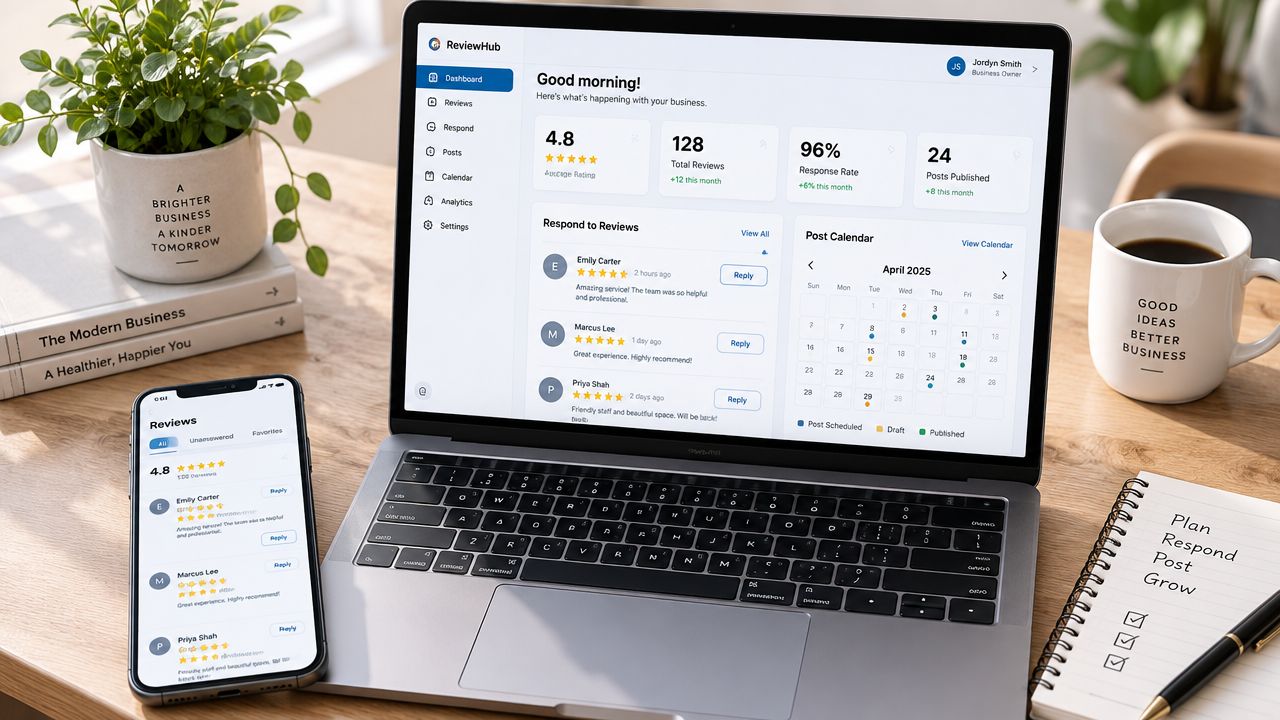
Google Business Profile should be the operational center for most local businesses. It lets you manage core listing information, respond to reviews, publish updates, and monitor how the business appears in Google Search and Maps.
Yelp for Business serves a different purpose. It supports profile management, customer communication, review responses, business insights, and optional advertising. Those tools can matter when Yelp already sends meaningful customers to your restaurant, hotel, salon, or service business.
Match tools to the work
Your team doesn't need every feature. It needs a workflow that prevents missed reviews and outdated information.
| Task | Primary platform | Practical priority |
|---|---|---|
| Map visibility | Google Business Profile | Highest |
| Review requests | Automate where appropriate | |
| Yelp accuracy | Yelp for Business | Keep current |
| Review responses | Both platforms | Assign ownership |
| Multi-location oversight | Central dashboard | Reduce logins and missed tasks |
| Fake review reporting | Platform tools | Keep evidence and follow up |
Map visibility
Review requests
Yelp accuracy
Review responses
Multi-location oversight
Fake review reporting
Third-party tools can combine review monitoring, review requests, response workflows, and reporting. They're useful when one owner manages several locations or when front-line staff don't have time to check each profile.
Automation should remove repetition, not remove judgment. A system can send a follow-up after a completed appointment or surface a review that needs attention. It shouldn't manufacture feedback, ask only selected customers, or hide a public review option.
Before paying for a tool, check whether it supports the platforms you use, keeps locations separate, allows human approval where needed, and preserves a clear record of customer feedback. A simple process used consistently is better than an advanced dashboard nobody opens.
Recommended Strategy for Local Businesses
Start with Google unless your customer data shows that Yelp is a primary discovery source. Google's reach, Maps integration, and documented connection between reviews and local prominence make it the default for restaurants, salons, clinics, hotels, contractors, and most multi-location businesses.
Then add Yelp according to the way customers buy from you:
Measure business outcomes, not vanity activity. Track calls, direction requests, website visits, appointment inquiries, and which platforms customers mention. Review volume and rating matter for Google local visibility, but neither platform guarantees a particular position or number of customers.
A tool such as RecensioAI B.V. can centralize review requests, public Google review access, private feedback, responses, and reporting across locations while preserving customer choice. Use it to make the process consistent, not to filter who gets asked.
This week, claim or verify each Google Business Profile, create a neutral Google review request, audit every Yelp listing, and assign one person to respond on both platforms. Give Google most of your effort, then use customer behavior and business category to decide how much Yelp deserves.
---
RecensioAI B.V. helps local businesses manage review requests, responses, Google Business Profile tasks, and multi-location reporting without hiding the public review option or filtering customer sentiment. Visit RecensioAI B.V. to review the workflow and decide whether it fits your Google and Yelp process.
- Restaurants and hospitality: Keep Yelp detailed and current because customers may research menus, service, and atmosphere there.
- Salons and clinics: Prioritize Google for nearby discovery, then monitor Yelp if customers use it to compare providers.
- Contractors and home services: Build a consistent Google request process and maintain Yelp for customers who cross-check providers.
- Multi-location franchises: Set the same Google workflow for every location, while allowing each market to receive the Yelp attention it earns.
- Established brands: Don't abandon Yelp if it already contains meaningful customer discussion or ranks for branded searches.
Frequently asked questions
You might also like
Handpicked articles for you
How to Protect Your Google Business Profile: Stop Unwanted Changes and Suspensions
The complete guide to protecting your Google Business Profile: who can change it, why suggested edits lead to suspensions, a security checklist, what to do if your profile is suspended, and how 24/7 monitoring restores your details where Google permits.
White-Label Local SEO Tools for Agencies
What RecensioAI offers agencies: an embeddable white-label Google Business Profile audit that works as a lead magnet on your own site, plus an agency account where you run every client workspace, report, SMS credit and invoice. With pricing, margin and a 30-day rollout.
How to Beat Your Competitors on Google in 2026
The complete playbook to outrank local competitors on Google Maps in 2026: how many reviews you need to overtake the business above you, how to break into the top 3, and how RecensioAI runs the work for you, with real screenshots from the app.