
Restaurant Competitive Analysis: A Practical Framework
Learn restaurant competitive analysis with a step-by-step framework covering map pack, menu, reviews, SEO, and operations to outsmart local rivals.
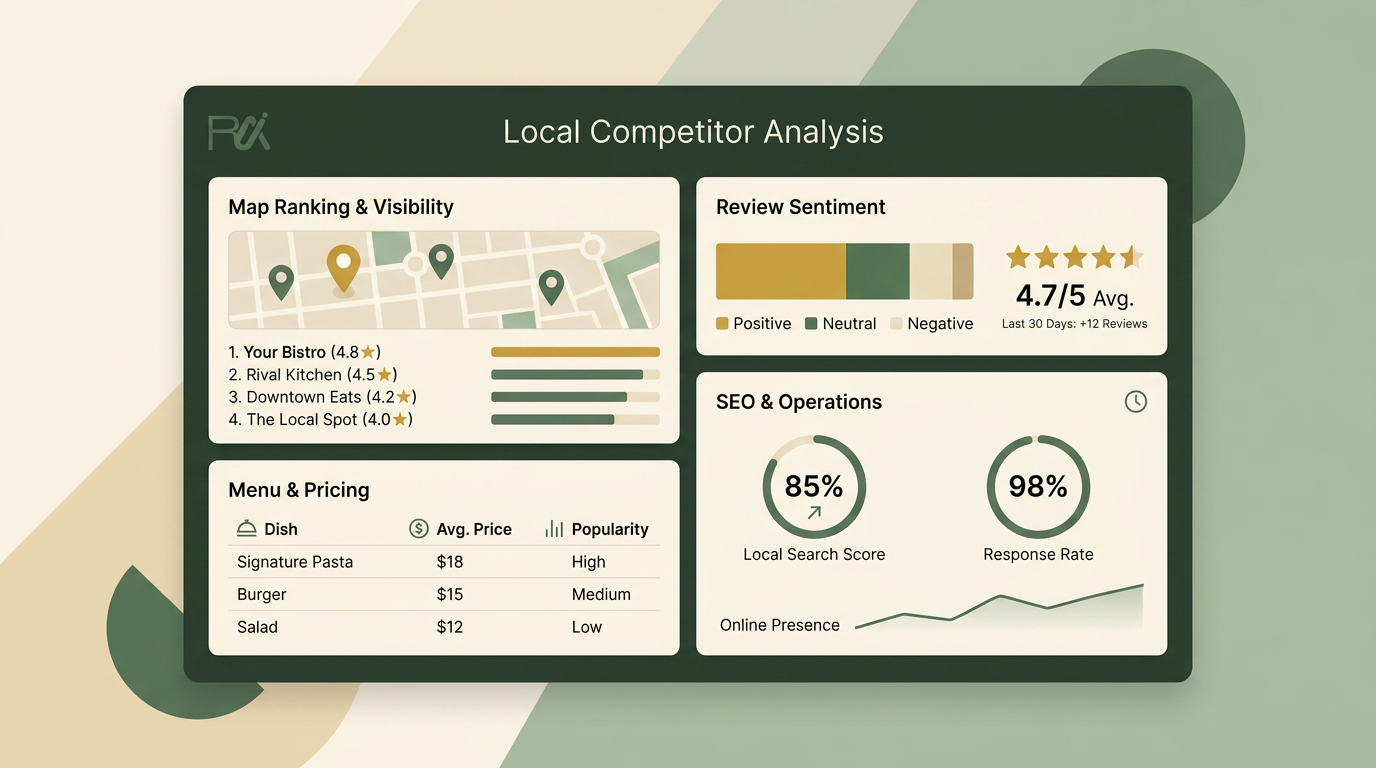
Table of Contents
- 1Introduction
- 2Why Your Competitors Look Stronger Than They Are
- 3Record what the customer sees
- 4Separate visibility from execution
- 5Build a Tight Competitor Set You Can Actually Track
- 6Define direct and indirect choices
- 7Build one working sheet
- 8Audit the Map Pack and Your Google Business Profile
- 9Check the profile in five passes
- 10Benchmark Menu, Pricing, and In-Store Operations
- 11Compare value, not just menu prices
- 12Pull Actionable Signals from Competitor Reviews
- 13Tag the experience, not just the sentiment
- 14Turn patterns into a short action list
- 15Set KPIs and a Monthly Rhythm That Sticks
- 16Use one fixed monthly meeting
- 17Your First Week and the One Thing to Do Next
Introduction
You check the lunch numbers, the phone, and the delivery dashboard. Nothing looks broken, yet a restaurant three blocks away appears first whenever customers search Google Maps for a nearby meal. Their food may not be better. They may be easier to find, easier to choose, and easier to trust.
That's why a useful restaurant competitive analysis starts with the local map pack and review momentum, then moves inside the building. You need to compare what customers see before they visit with what they experience after they arrive. The result should be a short list of changes you can make, not a spreadsheet nobody opens again.
Why Your Competitors Look Stronger Than They Are
A restaurant can look dominant online while running a weaker operation than yours. The owner three blocks away might have incomplete menu information, slow service, or poor parking. But if the restaurant appears prominently in Google Maps, has fresh reviews, clear photos, and an obvious ordering path, customers may never discover those weaknesses.
Google says local results are mainly shaped by relevance, distance, and prominence. Its guidance also notes that prominence can be influenced by links from other websites and review signals, including the number of reviews and positive ratings. Google's explanation of local ranking gives you the right starting point: compare the public signals first, then test the operating reality behind them.
Record what the customer sees
Search the phrases a real guest might use and write down:
Review volume deserves special attention. Google Search and Maps display review scores, selected reviews, and total review counts for local businesses. Industry benchmark reporting says Google accounts for over 95% of online restaurant review volume, while restaurants average just over 9 new reviews per unit each month and top-tier full-service concepts can approach nearly 20 new reviews monthly. The restaurant local search review benchmarks show why a steady flow of genuine reviews is a competitive signal, not just a vanity number.
- Discovery: Map-pack position, business name, category, distance, and whether the listing appears at all.
- Reputation: Star rating, total review count, review freshness, and recurring praise or complaints.
- Choice: Menu link, price level, food photos, ordering options, reservation details, and stated service attributes.
- Convenience: Hours, parking information, delivery coverage, phone access, and estimated wait information where shown.
Separate visibility from execution
After the online check, visit or call the competitor. Note whether the menu matches the promise, whether staff explain wait times, whether the dining room handles peak demand, and whether pickup is organized. A rival may win map visibility but lose customers through slow seating, confusing parking, or inconsistent portions.
Operator's rule: Don't copy the competitor's surface. Find the reason customers choose them, then decide whether you can deliver that benefit more reliably.
The strongest operators build these comparisons into regular routines. A guide to the repeatable habits of top operators is useful when you're turning occasional research into a habit shared by the owner, general manager, and shift leaders.
Score each rival across discovery, reputation, offer, convenience, and execution. That prevents one high star rating from hiding operational weaknesses, and it can reveal where your lower-ranked restaurant already has an advantage.
Build a Tight Competitor Set You Can Actually Track
A long list of every restaurant nearby creates busywork. Start with three to five direct competitors that satisfy the same customer need at a similar price and distance. Add a smaller indirect list for businesses competing for the same occasion through a different format.
For a casual dining restaurant, direct competitors might be neighborhood bistros and family-style restaurants serving a similar dinner audience. Indirect competitors could include an upscale pub, a food hall, a meal-prep kitchen, or a delivery-first concept that wins the same weekday occasion.
Define direct and indirect choices
Use these questions before adding a business:
Track direct and indirect competitors separately. Direct rivals help you make immediate menu, pricing, and service comparisons. Indirect rivals show where customers may spend an occasion you haven't fully claimed.
- Would the same customer consider both restaurants? A family choosing a convenient Friday dinner may compare your full-service location with a pizza shop, even if the menus differ.
- Does the price feel comparable? A premium steakhouse may be geographically close but irrelevant to your everyday lunch customer.
- Does the service model overlap? Counter service, delivery, reservations, and takeout each change the decision.
- Does the business appear for the same search? A restaurant showing up for “family restaurant downtown” deserves more attention than one that never enters your customer's consideration.
Build one working sheet
Create columns for:
Use a short inclusion note such as “appears in map results for Italian dinner” or “captures weekday lunch.” That note keeps the list tied to customer behavior instead of personal opinions.
Record rankings from the same general location, device, and search conditions whenever possible. Local results can vary, so don't treat one personalized search as a final verdict. Review the list quarterly because menus, delivery areas, hours, and visibility change.
Franchise and multi-location operators also need to distinguish local competition from brand-level decisions. Resources covering franchise expertise for restaurant operators can help when you're comparing standardized systems with independent local execution.
- Restaurant name and address
- Distance from your location
- Cuisine and price level
- Primary customer or occasion
- Service model
- Website and phone number
- Google Business Profile link
- Reason for inclusion
- Competitive threat
Audit the Map Pack and Your Google Business Profile
Run the map-pack audit from a clean browser or private window. Use the same device and search location each time, preferably from a point near the restaurant. Test several intent-based searches, not just your business name.
Useful queries include:
Log the date, approximate search location, query, businesses shown, order of appearance, and whether your profile appears. Take screenshots of meaningful changes, but don't draw a conclusion from one result.
- “casual dinner near me”
- “family restaurant downtown”
- “lunch with outdoor seating”
- “Italian takeout near me”
- “restaurant with reservations”
Check the profile in five passes
First, verify the fundamentals. Confirm the primary and secondary categories, address, hours, phone number, website, menu link, attributes, and service options. A restaurant that advertises outdoor dining but has no matching attribute or current photo creates avoidable uncertainty.
Second, inspect presentation. Look at the logo, cover image, food photography, exterior, interior, and photo freshness. The profile should help a guest answer basic questions quickly: Does this look like my kind of place? Can I find it? Is it open when I need it?
Third, read the trust signals. Record star rating, review count, recent review activity, owner responses, and repeated complaints. Broader consumer-review data cited in restaurant industry summaries says 97% of consumers read online reviews for local businesses, and 68% use only businesses rated four stars or higher. Restaurant review behavior and local competitive analysis explains why the profile must pass both discovery and trust checks.
Fourth, examine prominence indicators. Track how often the restaurant appears in your test searches, along with calls, direction requests, website clicks, reservations, and ordering options where available. These actions show whether visibility is producing useful customer behavior.
Fifth, check activity and completeness. Review Google Posts, events, special announcements, menu changes, and outdated information. Posting activity and review responses can support trust and profile completeness, but they aren't confirmed Google ranking factors.
Use the Google Business Profile checklist to turn the audit into a repeatable manager task. Rate each item pass, partial, or fail, then assign the repair to a named person. A missing menu link may be fixed during one shift. A weak photo library may need a scheduled shoot.
Review responses deserve their own quality check. Restaurant Business reporting based on BrightLocal's 2024 Local Consumer Review Survey says 40% of consumers would avoid a business after seeing a negative review with no response, while 88% say they're likely to use a business that responds to all reviews. The cited review-response reporting supports the trust argument, not a claim that responses directly improve rankings.
Pull Actionable Signals from Competitor Reviews
Reviews are customer language collected at scale. They show what guests notice after the meal, including problems owners may not hear during a busy shift. Star ratings provide context, but recurring themes provide the work list.

Pull 50 to 100 recent reviews per competitor from Google, Yelp, and OpenTable when those platforms are relevant to your market. Guidance on conducting competitor analysis recommends reviewing that range, grouping complaints by theme, and watching changes over time.
Tag the experience, not just the sentiment
Create a simple tag list:
Read each review and add every relevant tag. Then note whether the comment is positive, negative, or mixed. A four-star review that repeatedly mentions slow seating may reveal a larger operational opportunity than one angry one-star review.
Keep a second column for the customer's actual wording. “No clear parking directions” gives you a more useful task than “parking weakness.” You can rewrite your profile information, improve signage, or train staff based on the specific complaint.
- Wait time
- Service
- Portion size
- Value
- Noise
- Parking
- Cleanliness
- Dietary accommodation
- Taste
- Delivery or pickup friction
Turn patterns into a short action list
Choose the three most repeated complaints and three strongest compliments. Do not copy a competitor's weakness into your own marketing. Fix the process behind it.
Examples:
Review your own customer feedback beside the competitor tags. The best opportunity often sits where a competitor receives repeated complaints and your operation already has a credible solution. Re-tag the set quarterly and compare whether the same themes are becoming more or less common.
A restaurant-specific review management system can help organize review requests, responses, and recurring themes, but the operating decision still belongs with the owner or manager who can change staffing, training, or process.
- Repeated wait complaints: Add a host during the busiest period or publish a clearer wait expectation.
- Portion concerns: Add portion cues to the menu and train servers to explain sharing options.
- Parking confusion: Update directions on your Google Business Profile and website.
- Dietary uncertainty: Mark suitable dishes clearly and create a consistent staff answer.
- Frequent praise for speed: Study the competitor's ordering and handoff process before changing yours.
Set KPIs and a Monthly Rhythm That Sticks
A competitive audit fails when nobody owns the next action. Keep the scorecard small enough for a manager to update without extra software, and keep each metric tied to a decision.
Track these five measures:
Assign one person to each data point, even if that person is you. Set a target range rather than an artificial promise. If the map-pack position changes, ask what changed in the search result and in your profile. If review themes stay negative, change the operational response instead of just asking for more reviews.

- Map-pack rank for your top three search phrases. Record the query, location, date, and visible competitors.
- Google review count and average rating. Watch both volume and quality, not one in isolation.
- Profile photo freshness. Log the date of the latest useful interior, exterior, food, and team images.
- Share of voice across the top ten review tags. Compare how often customers mention your strengths and weaknesses against the competitor set.
- Average competitor price for your signature dish. Include bundles and portion cues before deciding whether the comparison is fair.
Use one fixed monthly meeting
Reserve the same calendar slot each month. A 60-minute review can follow this order:
Store the scorecard, screenshots, review tags, and menu sheet in one shared folder. Put the date in each filename so the manager can compare months without hunting through messages.
The KPI should change the meeting. If a measure doesn't move after two months, change the action before changing the goal. A new photo may address presentation. It won't solve slow seating. A menu rewrite may clarify value. It won't fix an unreliable pickup shelf.
- 10 minutes: Map-pack movement and Google Business Profile changes
- 15 minutes: Review themes and response quality
- 15 minutes: Menu and pricing differences
- 10 minutes: Wait times, ordering, parking, delivery, and other operating signals
- 10 minutes: Write the next 30-day action list
Your First Week and the One Thing to Do Next
You don't need a perfect research system to start. You need a clean baseline and one change that reaches customers quickly.

Use the first week like this:
My preferred first move is usually practical rather than clever. If your profile is incomplete, rewrite the description so it clearly states cuisine, service model, location, and primary occasion. Then add ten useful, recent photos showing the entrance, dining room, signature dishes, seating, and parking approach. Don't add generic images that fail to answer a customer question.
Keep the weekly work alive with a short monthly check-in. RecensioAI can automate recurring review requests, review responses, profile audits, posts, and competitor tracking, while your team uses the findings to improve the operation.
---
RecensioAI B.V. helps local businesses manage review requests, responses, Google Business Profile checks, recurring review themes, and competitor activity from one system. Visit RecensioAI B.V. to see whether it fits the monthly competitive audit you're putting in place.
- Day 1: List direct and indirect competitors. Rank them by distance, customer overlap, and menu overlap.
- Day 2: Run the map-pack audit and save screenshots of the top three results for your main searches.
- Day 3: Enter your menu, three competitors' menus, prices, bundles, hours, ordering methods, and parking details.
- Days 4 and 5: Read the two closest rivals' reviews and tag comments by wait time, service, value, portions, parking, and other recurring themes.
- Day 6: Record your Google Business Profile baseline for calls, direction requests, and website clicks.
- Day 7: Choose one change tied to the clearest competitor weakness and assign an owner.
You might also like
Handpicked articles for you
Hotel Review Management: Automate Post-Stay Requests with Apaleo, Mews and Your PMS
A practical guide to turning hotel checkouts into timely review requests, with Apaleo live, Mews early access and flexible PMS alternatives.
Why the Business Around the Corner Beats You on Google: What 21,373 Profiles Reveal
We compared 21,373 Google Business Profiles with their three strongest nearby competitors. The gap is smaller than most owners think, but it has two sides: rating and volume.
Treatwell Review Management for Salons: One Reputation View Alongside Google
Bring your public Treatwell rating and recent reviews into RecensioAI, then combine salon signals with Google for faster, better decisions.