How to Appear in Google AI Overviews for Local Business (2026)
Google AI Overviews and AI Mode now answer local questions before users see the map. This is the 2026 playbook, what AI actually cites, the trust signals that get you picked, and how RecensioAI runs the whole flow for you.
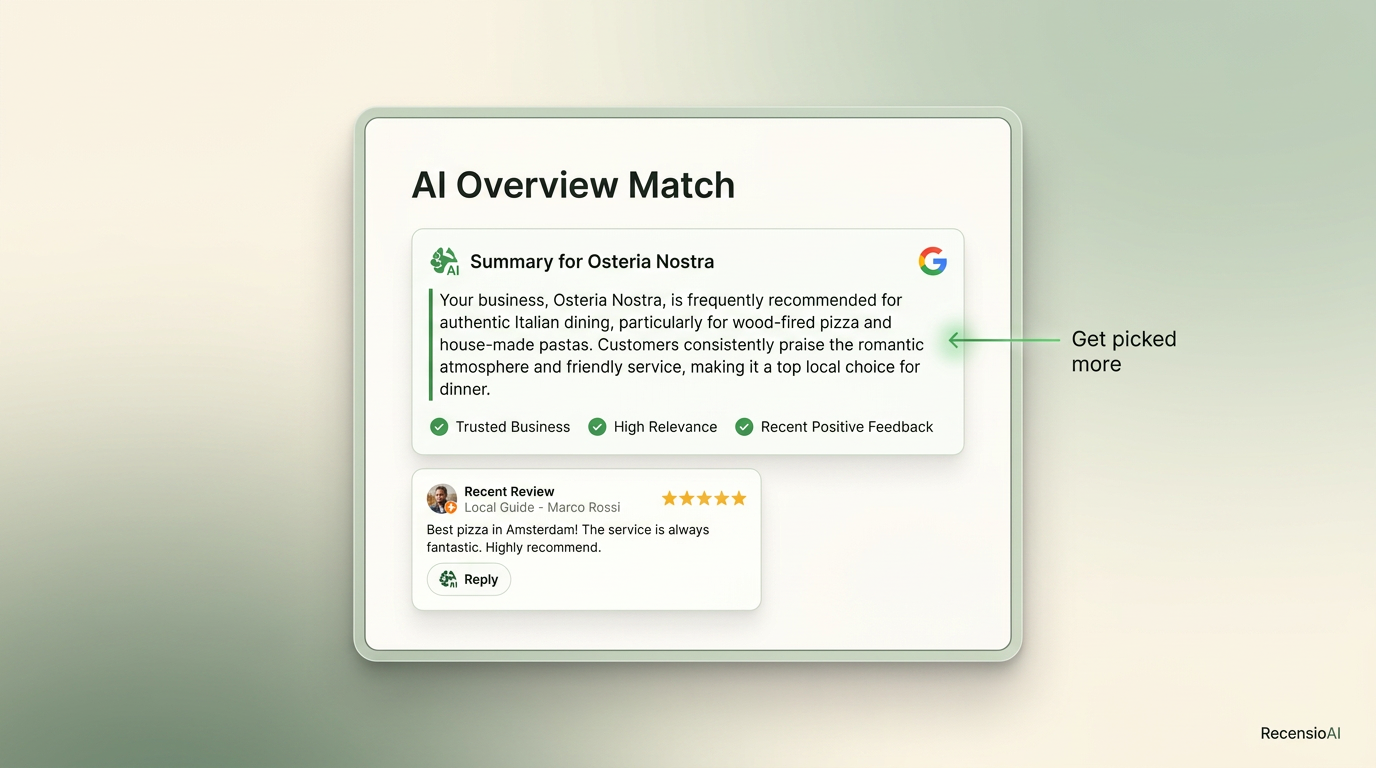
Table of Contents
- 1Why AI Overviews changed local search in 2026
- 2What Google's AI actually cites for local answers
- 3Signal 1 — Crystal-clear entity data
- 4Signal 2 — Content that answers the exact question
- 5Signal 3 — Recent, specific reviews that name the service
- 6Signal 4 — Freshness across profile, posts, and photos
- 7Signal 5 — Consistent presence beyond Google
- 8How RecensioAI runs this whole loop for you
- 9How long until AI Overviews start citing you
Why AI Overviews changed local search in 2026
For the first time since Google added the map to search, the map is no longer the first thing users see for local questions. AI Overviews and AI Mode summarise the answer directly — "a family-friendly Italian restaurant near Amsterdam Zuid open tonight" — and cite two or three businesses inside that summary. If you are cited, you get the click before the ten blue links even render. If you are not, you may lose visits you used to win on rank alone. In 2026 the cited business is chosen by a different scoring model than the classic local pack. Rank still matters, but freshness, entity clarity, and answerable content matter more than they ever did before.
- AI Overviews answer 40%+ of "near me" queries in 2026
- Cited businesses see 2–3× the click-through of the same business at the same rank pre-AI
- Uncited businesses on the map still exist — but the click volume shifts to the citations
- Selection is content-driven, not just proximity-driven
- The model re-runs continuously — you can win a citation this week and lose it next
What Google's AI actually cites for local answers
AI Overviews pull answers from a specific set of sources for local queries: the Google Business Profile, the business's own website, Google reviews, and a small number of trusted directories. What the model needs from each is different. From the profile it needs clean entity data. From the website it needs a page that answers the exact question a human would ask. From reviews it needs recent, specific, first-person language. From directories it needs consistent NAP (name, address, phone) so the model can confirm this is the same business everywhere. Miss any one of those and the model deprioritises you — even if your ranking is fine.
- Business Profile: primary category, services, hours, photos, posts
- Website: a page whose H1 matches the user's question, in plain language
- Reviews: recent, specific, mentioning the service the user asked about
- Directories: identical NAP across the top 15 for your country
- Structured data: LocalBusiness + Service + FAQPage schema where it fits
Signal 1 — Crystal-clear entity data
Before AI can cite you, it has to be sure who you are. Your business name, address, phone number, categories, and services must be identical across Google, your website, and every directory the model checks. One typo — Straat vs Str., a comma in the wrong place — and the model treats you as two different businesses and cites neither. This is the boring foundation, and it is where 70% of missed citations start. Run the Free Google Business Profile scan to see every entity mismatch in one report, then fix them in the order the report suggests.
- One canonical spelling of your business name — pick it and use it everywhere
- One primary category, exact match, not a lookalike
- Address formatted identically (abbreviations, punctuation, spacing)
- One phone number as primary; extras go in secondary
- Website URL uses the same protocol and www prefix everywhere
Signal 2 — Content that answers the exact question
AI Overviews are extractive. They lift a sentence or short paragraph that clearly answers the query. Marketing paragraphs ("we deliver excellent service across the region") never get cited because they answer nothing. What gets cited: a page whose H1 is the user question, whose first paragraph is a 40–60 word direct answer, and whose next section is a short bulleted list of specifics. Write one such page per service you offer, and per location if you have multiple. This work also happens to be the strongest local-SEO investment you can make, so it pays twice.
- H1 = the exact user question ("Emergency plumber Amsterdam Zuid")
- First paragraph = 40–60 word direct answer, no fluff
- Next section = 5–7 bullet specifics (price range, hours, service area, warranty)
- Include a FAQ block with 3–5 real questions and short answers
- One page per service × per location — do not merge them
Signal 3 — Recent, specific reviews that name the service
Reviews are the strongest signal AI uses to decide whether a business actually delivers the service the user asked about. A review that says "they fixed my leaking radiator on a Sunday for a fair price" is worth ten reviews that say "great service." The model reads recency and specificity together — a specific review from last month beats a specific review from 2022. This is why steady, recent reviews matter more in 2026 than a big pile of old ones. RecensioAI's review request automations send the ask within 24–72 hours of the visit, when specifics are still fresh in the customer's memory.
- Recency: reviews from the last 90 days weigh most
- Specificity: the service, the staff member, or the problem gets named
- Language: reviews in the customer's language beat translated stubs
- Volume: enough to establish a pattern, not to spike
- Owner replies: 100% reply rate signals a business that is present
Signal 4 — Freshness across profile, posts, and photos
AI models prefer businesses that look actively run. That means weekly Google Posts, a new photo every couple of weeks, updated hours before holidays, and services edited when they change. A profile that hasn't been touched in 60 days is scored as "open, but is it still the same business?" — which is enough for the model to prefer a fresher competitor. RecensioAI's post calendar suggests weekly post topics based on your services and season, drafts them, and publishes them on your schedule — no thinking required.
- One Google Post per week, minimum
- One new photo every 10–14 days
- Hours updated before every holiday period
- Services and prices reviewed monthly
- Q&A section actively managed — answer public questions within 48 hours
Signal 5 — Consistent presence beyond Google
Google's AI cross-checks a small set of trusted directories to confirm a business is real. For most countries that includes Apple Maps, Bing Places, Yelp, TripAdvisor (if hospitality), and the country's dominant directory (in NL: DTG, De Telefoongids; in FR: PagesJaunes). You do not need to be on 200 directories — you need to be on the right 10, with identical data. Once you are, do not touch them: consistency is the whole point. Inconsistency across just two directories is enough to make the AI model skip you.
- Focus on the top 10–15 directories for your country and vertical
- Use identical name, address, phone, and website URL
- Skip low-quality directories — they add noise, not signal
- Do not stuff keywords into the business name — this alone tanks trust
- Re-check quarterly for auto-generated listings that create duplicates
How RecensioAI runs this whole loop for you
The five signals above are exactly what RecensioAI is built to keep in shape, week after week, without needing a marketing team (see all features). Connect your Google Business Profile once and the app handles the audit, the review request cadence, the AI replies, the private-feedback recovery, the Google Post calendar, and the directory sync report. It reads the same signals the AI Overviews model reads, in the same order, and tells you the one thing to fix next.
- Weekly AI-readiness score updated automatically
- Automated review requests via email, SMS, WhatsApp, kiosk, QR
- AI review replies in the customer's language, in your business voice
- Google Post calendar with drafts you approve in one click
- Directory drift report — flags any NAP mismatch across the top 15 directories
- One dashboard, one price (Starter €47, Pro €77, Multi €177) — see pricing
How long until AI Overviews start citing you
Realistically, the AI Overviews model updates its view of a business over a 30–60 day window. Do the work now and the first citations arrive in month two, with a steadier presence by month three. Start today by running the Free Google Business Profile scan to lock in your baseline — you will want the before-and-after report at day 90.
- Days 1–14: entity data cleaned across Google + top 10 directories
- Days 15–30: three answerable service pages published, weekly posts started
- Days 31–60: review cadence stabilised, reply rate at 100%
- Days 61–90: first sustained AI Overview citations, click-through lift measurable
- Month 4+: citations become the norm, not the exception
Frequently asked questions
You might also like
Handpicked articles for you
Review Sentiment Analysis: Turn Scattered Feedback Into Clear Priorities
Combine reviews from Google, Treatwell and other platforms, detect recurring patterns, and see where your team and service can genuinely improve.
White-Label Local SEO Tools for Agencies
What RecensioAI offers agencies: an embeddable white-label Google Business Profile audit that works as a lead magnet on your own site, plus an agency account where you run every client workspace, report, SMS credit and invoice. With pricing, margin and a 30-day rollout.
How to monitor your business in ChatGPT, Gemini and Perplexity (AI visibility 2026)
Complete guide to AI visibility in 2026: how to measure whether ChatGPT, Gemini and Perplexity recommend your business, which signals matter, and step-by-step how to get more visible in AI search engines.