
4 and a Half Stars: What It Means for Local Business
A 4 and a half stars rating can outperform a perfect 5.0. Learn how Google calculates ratings, why 4.5 builds trust, and what it means
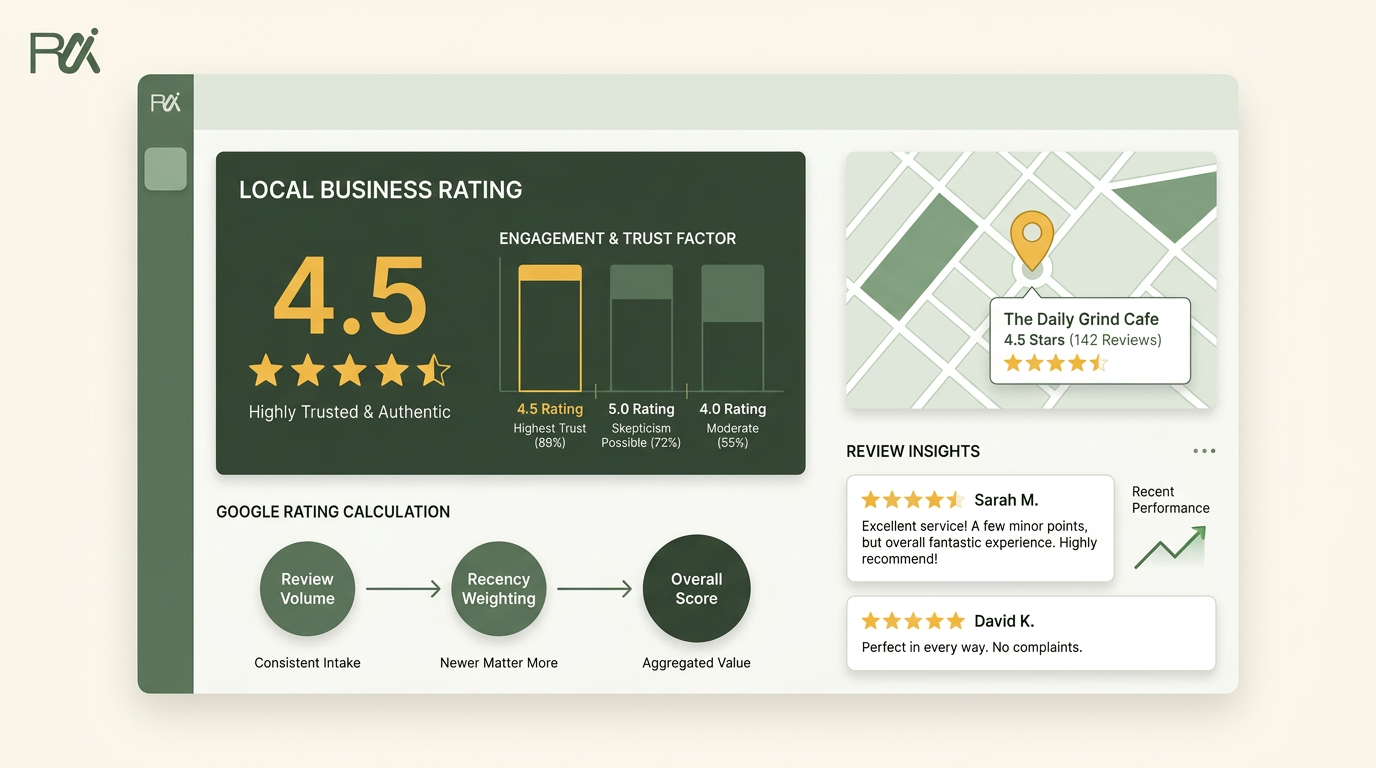
Table of Contents
- 1Introduction
- 2Why a Perfect 5.0 Is Not the Goal
- 3The trust band customers recognize
- 4How Google Calculates Your Star Rating
- 5What you can and can't control
- 6What 4.5 Stars Does for Your Local Search Visibility
- 7The map results decision
- 8Where owners misread the signal
- 9How 4.5 Stars Compares to Other Rating Bands
- 10Building a Credible 4.5-Star Profile This Week
- 11A practical seven-day reset
- 12Review Volume Matters More Than You Think
- 13Use a steady operating rhythm
- 14Your Next Step for Stronger Local Rankings
- 15Complete the triage before the week ends
Introduction
Most local business owners are told to chase a perfect 5.0-star rating. That sounds sensible until you look at how customers judge reviews. A flawless profile can feel less believable than one with a few honest complaints.
For a restaurant, salon, clinic, hotel, or contractor, 4 and a half stars can be a stronger commercial position. It signals that most customers had an excellent experience while leaving enough room for the profile to look real. The important qualification is that the score must sit on a healthy base of genuine, recent feedback. A thin profile with the same average won't carry the same weight.
Why a Perfect 5.0 Is Not the Goal
A flawless profile does not automatically earn the most trust from a prospective customer comparing businesses on Google Maps. A few credible signs of imperfection can make strong reviews feel more believable.
The Northwestern University Spiegel Research Center found that purchase likelihood peaks at an average rating between 4.2 and 4.5 stars, then starts to decline as the rating approaches 5.0 stars. Its analysis covered more than 40 product categories. The central finding is practical: a 4.5-star average can outperform a flawless 5-star rating because shoppers may question whether a perfect profile reflects ordinary customer experience. Review the Spiegel Research Center analysis of 4.5-star ratings for the underlying research.
Customers rarely inspect a score like accountants. They scan for patterns, review detail, and how the business handles criticism. A profile containing only five-star comments can raise questions about selective feedback or undisclosed service problems. A few lower ratings, answered clearly and professionally, can make the stronger reviews easier to trust.
The trust band customers recognize
The goal is not to collect poor reviews. Deliver excellent service, then request honest feedback from customers who used the business. Operationally, that means treating a less-than-perfect rating as information to address, rather than a crisis to suppress.
| Star Rating Band | Purchase Likelihood | Perceived Authenticity | Consumer Skepticism Level |
|---|---|---|---|
| Below 4.0 | Weaker | Mixed to low | High |
| 4.0 to 4.1 | Moderate | Reasonably credible | Moderate |
| 4.2 to 4.5 | Strongest band identified by the study | High | Lower |
| 4.6 to 4.9 | Strong, but depends on volume and detail | High to mixed | Moderate |
| 5.0 | Can be weaker than expected | Potentially low | Higher |
Below 4.0
4.0 to 4.1
4.2 to 4.5
4.6 to 4.9
5.0
The trade-off matters most for high-consideration purchases. Someone choosing a dentist, wedding venue, hotel, or contractor wants confidence that the business performs well and handles ordinary problems. A rating that looks polished but plausible can support that decision better than a score that appears too perfect to question.
Practical rule: Build a profile that looks consistently excellent and human. Do not make a perfect score the operating target.
How Google Calculates Your Star Rating
Your Google Business Profile displays an average rating, but Google doesn't publish every detail behind how reviews are selected, displayed, or used across its systems. You shouldn't promise yourself that a particular new review will move the visible number in a predictable way.
The simple part is the arithmetic. Google-style ratings are averages of the scores customers leave. If a restaurant has many reviews averaging 4.5, a new five-star review usually has a smaller effect than it would on a profile with only a few reviews. That doesn't mean every review has equal practical importance across local search. Google says local results rely mainly on relevance, distance, and prominence, and it identifies review quantity and positive ratings as factors that can help local ranking. See Google's guidance on improving local ranking.
Consider the operating picture:
Those examples show why you shouldn't react to one review in isolation. The displayed average changes according to the full set of ratings, and the business's reputation develops over time.
- A restaurant with 200 reviews averaging 4.5 has a broad record of customer experiences.
- A plumber with 15 reviews averaging 4.8 has a stronger displayed average, but a much smaller evidence base.
- A dental practice with 80 reviews at 4.3 may have a clear service issue to fix, yet its profile still offers more context than a brand-new listing with only a handful of ratings.
What you can and can't control
You can control the consistency of your service, the timing of review requests, the accuracy of your profile, and the quality of your responses. You can't control whether a customer gives three stars, whether a review remains visible after Google's checks, or how quickly the displayed average updates.
Review recency also matters to customers. A profile that was active last month feels more useful than one whose latest feedback is old, even when the average looks similar. Keep a simple record of the date, service type, rating, recurring complaint, and action taken. If you want a broader way to organize customer commentary, you can browse guest feedback insights from Creventa.
Don't tell staff that their job is to manufacture a number. Tell them the job is to deliver a service worth describing accurately. That produces a more durable profile and gives you operational information you can use.
What 4.5 Stars Does for Your Local Search Visibility
A 4.5-star rating works in two places at once. It appears as a visible trust signal to the person comparing businesses, and it forms part of the review information Google considers when assessing prominence in local results.
Google states that more reviews and positive ratings can help local ranking. It doesn't say that reaching 4.5 guarantees a place in the local pack. Relevance and distance still matter. A highly rated hotel across town may not outrank a closer hotel for every search, and a salon with an incomplete category or inaccurate hours can lose a customer before reviews matter.

The map results decision
When someone searches for “plumber near me” or “best Thai restaurant near me,” they often compare the three listings shown in the local pack. The rating helps them decide which listing deserves a tap, a call, or a request for directions.
That behavior matters even when it isn't a confirmed ranking mechanism. A strong rating can make your listing easier to choose, while a weak rating can eliminate it before the searcher reads your services. BrightLocal's local consumer research found that 31% of consumers now only use a business with 4.5 stars or more, up from 17% the prior year. You can read the BrightLocal local consumer review survey for that finding.
The rating also needs context. Customers may choose the 4.5-star clinic with a substantial review history over a 4.9-star clinic with very little feedback. The score gets attention, but the profile's evidence helps close the decision.
Where owners misread the signal
Responding to reviews can improve trust and show that your business is paying attention. It isn't a confirmed Google ranking factor, so don't treat response activity as a substitute for genuine customer experiences or accurate profile information.
The same applies to review text and posting activity. Use them to explain services, address concerns, and keep the profile complete. Don't claim that a particular response format will push your listing upward.
If your profile needs broader visibility work beyond reviews, Aim Set Win SEO services can provide context on the wider search work businesses often manage. Keep the priority clear: serve customers well, request honest feedback, and maintain a complete Google Business Profile.
How 4.5 Stars Compares to Other Rating Bands
Higher isn't always more persuasive. The useful question is whether your rating makes a customer comfortable enough to compare services, read reviews, and contact you.
A business below 4.0 stars often has a trust problem that service improvements must address first. A profile from 4.0 to 4.4 can compete, but may lose customers who now screen aggressively for ratings. The 4.2 to 4.5 range sits inside the strongest purchase-likelihood band identified by Northwestern's research.
Ratings above that range can still perform well. A 4.8-star profile with detailed, genuine reviews may look excellent. The risk begins when a perfect or near-perfect score comes with very little review volume, repetitive language, or no visible evidence of normal customer variation.
| Rating Band | Trust Perception | Conversion Rate | Local Pack Performance | Customer Skepticism |
|---|---|---|---|---|
| 3.5 to 4.0 | Concerned customers may hesitate | Weaker | Often less competitive | High |
| 4.0 to 4.4 | Solid, but not distinctive | Moderate to strong | Depends heavily on relevance, distance, and prominence | Moderate |
| 4.5 to 4.7 | Strong and credible | Strongest evidence in the cited study | Helpful review signal, not a guarantee | Lower |
| 4.8 to 4.9 | Very strong if supported by volume | Strong, with context required | Can compete well | Moderate |
| 5.0 | Impressive, but may appear unusual | Can decline relative to the strongest band | Depends on the complete local profile | Higher when evidence is thin |
3.5 to 4.0
4.0 to 4.4
4.5 to 4.7
4.8 to 4.9
5.0
The table's conversion column should be read directionally, not as a promise of a specific result. Your price, service area, availability, photos, category, and competitors still affect what happens after a searcher sees the rating.
A 4.5-star profile with meaningful review volume can feel safer than a 5.0 profile with scarce evidence. For a practical discussion of what a rating can mean financially, see this guide to Google star ratings and revenue.
Building a Credible 4.5-Star Profile This Week
You can improve the process without turning review requests into an awkward sales pitch. Ask every customer for honest feedback after a completed interaction, and make the public Google option easy to find.
A practical seven-day reset
Google prohibits fake engagement, including reviews based on no real experience, paid ratings, and content posted from multiple accounts by or at the request of one person. Its fake engagement policy makes honest, voluntary feedback the only safe foundation.
A private feedback option can sit beside a public Google review option, but the customer must choose. Never intercept negative experiences or route unhappy customers away from Google. That practice is review gating and puts the profile at risk.
- Audit days one and two. Check your business name, address, phone number, hours, categories, services, attributes, and photos in your Google Business Profile. Fix inaccuracies before asking customers to visit a listing that gives them the wrong information.
- Build the request on days three and four. Add a direct Google review link to your post-visit email, SMS message, receipt, or QR code. Keep the language neutral: “Thanks for visiting. Please share your honest experience on Google.” Don't ask only for five stars, and don't offer money, discounts, or gifts for positive feedback.
- Train the team on days five and six. Ask at a natural point, such as after a completed haircut, a successful repair, a check-out conversation, or a patient thanking the receptionist. Staff shouldn't pressure customers or ask while a complaint is still being handled.
- Respond on day seven. Reply to existing reviews, including critical ones. Acknowledge the specific issue, avoid arguing in public, and invite the customer to continue the conversation privately when appropriate. Don't expose personal medical or service details.
Review Volume Matters More Than You Think
A rating without context is a weak decision signal. Customers want to know whether the score represents a broad stream of experiences or only a few enthusiastic visitors.
One 2026 study found that 56.8% of patients chose a 4.5-star provider with 1,050 reviews over a 4.9-star provider with only 25 reviews. That result illustrates a practical truth for clinics and other local businesses: review count can outweigh a higher average when customers are deciding whether the rating is believable. See the study on review volume and online reputation for doctors for the comparison.
The same logic applies to a coffee shop, hotel, contractor, or salon. A customer may accept a slightly lower score when the profile contains enough detail to reveal consistent strengths and recurring weaknesses. A small profile gives them less evidence and makes the average more fragile.

Use a steady operating rhythm
Don't wait for a busy season, a grand opening, or a sudden run of positive feedback. Add review requests to the same workflow your team already follows after an appointment, completed job, departure, or purchase.
Track three things each week:
Google identifies review quantity and positive ratings as part of prominence, but it doesn't publish a universal review threshold for every town or industry. Don't rely on a made-up target. Compare your profile with the local businesses you compete against.
For a practical way to think about competitive review gaps, use this guide on how many reviews you need to outrank a competitor on Google Maps. The operating objective is simple: maintain a credible rating while generating genuine feedback consistently.
- Rating distribution: Count the one-star through five-star reviews so you can see whether the average hides a recurring issue.
- Review recency: Note whether new customers are still describing the current experience.
- Competitor evidence: Compare your review count and recent activity with the businesses appearing for the same local searches.
Your Next Step for Stronger Local Rankings
Start with the profile you have. Open your Google Business Profile and record its average rating, total review count, rating distribution, and dates of recent reviews. Compare those details with businesses appearing for your priority “near me” searches. A credible 4.5-star profile depends on steady operations, not a short burst of review requests.
Complete the triage before the week ends
Claim and verify the profile if needed. Respond to the five most recent reviews, positive and negative, with specific, professional replies. Then add a review-request step after each completed visit or job.
Use tools already in your workflow. Point-of-sale systems, appointment software, email platforms, and SMS providers may support follow-up messages. If you need a dedicated option, RecensioAI can automate review monitoring and requests, provide response workflows, audit Google Business Profile details, and support multi-location reporting. The software should support service recovery and honest customer contact, not substitute for them.
Google's local ranking guidance helps separate confirmed factors from assumptions. Review what matters for Google Business Profile rankings in 2026. Ratings and review volume are important, but no tool can guarantee placement in the local pack.
Set a weekly operating routine. Review your rating distribution, address recurring service problems, request honest feedback after completed interactions, and respond in ways that show future customers how your business handles criticism. This is how a strong rating band stays credible while your profile keeps generating fresh evidence.
RecensioAI B.V. offers automated review requests, review monitoring, response workflows, Google Business Profile audits, and multi-location reporting for local businesses. Visit RecensioAI B.V. to see whether its tools fit the process you want to put in place this week.
You might also like
Handpicked articles for you
Hotel Review Management: Automate Post-Stay Requests with Apaleo, Mews and Your PMS
A practical guide to turning hotel checkouts into timely review requests, with Apaleo live, Mews early access and flexible PMS alternatives.
Why the Business Around the Corner Beats You on Google: What 21,373 Profiles Reveal
We compared 21,373 Google Business Profiles with their three strongest nearby competitors. The gap is smaller than most owners think, but it has two sides: rating and volume.
Treatwell Review Management for Salons: One Reputation View Alongside Google
Bring your public Treatwell rating and recent reviews into RecensioAI, then combine salon signals with Google for faster, better decisions.